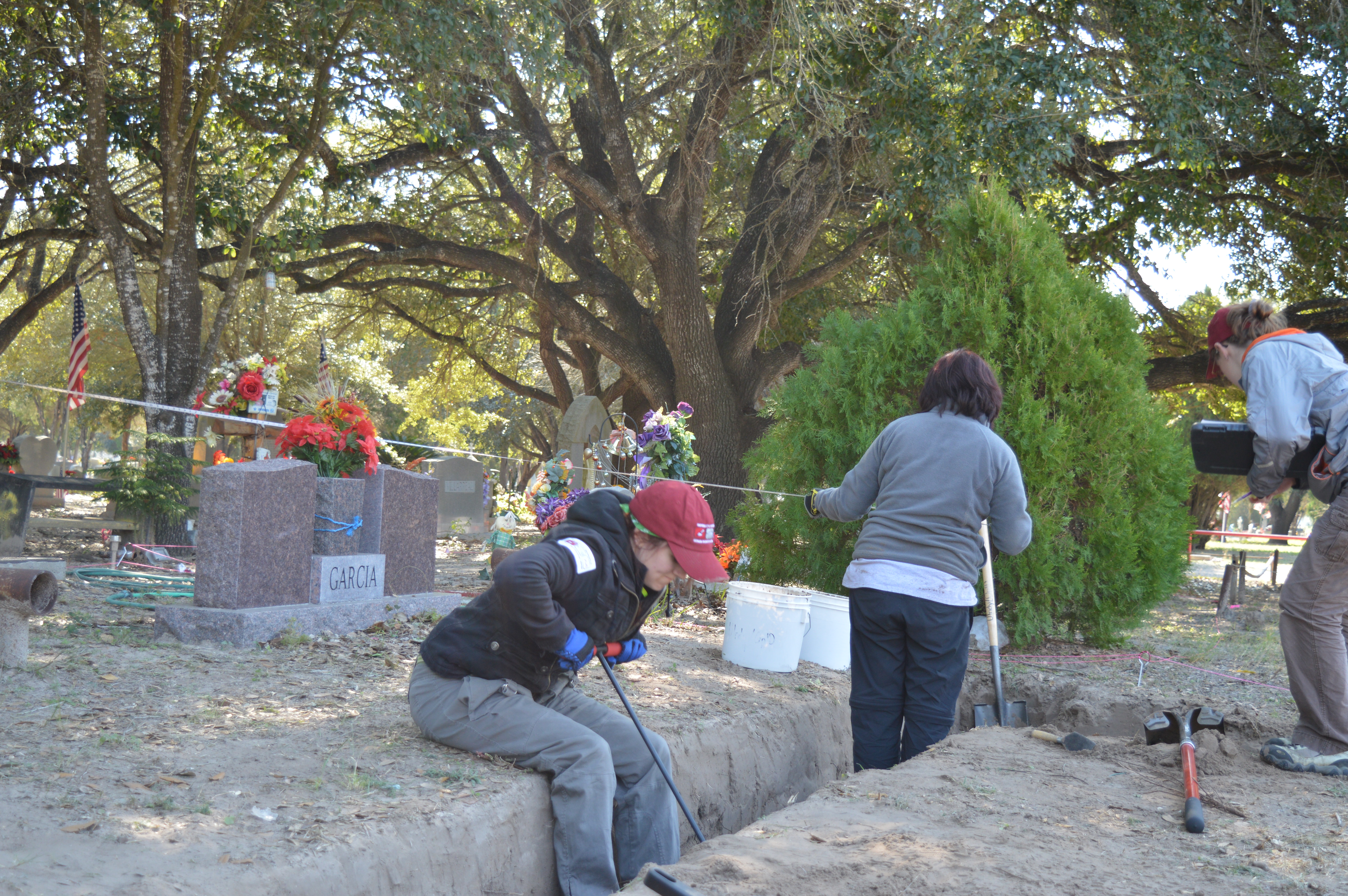
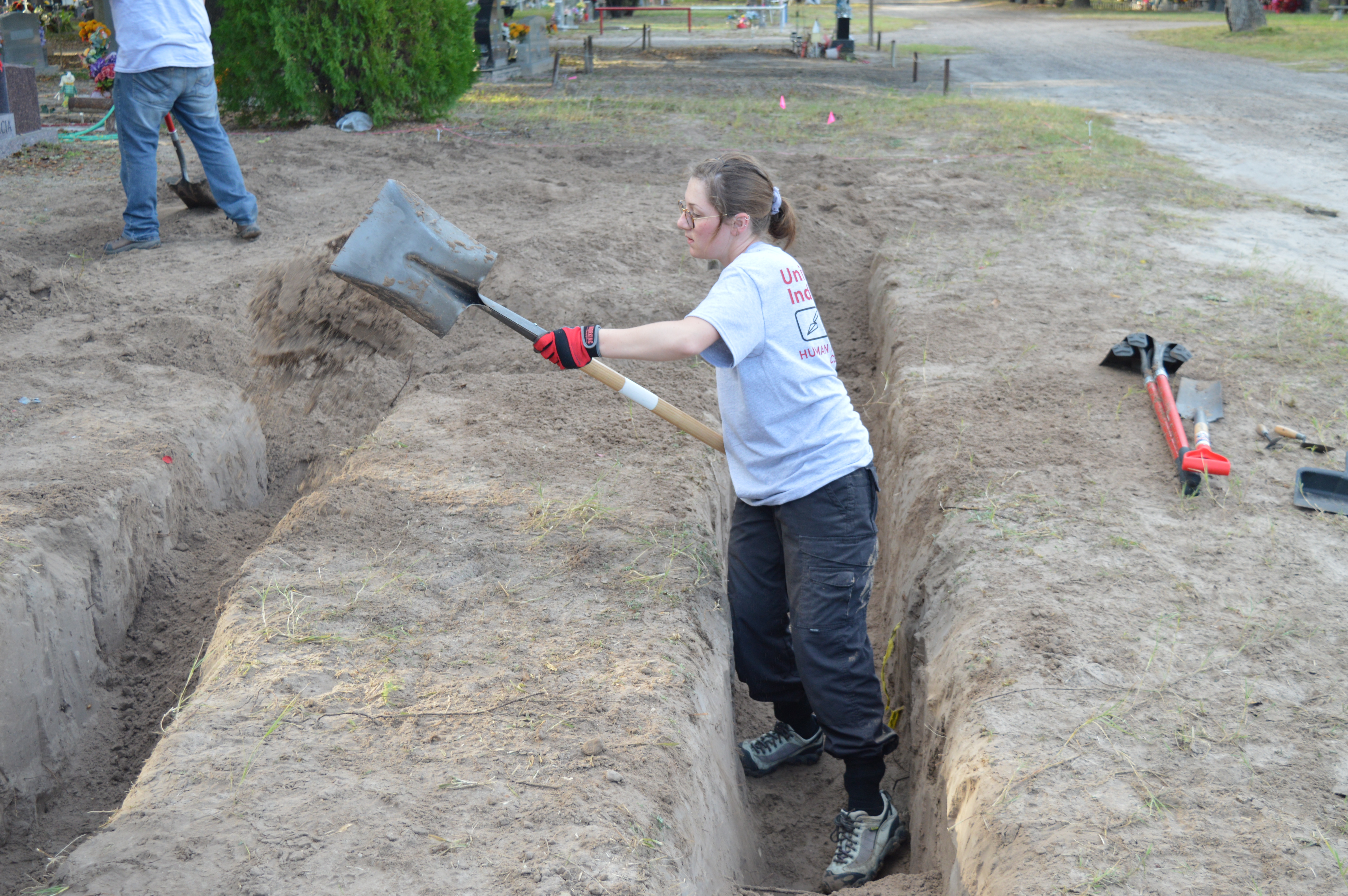
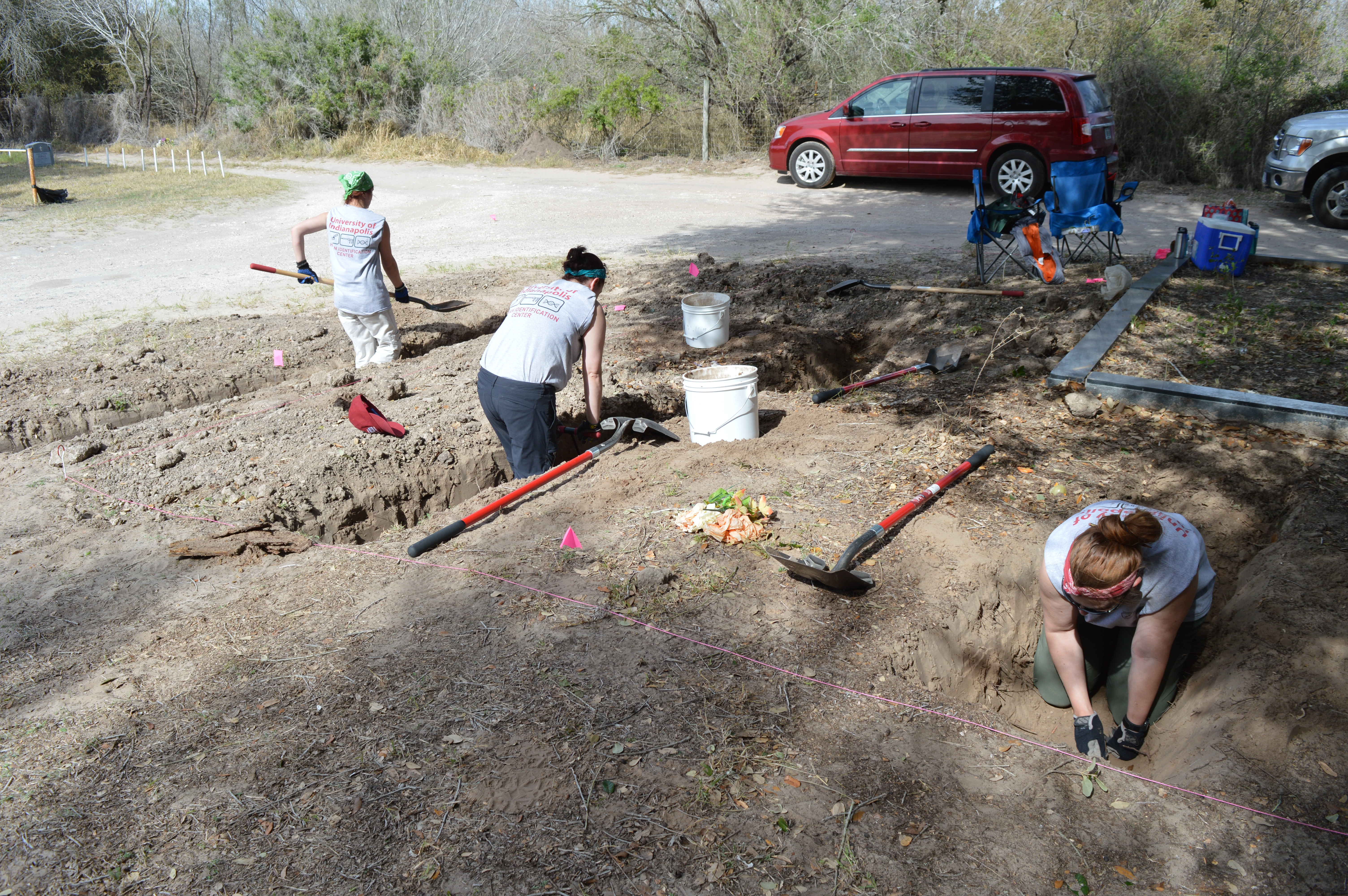
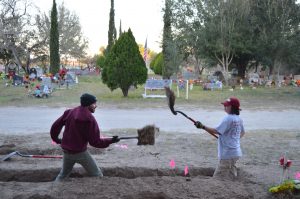
Today the 5 of us moved approximately 21,000 pounds of dirt (or about 4200 pounds of dirt per person). Let that sink in for a moment…. TODAY each of us moved about 4200 pounds of dirt! We calculated that from the measurements of the trenches we dug today. That doesn’t even include the fact that we had to move some of the dirt to a pile and then move it back to the trenches (making it closer to 6,000 pounds of dirt for each of us). It got hot in the afternoon, so we had to enforce a dig for 5 minutes and rest for 5 minutes rule. Not only was this necessary for safety but it also kept the momentum going late into the afternoon.
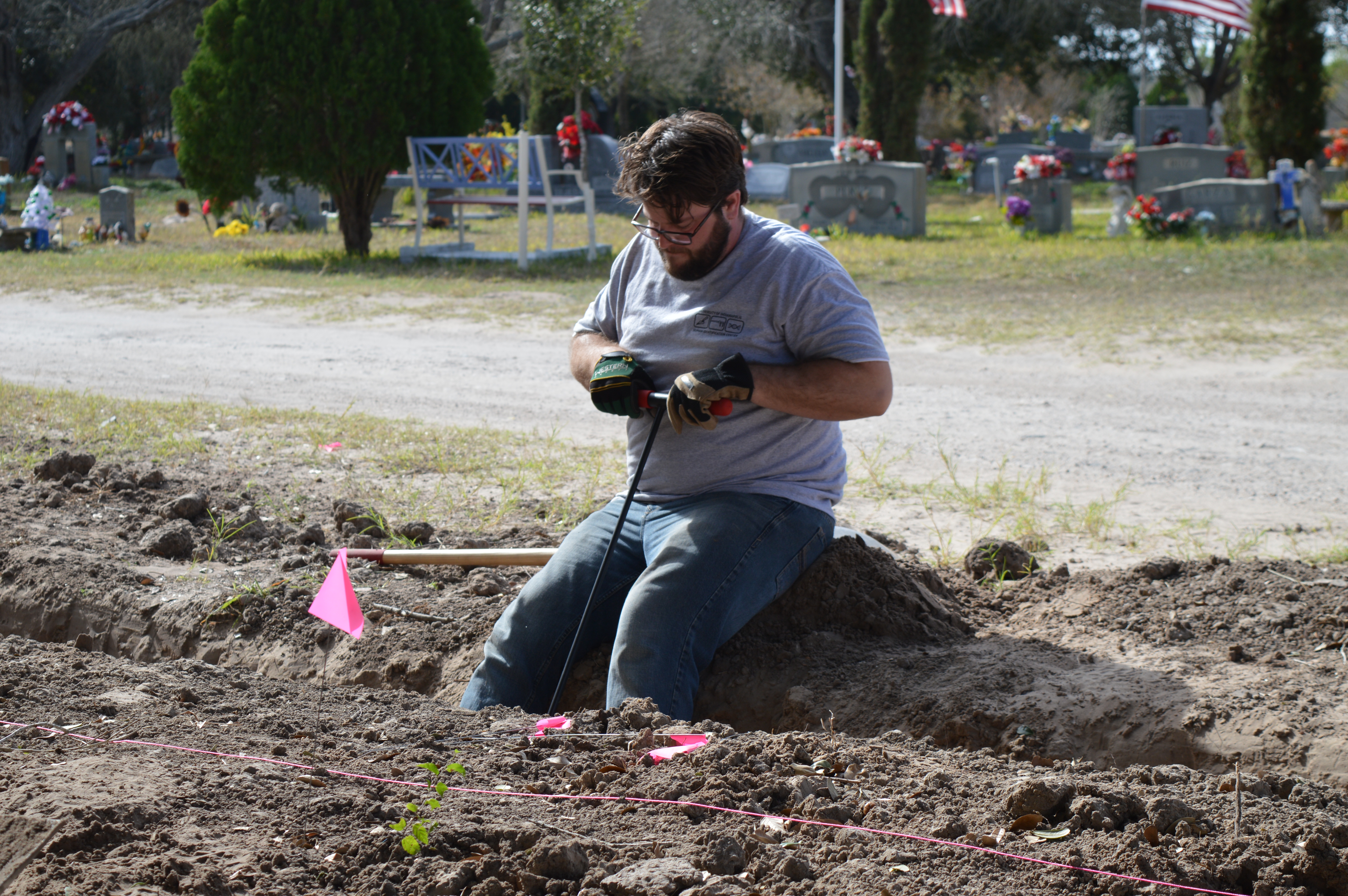
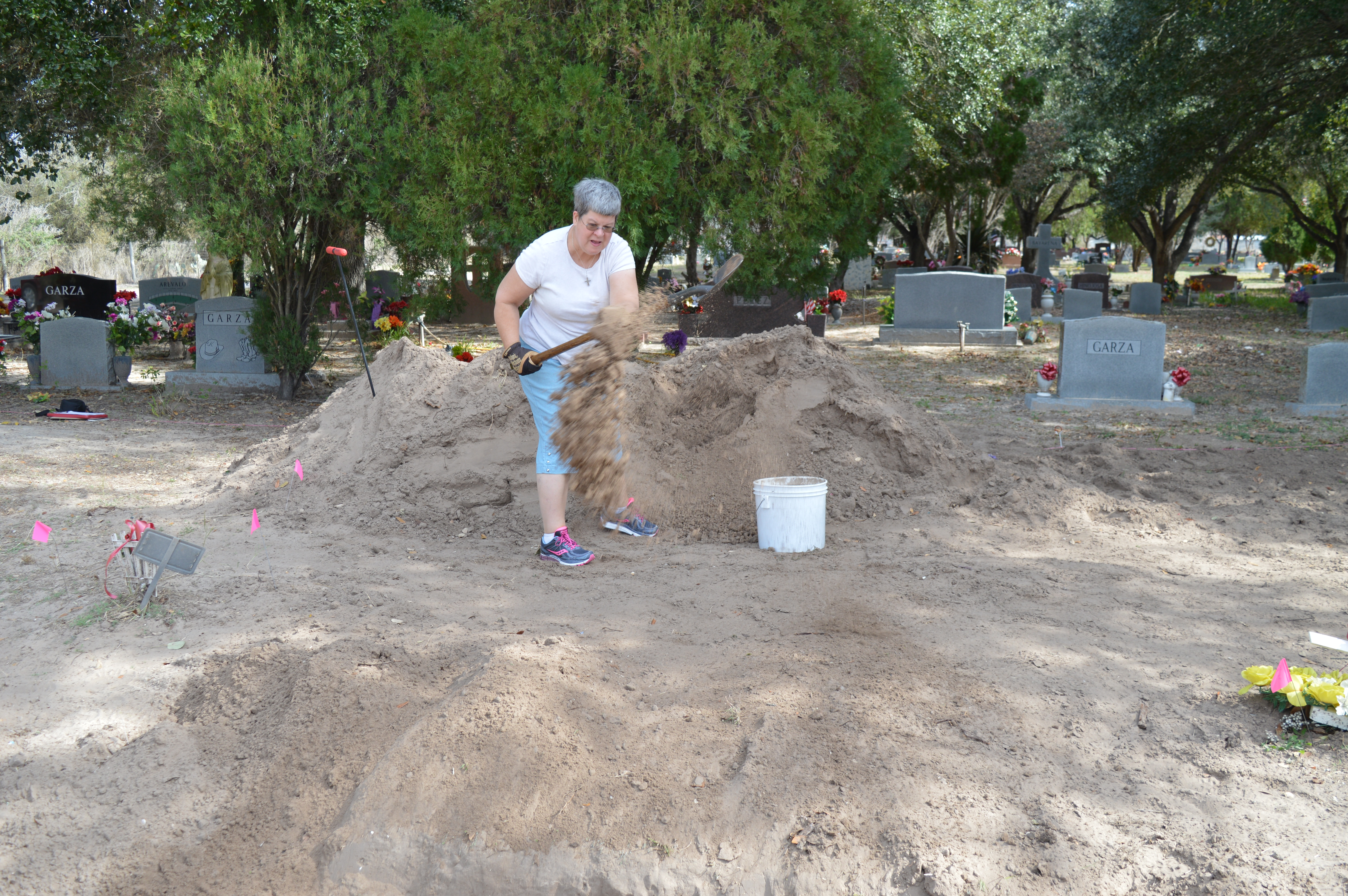
Leann digging test trenchesErica, Jessica and I digging test trenchesJustin probing the test trenchesSister Pam helping to move the dirt pile
Tomorrow is our last day working at Sacred Heart for this field season. We still have about 30% of the area that needs explored. Every excavation season we seem to be down to the wire and fighting time to finish. So this year will be no different.
The UIndy group is decreasing in numbers rather quickly. Ryan was only able to join us for his day off from work. He essentially came straight to the cemetery when ending one shift, worked the entire next day in the cemetery with us, and then excavated a partial day with us before driving straight back to work. Our three cultural anthropologists have other tasks associated with the South Texas Human Rights Center and are leaving to go back to Indiana in the morning. That means for most of the day today we were a group of 5 tackling what seemed like the impossible: Clear a 32 meter by 10 meter patch of land to a depth of 100cm.
We recreated the 8 quadrant grid that was originally constructed over this portion of the cemetery to organize the excavation efforts. We have started strategically dividing each of these quadrants into a series of deep test trenches. We create 2 parallel trenches running north-south that are 8m in length and 2 trenches that are parallel to each other running east-west that are 5m in length. Essentially we are diving each quadrant like a large tic-tac-toe board. We dig each trench to approximately 60cm in depth and then use a metal T-Probe to investigate beneath our trench floor. Additionally, we probe at angles down into the dirt that we did not dig to investigate whether or not anything is buried under the surface as well as probe the surface of the undisturbed areas. If we find something while digging our trenches or with the probe we stop to investigate whether it is the remnant of a burial that was already removed or whether it represents a burial not located by the methods applied in the 2013 field season. Our approach is slow, tedious and back breaking, but it has proven to be successful. Over the next few days the temperatures will be increasing, so we will be challenged by both the heat and our small team numbers. With three quadrants down that leaves five to go in our last two days in Falfurrias.
Winter excavations have their own unique set of challenges. Today the high was in the 30s, it was very windy and rainy. It was the kind of weather that made me question whether we were actually in South Texas. We decided the risk of working wet in freezing temperatures was too great and decided to take the day off to go to McAllen. We loaded up the cars, got a bag full of Whataburger breakfast taquitos “to go” and started driving south on 281.
Sacred Heart Church Humanitarian Respite Center
Our first stop was the Sacred Heart Church where the Humanitarian Respite Center is located. Sister Pam and Sister Norma talked about the function of the center: “The center provides a place for the countless men, women, children, and infant refugees to rest, have a warm meal, a shower, and change into clean clothing as well as receive medicine and other supplies, before continuing onto their journey.” We learned they were averaging 400 asylum seekers per day before Christmas and about 100 per day now in the New Year. We divided up into groups that sorted donations, made small bags of toiletries and baby supplies, helped in the kitchen, held babies and played with children so parents could shower, located new clothing for families and a variety of other tasks. The center runs solely on the kindness of volunteers and donations.
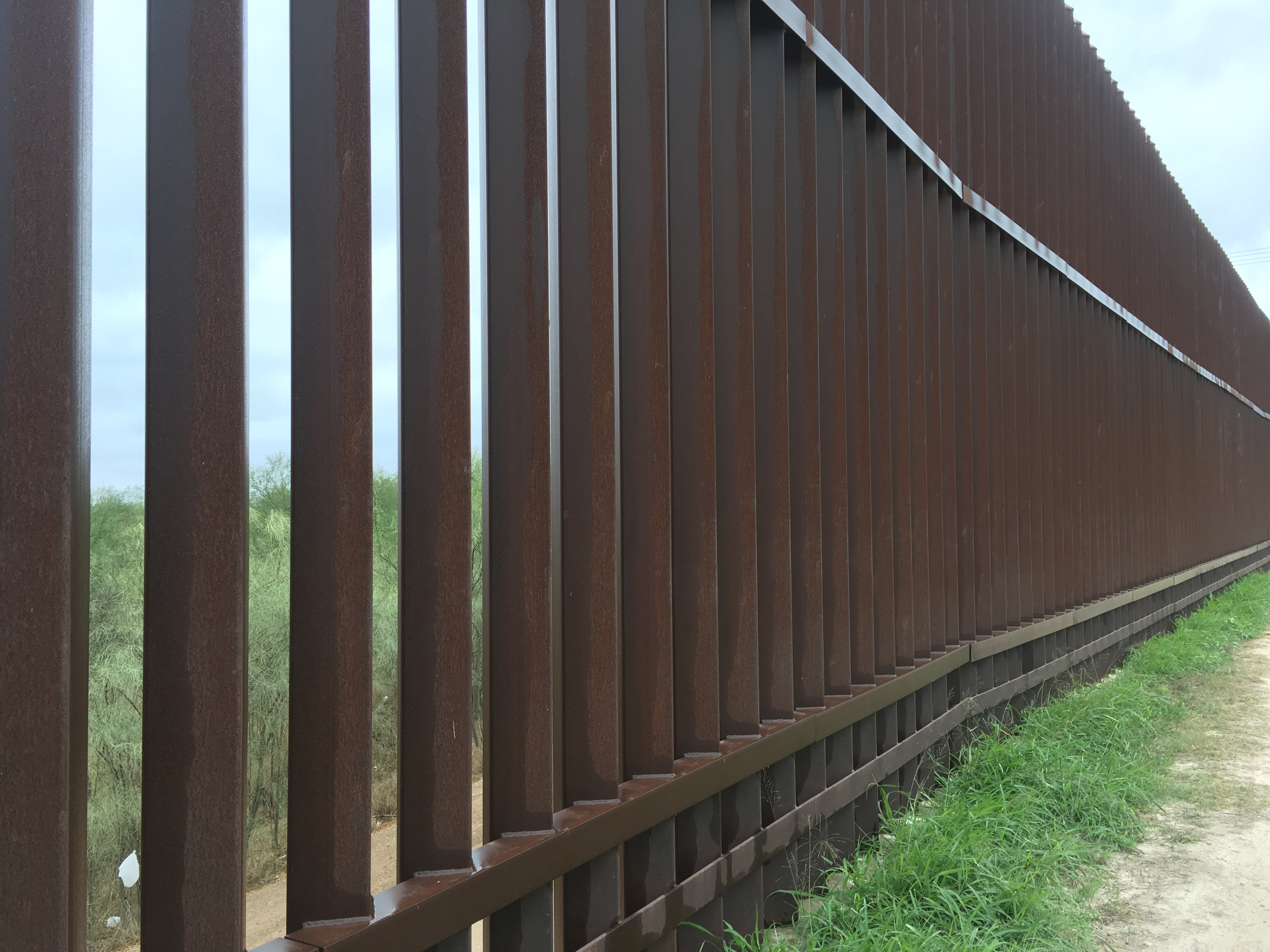
The border wall in McAllen, TX
Once the morning’s group of families finished rotating through the center we drove to the border wall. This part of the wall is more of a fence made of iron beams repurposed from Vietnam era military materials. After approximately 6 minutes at the wall we were approached by a Border Patrol vehicle. At first we were nervous we would be asked to leave immediately, but instead the officer welcomed the opportunity to talk with us and answer questions. He told us stories of his experiences with patrolling the wall and the people he encountered.
We left McAllen and began our drive north on 281. We needed to go through the Falfurrias Border Patrol Station on our way home. While we had no trouble getting through the large three lane traffic checkpoint, the wait in line provided us a moment to reflect on the fact that this is the reason we see so many deaths in Brooks County. It is this checkpoint that migrants are attempting to circumvent as they enter the brush land that surrounds the station, resulting in many of them loosing their lives.
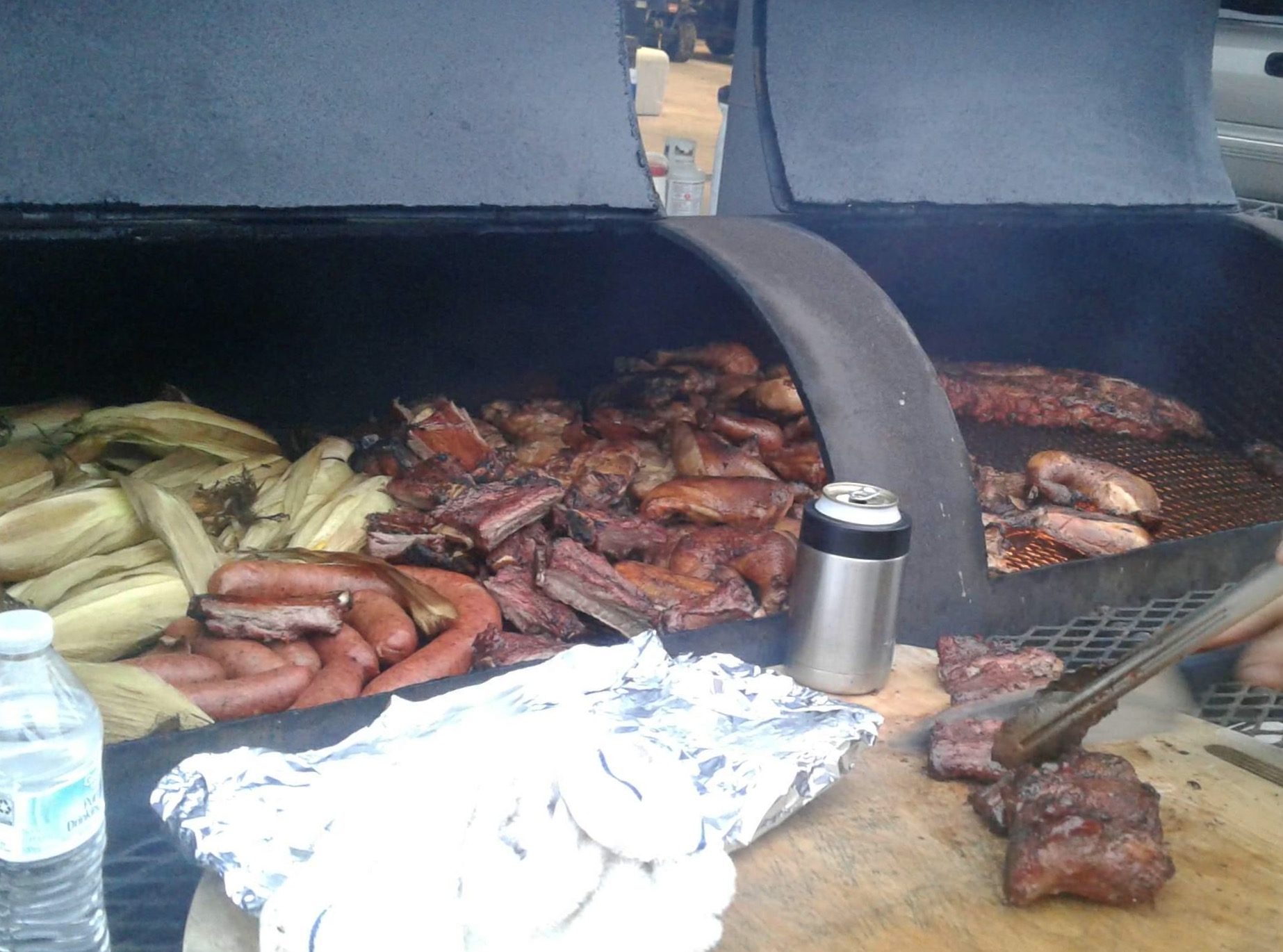
The smoked feast
We ended the day at La Cope Ranch in Encino for dinner provided graciously by the Ed Rachel Foundation. Their mission statement is taken from the last will and testament of the Foundation’s benefactor: “I devise and bequeath the rest and residue of my estate of every kind and wheresoever situated real, personal and mixed, to such corporation to be used exclusively for the benefit of charitable, scientific, literary or educational purposes within the State of Texas“. The foundation has generously supported Texas State‘s work in migrant identification over the last few years. The meal was amazing and the representatives of the foundation were so nice and genuinely interested in the work we are doing towards migrant identification. The day off from digging allowed our muscles to rest and our minds to recharge. We are ready to jump back in to excavations in the morning.


 We recreated the 8 quadrant grid that was originally constructed over this portion of the cemetery to organize the excavation efforts. We have started strategically dividing each of these quadrants into a series of deep test trenches. We create 2 parallel trenches running north-south that are 8m in length and 2 trenches that are parallel to each other running east-west that are 5m in length. Essentially we are diving each quadrant like a large tic-tac-toe board. We dig each trench to approximately 60cm in depth and then use a metal T-Probe to investigate beneath our trench floor. Additionally,