Category Archives: Reflections

Reflections on how we feel and how the mission is changing us

Peace on Earth and Goodwill to All

“Peace on Earth and Goodwill to All” is a phrase we hear and see a lot this time of the year. It’s displayed in lights, sung in songs and printed on Christmas cards.  But what does that phrase truly mean or in today’s society does it mean anything at all? And who, if anyone truly works towards those lofty goals of world peace and extending goodwill to all?

Peace on Earth Goodwill to All over the Earth.

Rebellious Humanitarianism –As we prepare to leave for the border I am confronted with the stark contrast of the love and joy that come with Christmastime and the thundering call for exclusion of all “others”.  On the one hand I was raised to treat others the way I want to be treated, yet extending dignity and basic human rights to the “others” is considered a form of rebellion. At what point did humanitarianism become an act of disobedience? If humanitarianism is the promotion of human welfare, than using the term rebellious humanitarianism suggests that not all deserve health, happiness or freedom in every situation.
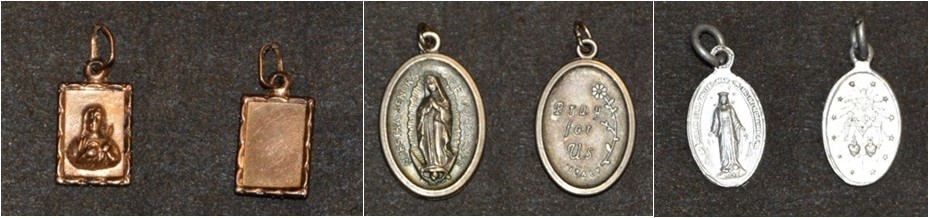
Religious charms that were carried by a female that perished in 2012.
Religious charms that were carried by a migrant that perished in the Texas Borderlands

Radical Hospitality — I recently read a letter from the Colibri Center for human Rights that talked about giving radical hospitality.  About going beyond all expectations to do what is right and not necessarily what is easy. Hospitality refers to the warm reception of guests, visitors, or strangers. Radical means advocating for change in a political or social context. Putting the word radical in front of hospitality sends a clear message that hospitality in certain contexts is not extended to all. That not all are welcome here.
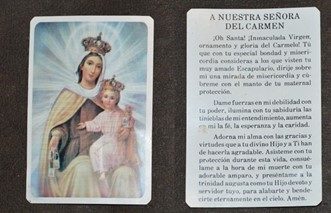
Prayer card carried by a migrant.
Prayer card  that was carried by a migrant that perished in the Texas Borderlands

Political Caregiving — In the Forward to the book “Sociopolitics of Migrant Death and Repatriation: Perspectives from Forensic Science“, Dr. Robin Reineke speaks about caring for certain groups of people in a way that makes caregiving political. That advocating for  marginalized groups by providing dignity in life and in death is an act of social justice, and can bring to light accountabilities that are being hidden from the masses. To care for someone is to protect them. However, in certain contexts providing care goes against the state and suggests that not all should be cared for.
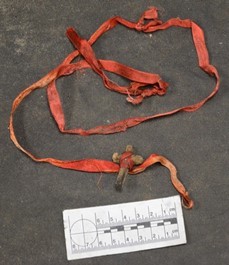
Cross that was carried by a migrant.
Cross that was carried by a migrant that perished in the Texas Borderlands

So – all are not welcome, not all are deemed worthy of health, happiness and freedom, and not all deserve care and protection – unless you are practicing rebellious, radical or politicized acts of kindness.  Tomorrow the Beyond Borders Team will embark to the Texas Borderlands to volunteer our time in working towards Peace on Earth and Goodwill to All.

We hope 2018 brings you and your loved ones health, happiness and feelings of safety and freedom.

~KEL
Beyond Ready

It is almost unbelievable that in less than two weeks (as I write this) I will be on my way to Willacy County, Texas to begin participating in the Beyond Borders mission. I have been passionate about applying an anthropological approach to humanitarian efforts for years now, but this will be my first experience. I want to be as informed as possible before arriving in Texas, so I have been spending some time over winter-break reading about this relatively silent mass disaster that is taking place in our country. It is truly heartbreaking to hear some of the personal stories of those involved, so I am both excited and nervous to embrace the challenges ahead. However, I am confident our team will work together to reach our designated goals.

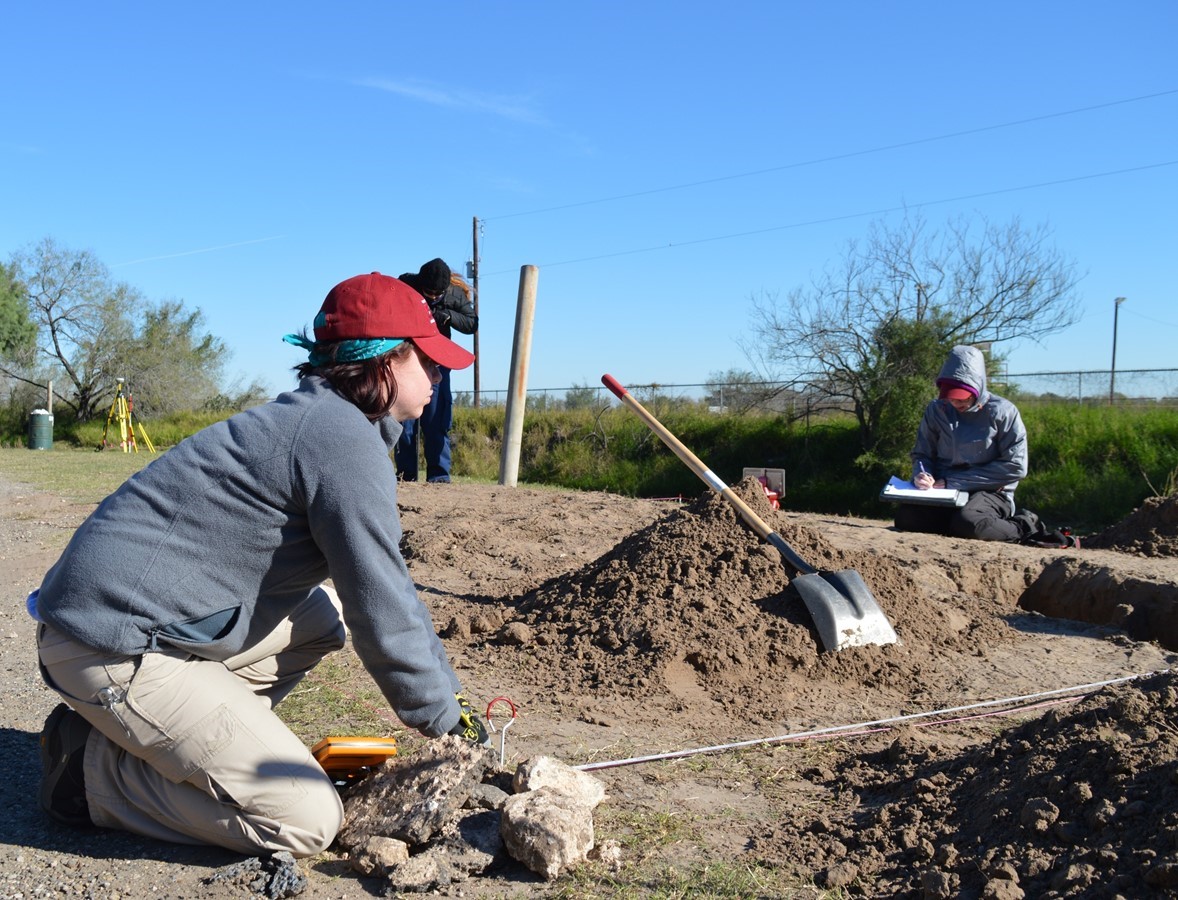
This January, we will be solely focused on exhumation, and I will assume the position of mapping apprentice. Leann, the current mapping expert for our team, has gained a great deal of valuable experience through Beyond Borders, and other cases in which the University of Indianapolis has assisted law enforcement agencies in Indiana. Every exhumation varies depending on the circumstances, landmarks, vegetation, soil, weather, and so many other factors that I am sure to discover once we get started. I feel so incredibly grateful to have been provided this opportunity because the ability to create accurate hand-drawn and digital maps is such an essential technical skill that is needed for every archaeological situation. I have big shoes to fill as Leann’s apprentice, but I am positive she will be an incredible mentor!

As the trip approaches, I keep thinking about how much this experience is likely to affect my career as an anthropologist and human biologist for the rest of my life. I was not expecting to be nervous or anxious, but as I continue packing and shopping for supplies the reality is sinking in. Even after completing my first semester of graduate school, I feel a bit rusty in osteology. There is so much to learn and constantly refresh upon when pursuing a career in forensic anthropology. As a relatively new student in the program, I hope that I have a strong, solid foundation that will enable me to quickly grasp the methodologies we employ. After hearing all the stories from the students who went to Texas for previous field seasons, I realized how many amazing memories are made during these trips with Beyond Borders. I look forward to meeting professors and students at Texas State University, law enforcement officers, and community members who are also involved in the project. Even though the work days may be brutal at times, working through it alongside my team members will allow me to get to know them on such a more personal level. I am eager to be part of the new memories, laughs, meals, car rides, and moments back at the hotel. This trip will be my first time in Texas, and I cannot imagine a better, more meaningful way to check another state off the list.

January 2, 2018…hurry up and come sooner!

Sammi


A new year and a new field season

In less than a week (as I’m writing this), our group leaves for another trip down to South Texas to assist in the humanitarian effort of identifying the remains of migrants who perished along the US-Mexico border. The first step in this process is the field season (exhuming the remains) and is sometimes the hardest step. This will be my third trip to Texas and even though I’ve been before, I cannot help but to feel a little anxious. My first trip to Texas, our group was at Sacred Heart Cemetery in Falfurrias, Texas which is place where several field seasons had occurred prior to my visit. In our group, we had members that had been to Falfurrias before which made it less apprehensive because I at least knew what to expect in terms of soil consistency and weather. Although, my very first trip to Texas in January 2017 saw record low temperatures in the 30s which none of us were prepared for. It all plays to our motto of ‘expect the unexpected’ and there was no way to know we would be bringing the cold, Indiana weather with us to Texas.

Team members mapping in a trench.
Jan 2017 – Record low temperatures

My second trip to Texas brought our group to a whole new city and cemetery. Although our group spent weeks carefully packing and deciding what tools to bring, nothing prepared us for the soil consistency that we found in Rio Grande City Cemetery. The soil consistency was more similar to cement; hard, compact, rocky soil that could only be penetrated by heavy machinery or a mattic. One of the many differences between Falfurrias and Rio Grande City was that in Rio Grande City, the graves were marked and the cemetery employee who actually made the graves years’ prior, was on scene to help us. The cemetery employee, Sylvestre, was a huge help in locating and systematically excavating the dirt until we were close enough to the actual burial that we could proceed with using our hand tools. As it turned out, the burials were closer to 5-6ft deep in Rio Grande City Cemetery versus only being 3-4ft deep in sandy soil like the graves in Falfurrias.

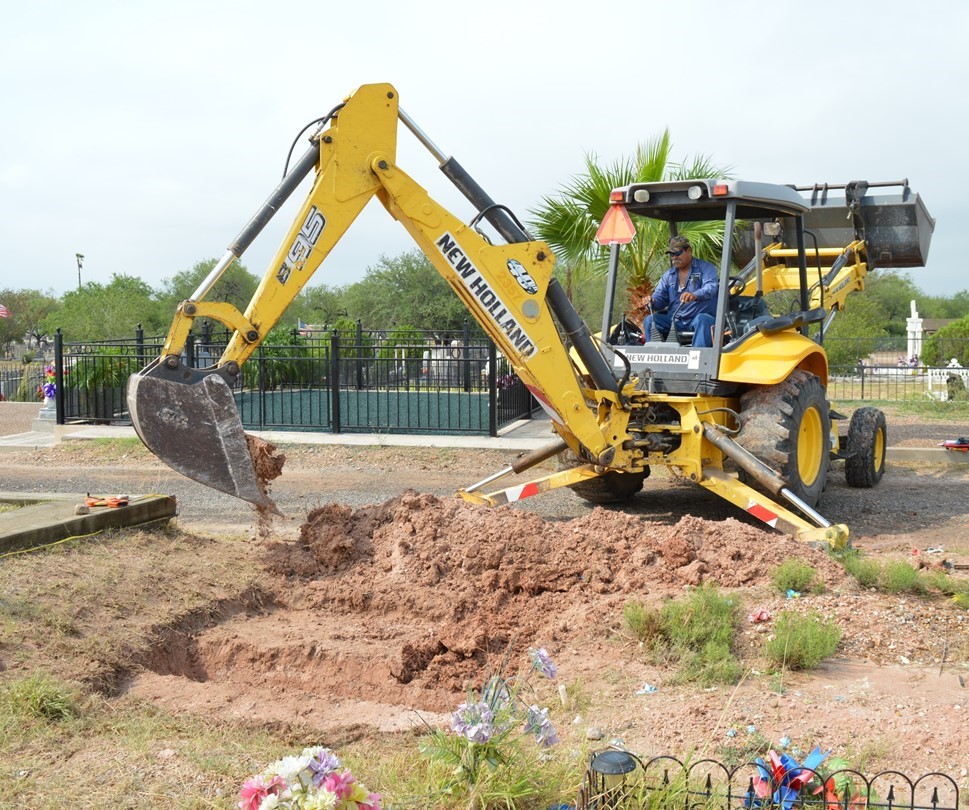
Back hoe digging a trench.
May 2017 – Sylvestre

For my third trip to Texas, I am not sure what to expect because I feel that the Sacred Heart Cemetery in Falfurrias and the Rio Grande City Cemetery were at opposite ends of the spectrum in terms of soil consistency and knowing the exact places were migrants were buried. What I do know, is that our team has a knack for adapting to our environments and always tackling surprises head on. Expect the unexpected is a motto we work by and it has helped us a great deal. I may be feeling apprehensive and a little anxious right now, but I know once we get to Texas, those feelings with dissipate. I am extremely grateful to have the opportunity to go back to Texas and help in this humanitarian effort. This experience changes you as a person and to be able to go back for a third season gives you a bittersweet feeling. Right now, I am going to spend the holidays with my family and thinking about the adventure that lies ahead in South Texas. I am unbelievably excited to be a part of this humanitarian effort and I am ready to start another field season with our amazing group from UIndy and Texas State University.

Jessica