I’m honored to have experienced and witnessed all that I did during our last trip to Texas. It was wonderful to see both the familiar and new faces of those who live and breathe the work of migrant rights and migrant identification on a daily basis. Eddie Canales, Sister Pam, Kate Spradley, and Tim Gocha each, in their own way, do the work of sustaining focus and demanding attention to lives too often dismissed as expendable, unimportant, or beyond help. I am grateful for the access they’ve given me and my students to the workings of this initiative. In one week, we were given the chance to experience a “crash course” in exhumation processes, media representation, migrant rights, and respite care and support. These folks represent silken threads of a much larger web of people who care and believe in our obligation and capacity to work towards a more just society. We have much to learn from them individually and collectively.
I’m thankful, again, to the UIndy forensic science team for continuing to allow, not just one, but three cultural anthropologists in their midst. As a scholar of US culture and society, I often describe my work as a form of analysis that makes the familiar seem strange. My aim, in part, is to explicate taken-for-granted forms of knowledge, practices, and values underlying dynamics and realities of life and the institutions mediating our lived experiences. This is, of course, not possible without the generosity, candor, and patience of research participants. I am grateful to have been immersed such thoughtful and gracious hosts. I am certain that my presence and questions must’ve made their familiar world seem strange in ways not always intended!
Finally, I am honored to have had the opportunity to mentor two bright and articulate students in data collection techniques of participant observation and unstructured ‘interviewing.’ I could not have anticipated how thoroughly proud I am of what they accomplished in such a short amount of time. Their insightful comments and questions, meticulous fieldnotes, and willingness to do the sometimes uncomfortably social (and physical!) work of cultural anthropology is great testament to their character and potential as future leaders in our communities and future scholars in their own rights. I am unbelievably proud and perhaps even more excited to work with them on analysis and presentation.
There are so many more people I encountered, spoke with, and learned from. From local law enforcement and local community members to respite center volunteers, this season’s ‘crash course’ was enriched by each of you and your willingness to engage those of us visiting for this short, but intensive burst of work. I am thankful for the work you do, each and every day, on behalf of migrant rights, migrant families, and compassion and justice for all.
Latest Posts
Guest Blog by Katharine Chapman Pope
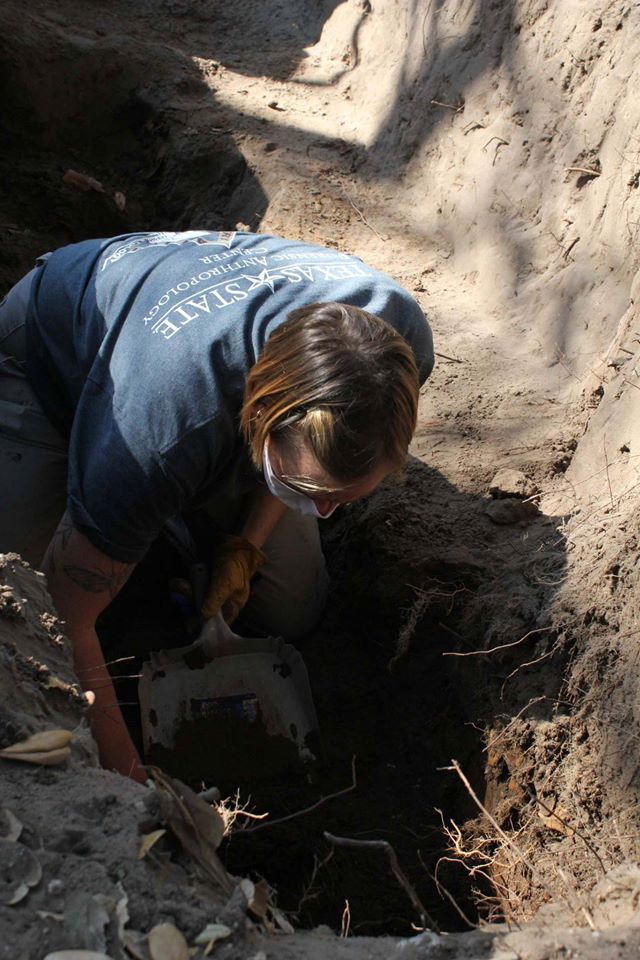 My name is Katharine and I received my master’s degree in forensic anthropology from Texas State in 2007. I’ve done a variety of jobs in the forensic science field, including crime scene investigator, WWII Casualty Analyst for the Department of Defense’s POW/MIA office, and currently, medicolegal death investigator. As a death investigator, I act as the eyes and ears for the forensic pathologist. I investigate all deaths in the state and determine if it falls under the jurisdiction of the medical examiner’s office. I see homicides, suicides, accidents, drug overdoses, and many other scenes and situations. Skeletonized cases or cases where identification is questioned, I use my training in anthropology to help confirm the decedent’s age, sex, ancestry, stature, and anything pathological or traumatic important to the case.
I volunteered for the exhumations at Sacred Heart for two different reasons. Primarily, the mission itself is very important to me. The idea of dying in anonymity seems utterly desperate, like tangible Limbo. Your family never knows what happened to you. They can’t go visit your grave when they miss you. And they never see justice or closure. I believe that all people deserve to be treated with dignity and respect, living or dead, no matter what. Is that crazy?! My second reason for volunteering is less altruistic. I have my own unidentified population at my home office (30 cases since 1965) and I wanted to see how TX State and UIndy handled intake, processing, and curation of their case load. I also need to keep up my archaeology and mapping skills.
Working with death on a daily basis hardened me – in order to get through the tasks required of the job, I numb myself to the emotions surrounding each case. When I arrived in South Texas, as a death investigator, I was still hard and numb. But I emerged from this experience as an anthropologist again, who considers the cultural and emotional story alongside of the human remains, the trauma, and the potential identification. The total picture of this mission is crushing, humbling, immense, and exhausting. I am so thankful to have participated in the process of helping resolve one tiny, but crucial portion of the problem. The families of these people deserve it.

The Denouement
This field season in Texas will be my last adventure as a UINDY graduate student. I have had the honor of working on this project since the beginning, but I will be graduating in May and (hopefully) moving onto a PhD program. It is impossible to explain how much this project has meant to me, and I am not eloquent, but I can try to distill some of the feelings into a handful of words.
Gratitude – I feel privileged to have been selected for this project. Each field season only allows a few of us Greyhounds the chance to travel to Texas, so I feel honored to have played my part for so long. I believe that I have represented our University in our motto of “Education for Service”. I am grateful for all the amazing people I’ve met, the knowledge I’ve gained, and the person I’ve become because of this work.
Pride – I am incredibly proud of the work that has been done by EVERYONE involved in this project. What we have collectively done so far is amazing. The primary purpose of this work is the identification and repatriation of unidentified border crossers. Collectively, we have identified ~20 individuals, and we are still in the processes of identifying well over 100 more. I look forward to every future identification that our efforts will bring.
Community – This has been one of the most unexpected outcomes of this project. I never imagined that our field work would make us honorary members of the Falfurrias community. This work has given us a chance to work throughout Brooks county. Besides excavations, we have dined with ranchers and constables, given lectures at border patrol, and built and filled water stations. Nearly every day we worked this season, people stopped by the cemetery to thank us for our efforts. It is powerful knowing that the community advocates our work. Fal has become a sort-of second home, and I cannot think of another community of which I’d rather be a part.
Closure – This work never ends. As long as there are deaths along the border there is still more work to do. We have nearly completed all excavations at Sacred Heart Burial Park, but that is only one cemetery in one county. Texas is massive. There are many more counties holding many more cemeteries. Without the proper attention, the unidentified people buried in these areas hold no hope of being returned to their families. This work must continue…
And yet, the end of this season brings me a sense of closure. I am incredibly proud of the caliber of work that we have done in Falfurrias. All the people who have worked on this project have started something amazing, and the efforts will continue even after I leave UINDY, and I know that this endeavor is in capable hands. I leave happy knowing that I have worked to the best of my abilities. My efforts have helped people be identified and families be reunited. I will always continue to advocate for human rights in every venue, but I am sated knowing that I have done my part.
Hasta que nos encontremos de nuevo, te dejo mi corazón. Gracias por todo.