Category Archives: Environment

Talking about the weather, terrain, flora, fauna, etc…

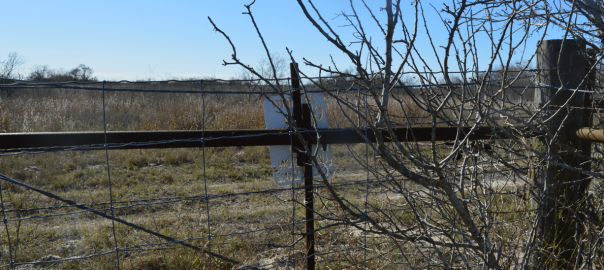
Fence with 911 emergency sign.

Day 4: Walls and Fences

The 6:45am alarm goes off. I turn it off and close my eyes. My body suddenly jolts, I had fallen back asleep for an extra 5 minutes. My teammates and I get up and start pulling out clothes and packing our bags. It is 38 degrees outside this morning. The high will only get up to 56 today, a stark difference from the day before which reached 90 degrees. After chugging our Vitamin C packet Dr. Latham gives us every morning at breakfast, we layer up in extra flannels.

Today’s plan is to return to the same ranch we searched yesterday. Don wants us to thoroughly search a new area to find out if there is any evidence of migrant activity less than about a year old. This, we learned, would help him determine if this area is a path that coyotes alternate using when they bring migrants through Brooks County. This part of the ranch has never been searched before, and since it is so large, it is crucial to have our group assist him. We anxiously await for Don and Ray to meet us so we can load up in the trucks and head off.
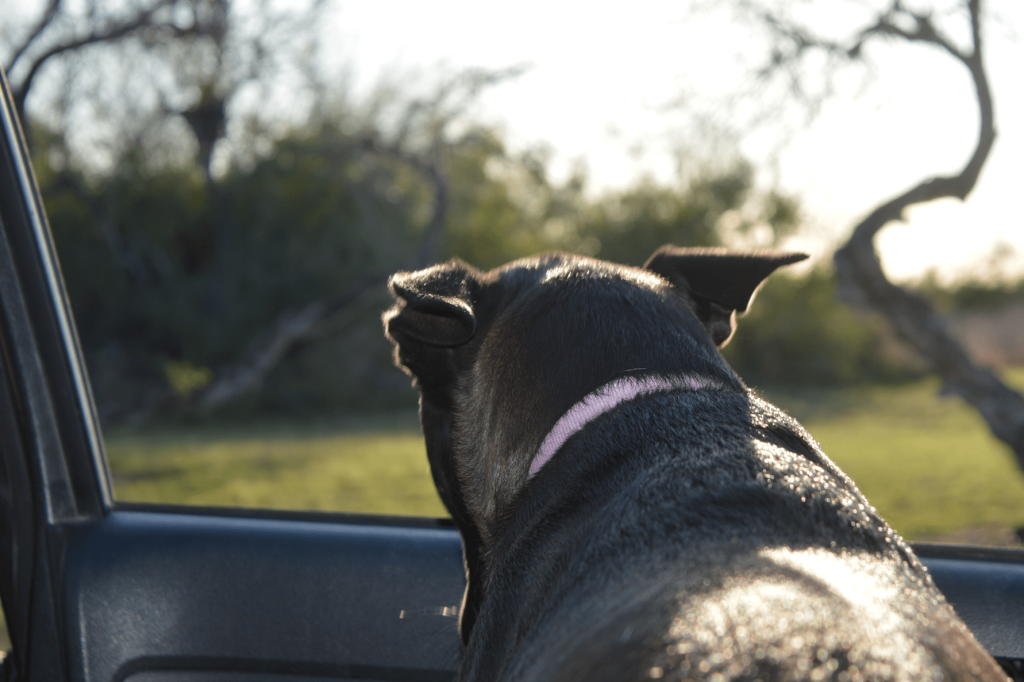
Socks looking outside, excited to get started!

This ranch has the same two-lane road next to the fence line that separates it from another ranch as we saw yesterday. The vegetation in this area has many dense and thick MOTs. Becase of the dense brush, migrants tend to walk along a path in areas like this. We learned that even though the sand may hold footprints, the winds the past few days have been strong enough to completely remove such evidence within hours. Our task today is to search along the road and slightly into some of the brush and trees in the periphery, which is where migrants would likely take a break and potentially leave items behind.
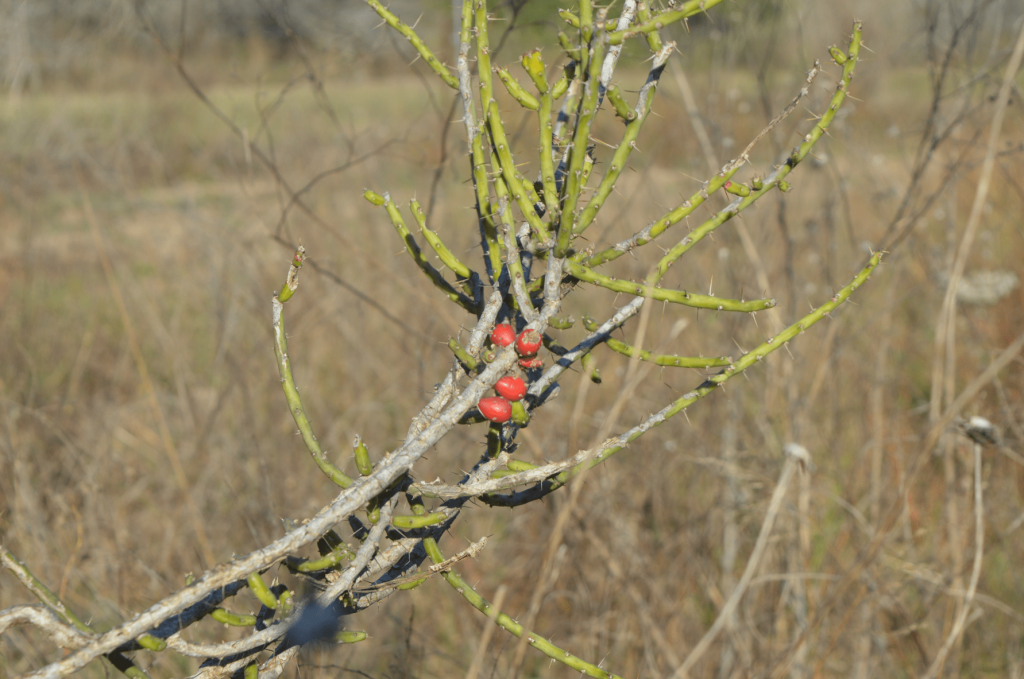
Pencil cactus in the tall grass
Pencil cactus in the tall grass.

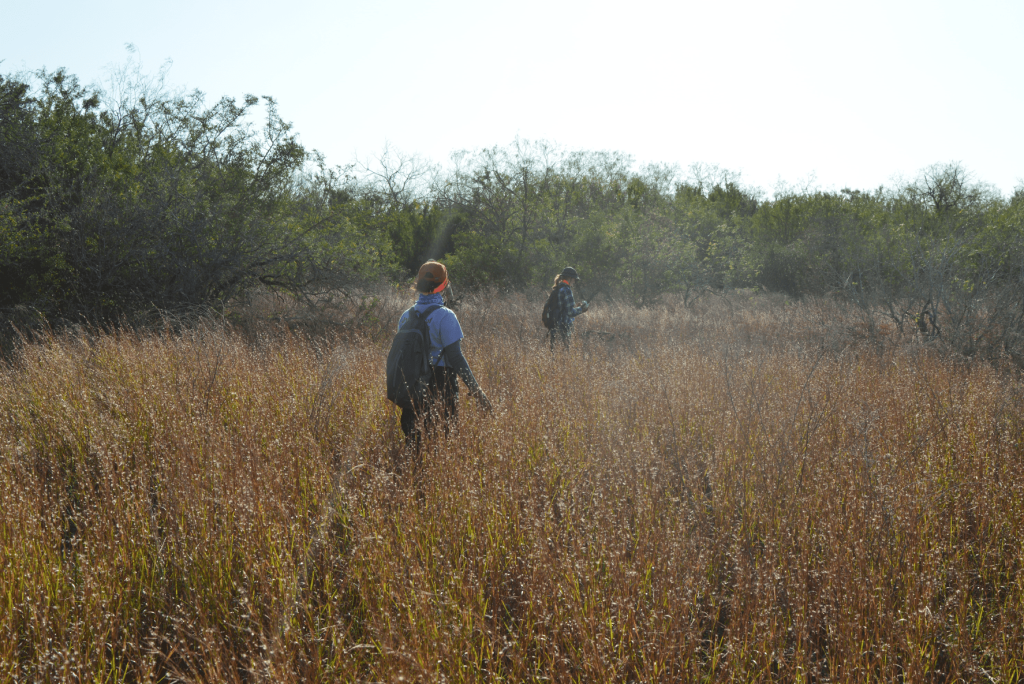
After taking our pre-day picture shivering in the morning air and we are off. First we start in a vast field of tall grass that goes up past our hips with a dense treeline to the east. Using a “buddy system,” we paired into three groups to easily keep an eye on each other. In the treeline, Makenna and I had to weave in and out of thorny tree branches which grabbed our clothes and hair while also dodging deceptively camouflaged pencil cacti. While searching, we observed areas where traveling migrants would potentially rest, but most did not show evidence of recent use. While searching in a MOT, I moved a low-hanging thick branch and thinking nothing of it, I then walked inside to search. It was not until I came back out with my buddy, that Ray came up to us to let us know we needed to pay attention to where we were going and be more aware when we move branches. Turns out that the branch I moved was a dead limb barely hanging above us and when I had moved it, it nearly came loose and could have fallen and hit Makenna. The possibility that this could have happened caused a deep fear and anxiety in my stomach. I don’t know what I would have done if I had been responsible for causing someone to get hurt. Getting injured out here is so easy (our many bandaids have proven that). I can’t imagine what a migrant might have to face after getting significantly hurt while traveling and under the complete mercy of a guide. According to Don and Ray, more often than not, they are abandoned by the group and literally left for dead.
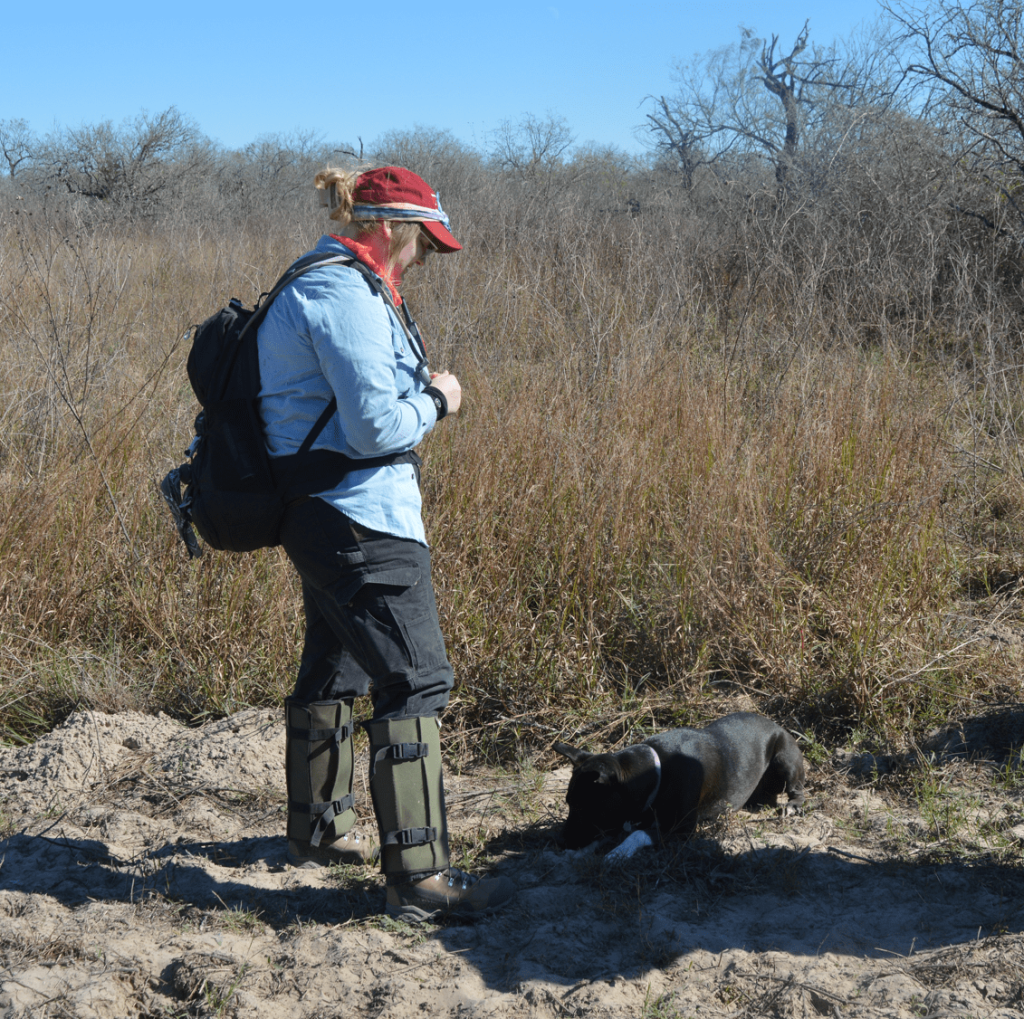
Training Socks to do tricks.
Training Socks to lay down.

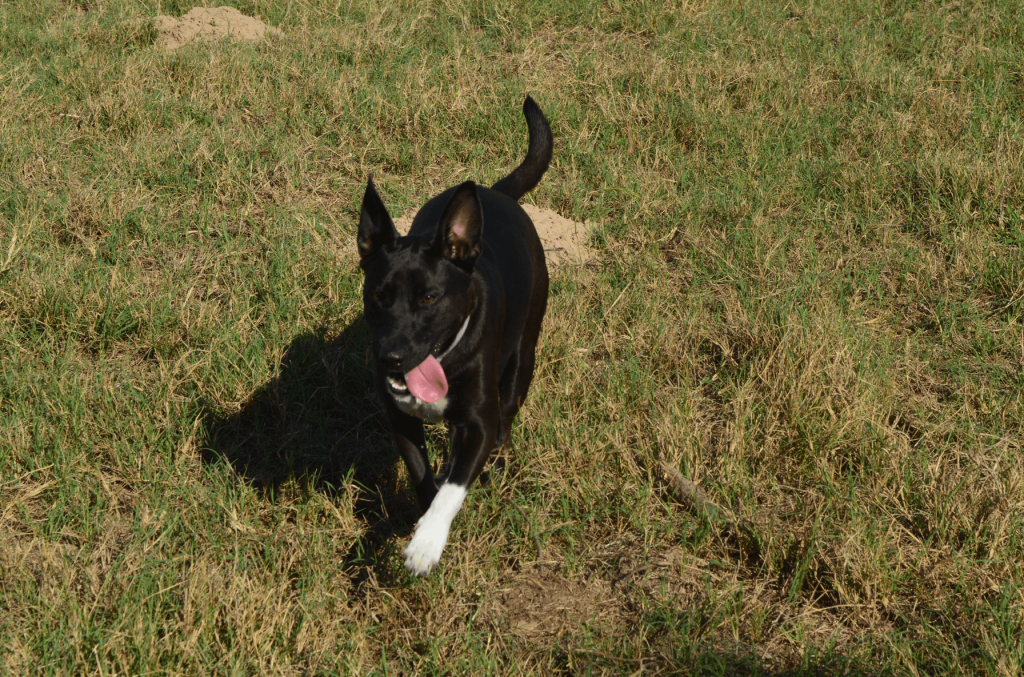
We continued searching and found a few items. Most common were cans and plastic bottles but many were not recent. Occasionally we saw mounds of non-human skeletal remains, including nilgai, hog, deer, and coyote. Ray was keeping a watchful eye on us all while we were searching with our buddies. Meanwhile, Don was off with socks searching ahead. Occasionally you’d hear him singing a lyric over the walkie to check in on us, with members responding back with the next verse. Finally when we were out of MOTs Don had returned to lead us to an area with some things he wanted to show and explain to us.
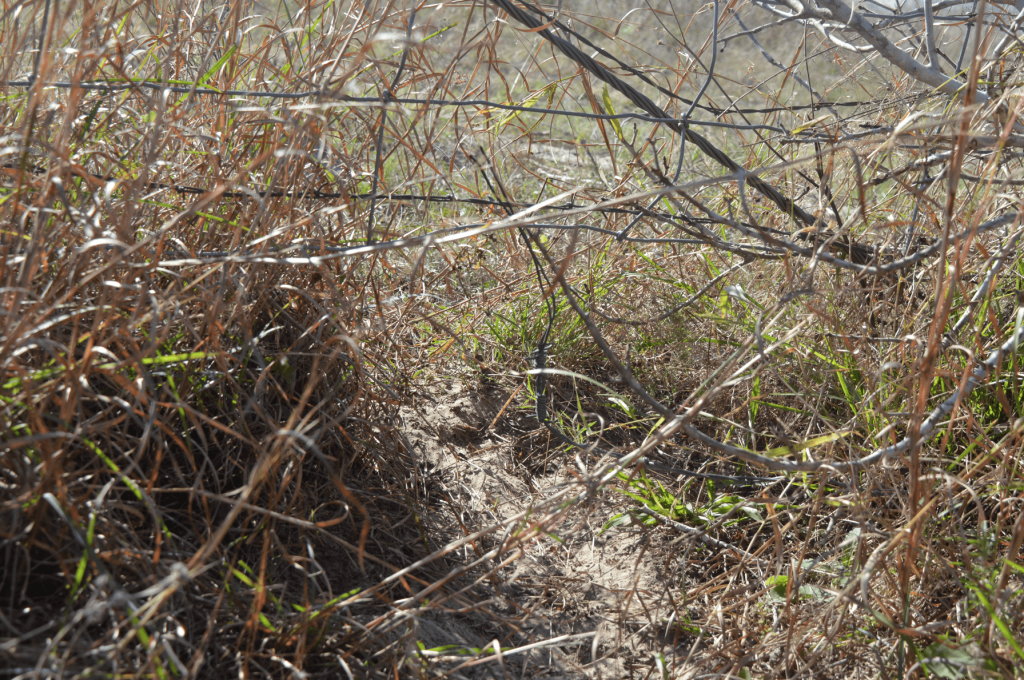
Gap under the barbed wire fence separating ranches.

We proceeded to walk down the sand road which was so hard to walk on in our heavy pants, boots, and gaiters. Finally, we reached a corner of the ranch where 3 ranches met. Here Don showed us a gap dug under one of the fences. We learned that typically these are dug by wild hogs and then, opportunistically, other animals and groups of migrants will use them to cross into different ranches. This gap just so happens to be placed directly next to an emergency 911 sign. These metal signs are made and placed around some ranches to provide a number for migrants to call if they are in distress. These are accompanied by a number they can give while calling which will notify authoriites exactly which sign they are located at. Many of the calls Don and other organizations get are approximate coordinates. Coordinates, no matter what instrument you use, are widely inaccurate. Thus when border patrol or Don goes out to search for the individual they are usually not at the actual coordinates provided. About 100 meters from this site, in the distance we could see a satellite emergency beacon. It makes me very relieved that things like these exist but it’s important to note, this is the first one I’ve seen in the ranches I’ve been to this year and last year, meaning they are not super common. If a migrant is in distress they likely won’t make it to an area with a sign or satellite. I can’t help but think of how many lives could have been saved if these were more common.
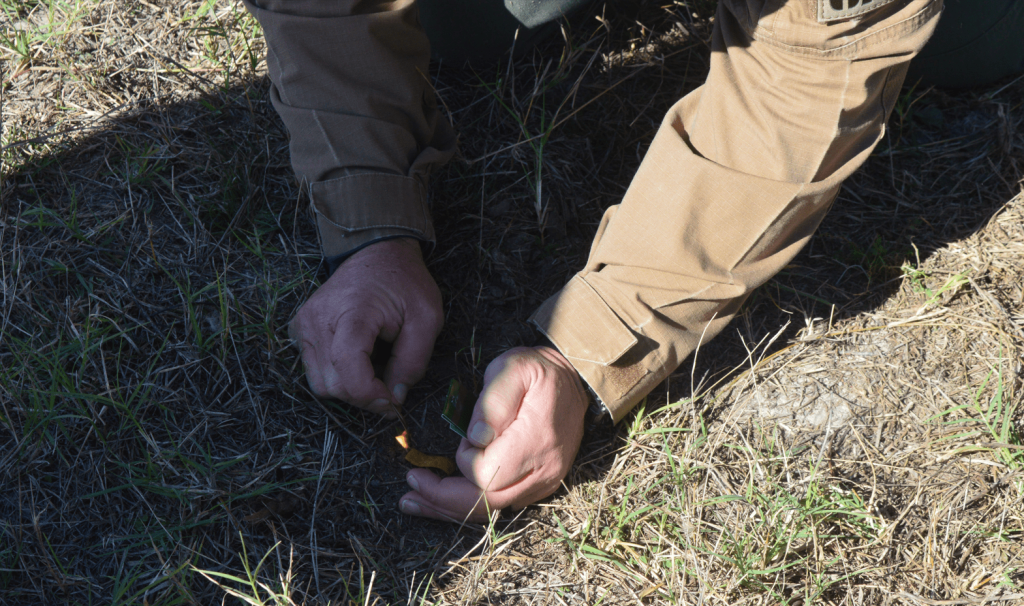
Ray lighting a Frito on fire.

During our lunch break, Ray taught us a survival strategy in which Fritos can be used to start a fire. We all laughed thinking this was a joke like always, but Ray proved it to be true, proceeding to light a Frito on fire with a simple match.
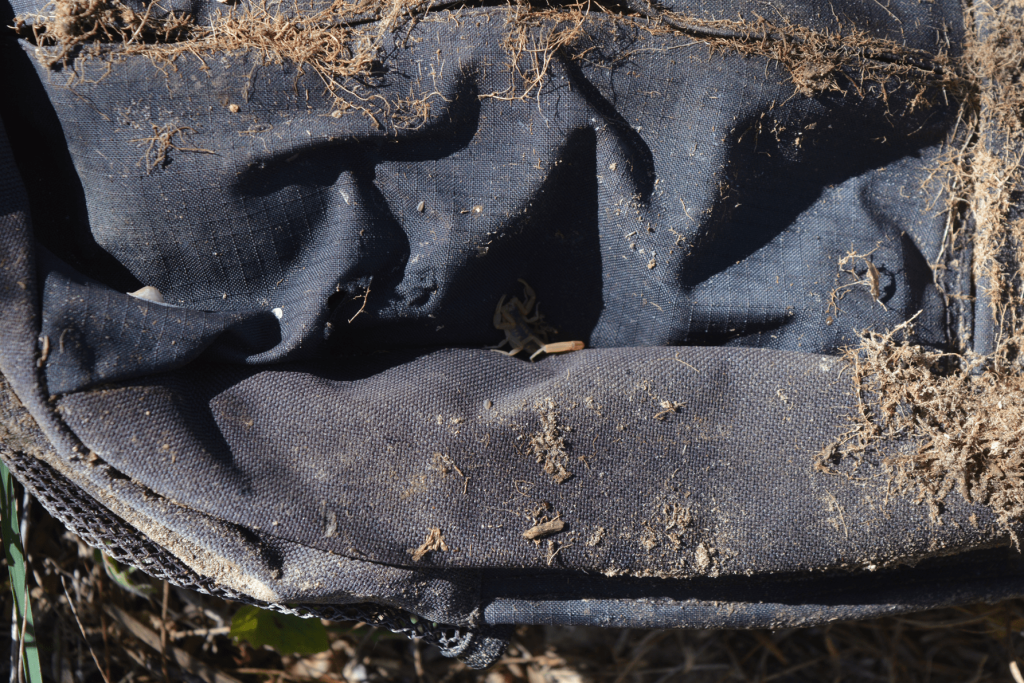
Scorpion on the backpack we found.

With full bellies and some newfound knowledge, we got back to searching more of the sand path and treeline next to it. We split with new buddies and began to find similar trash spread sporadically. Again, nothing suggested recent travel. It was then Lilly and Dr. Latham came across a backpack with a few cans. We gathered around, but as Lilly was picking up the bag to cut it open, a live scorpion caused her to drop it. Ray came over and picked the scorpion up with his knife and flung it away. Cutting the bag open revealed nothing but an obviously weathered shirt which showed the bag was there for a while. Soon after Don decided to conclude the search. We had successfully searched a large portion of land on a ranch that hadn’t been searched before. One more place Don can check off his list.

We drove back sharing stories about ourselves in the truck. I really value the times we all can take time away from the seriousness and heaviness of our searches and bond with each other and Don and Ray.

We departed Don and Ray as they needed to file a report for the recovery we did on Saturday with the JP or Justice of the Peace. It is similar to a coroner in other states but a JP has FAR more responsibilities which has proven to be overwhelming, especially with counties dealing with the migrant crisis like Brooks County. Although it is not on the border it has one of the highest rates of death of migrants due to the border checkpoint.
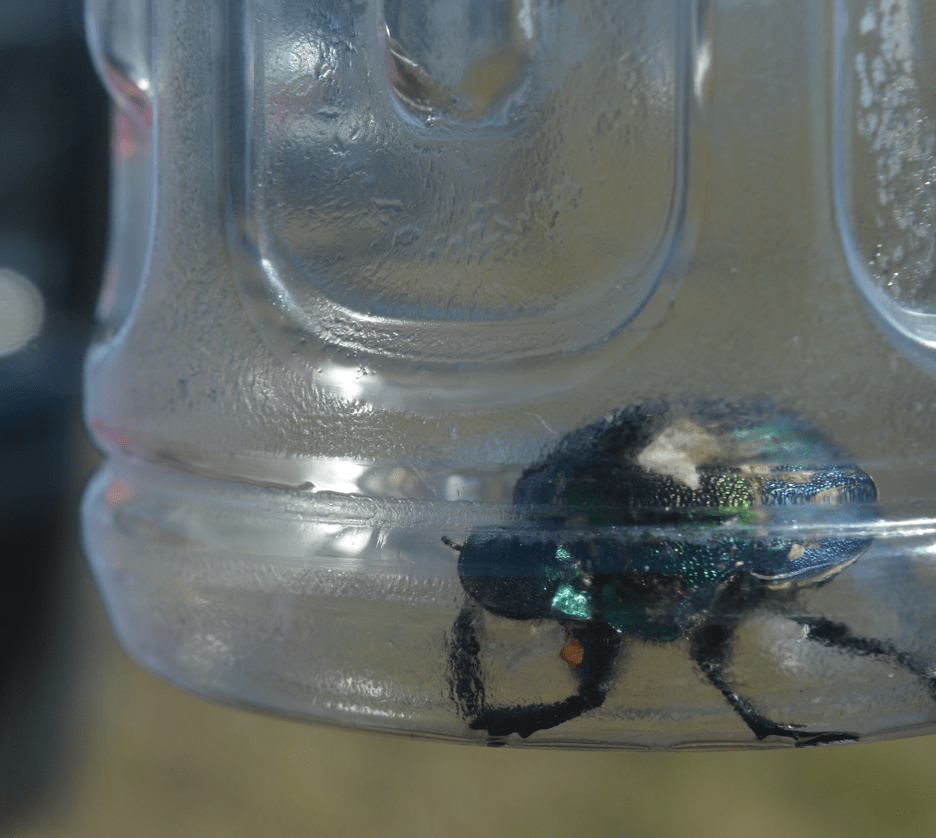
Scarab beetle I found and named Franklin.

After changing we were able to take a small break to relax and decompress in our hotel room. Being down here in Brooks has allowed me the opportunity to try new things, which I don’t do very often, and I am thankful to come back and experience more new things. This includes food like Sour Pickle Balls. Frankey and Lilly tried them, which resulted in an overwhelming spicy and sour taste and the unfortunate side effect of making their mouths and teeth a deep blue. After our short break we started our hour-and-a-half journey down to see the wall that separates the US and Mexico. We listened to music, watched the scenary chnage as we moved south, and talked about the day.
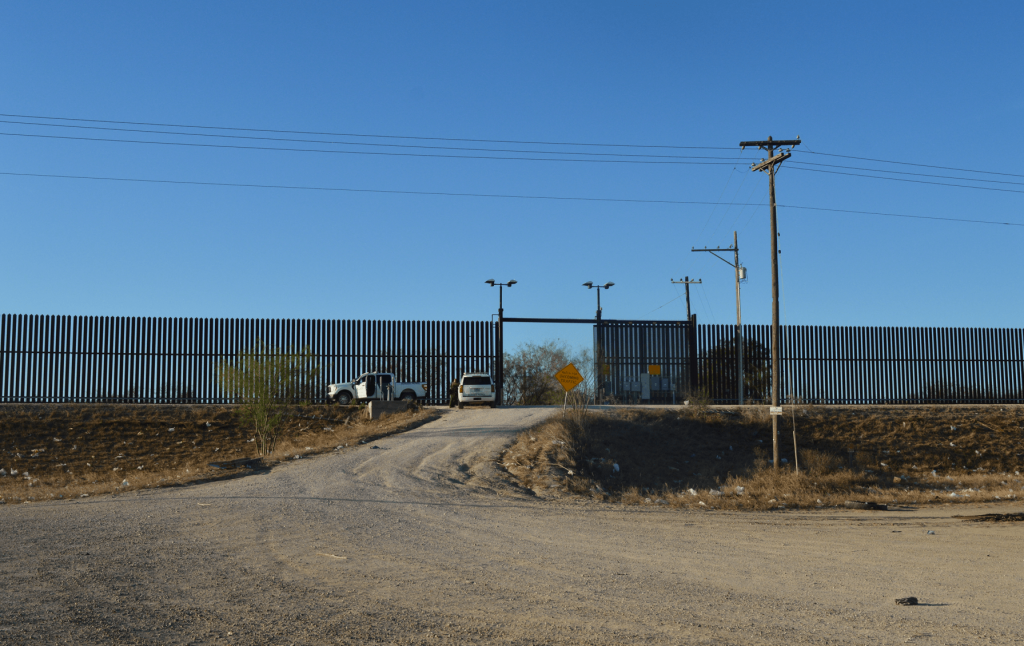
The wall between the US and Mexico.

When we arrived we came upon a vast urban area full of many businesses and surrounding residential areas. For some reason, I never thought there’d be a large city right along the border and a bridge to Mexico. I always pictured the environment we saw on the ranches spanning for acres and all of a sudden a huge wall, but this wasn’t the case. While driving we saw the massively tall wall in the distance. Further, though, it switched to a chainlink fence which I thought was weird at the time. We were no more than half a mile from Mexico.
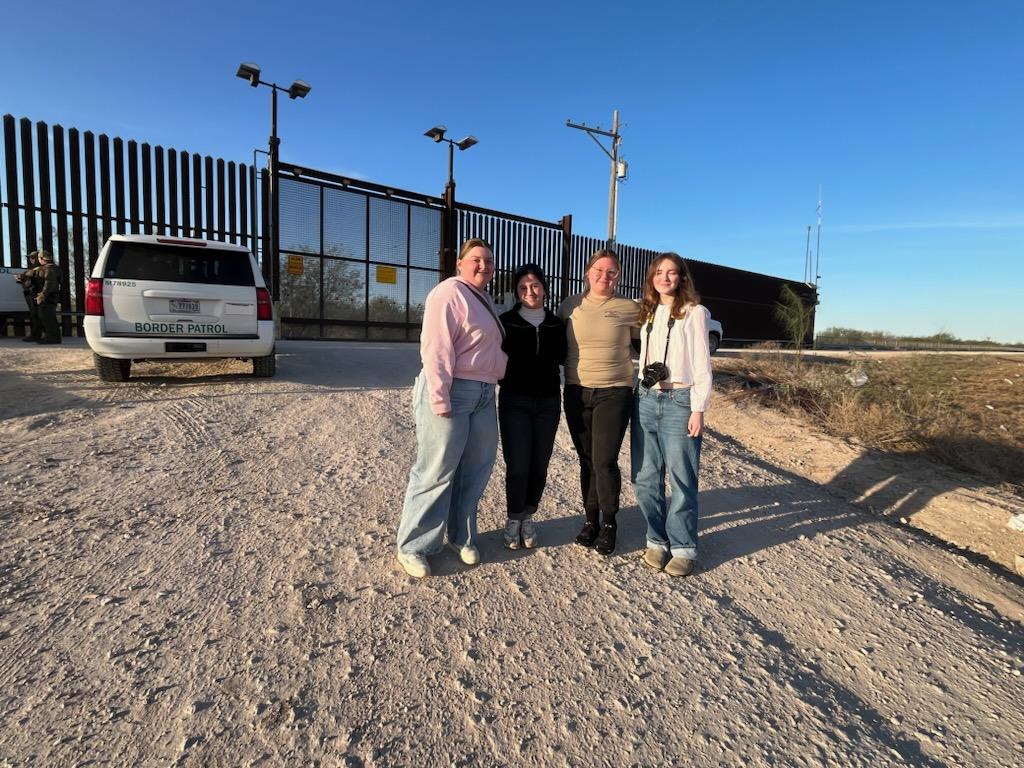
Team at the border
The 2025 team at the southern wall.

We were able to park at the base of the wall where a gate was located with multiple border patrol cars. We walked up and Dr. Latham introduced our group and we had the opportunity to talk to an agent there and ask questions. The border patrol agent we talked to was originally from Maine and he was stationed at the northern border between the US and Canada. Here we learned the reason the wall switches to a smaller fence in places is because on the other side there is a 15ft drop. Depending on where you are the wall looks different, with some parts newer than others. Likewise, we learned that border patrol doesn’t station people at a specific spot all the time. Typically they just patrol except for some high-traffic places. The border patrol agent told us the majority of what he has seen here is “turn in traffic” rather than chases. This means people will turn themselves in and seek out border patrol. Dr. Latham tells us that they will do this to declare asylum or if they are in distress. The agent is an EMT and works to take care of people in distress. He placed great emphasis on the fact that he checks on children first because they are smaller and may not handle the environment, climate, and trek nearly as well as the adults they travel with.
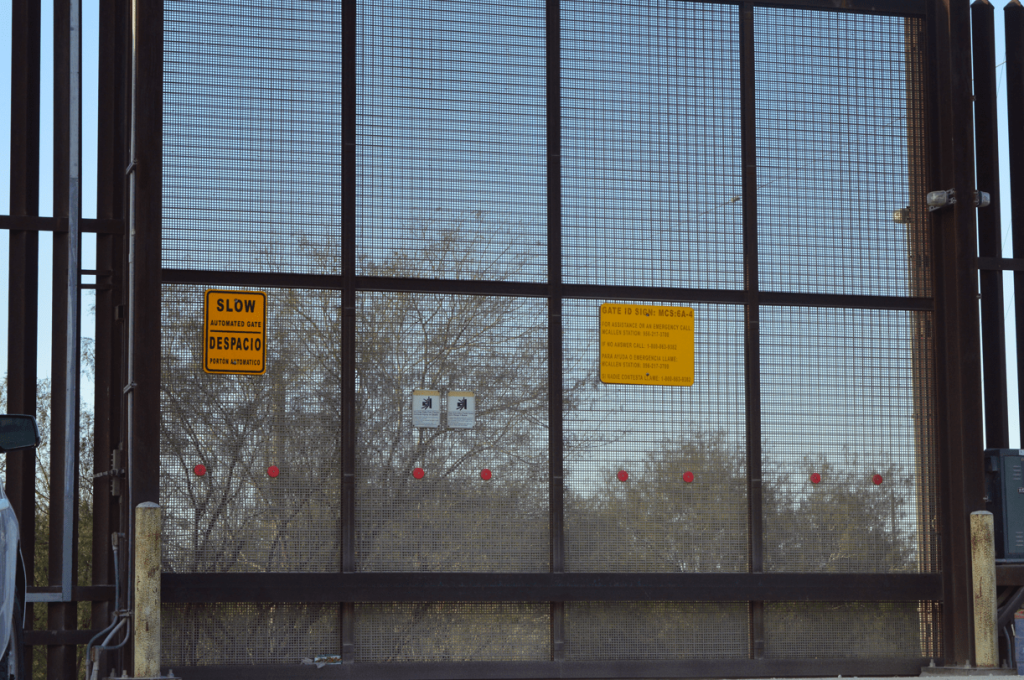
Gate of the wall between the US and Mexico.

While we were talking, the gate opened and a white and green border patrol truck pulled through and parked on the bank with two individuals riding in the bed of the truck. They help each other out and then are led to a place by the gate where they could sit and wait. Watching this made me feel so guilty and ashamed to be observing this serious moment like a tourist with camera in hand. I am so privileged to be born into the family I was. Why must someone struggle so much to escape one life to cross the border into a country where it is not guaranteed life will be any better? I was always told growing up that life isn’t fair, but in the context of the prolonged mass disaster at the border, it’s something I absolutely cannot get over. Dr. Latham said they probably turned themselves in to seek asylum. Seeing this made the crisis so much more real. There is likely high traffic right now because the right to seek asylum is still in effect under the current administration but with the new administration, border policies may change.
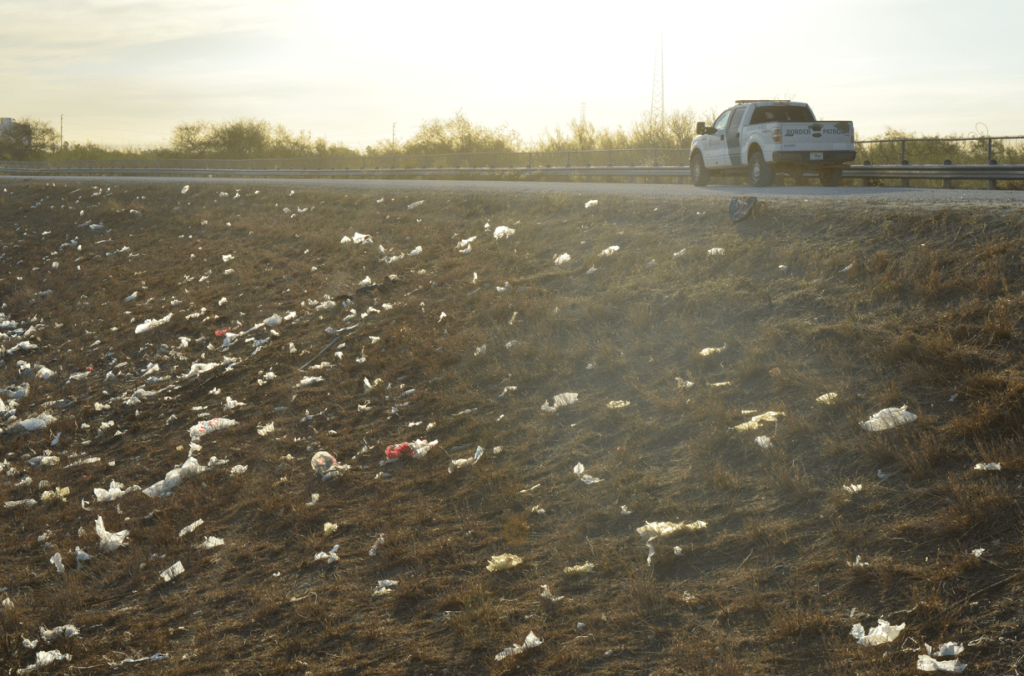
Trash littering the hill with the wall in the background.

As we were leaving, we walked down the path where I noticed the trash littering the hill on both sides. There was clothing, bottles, bags, water jugs, and right by the road: a ladder perhaps used to climb over the wall. As we pulled away, I was able to reflect that this was a defining moment for me and an opportunity I never would have been able to experience without Beyond Borders.
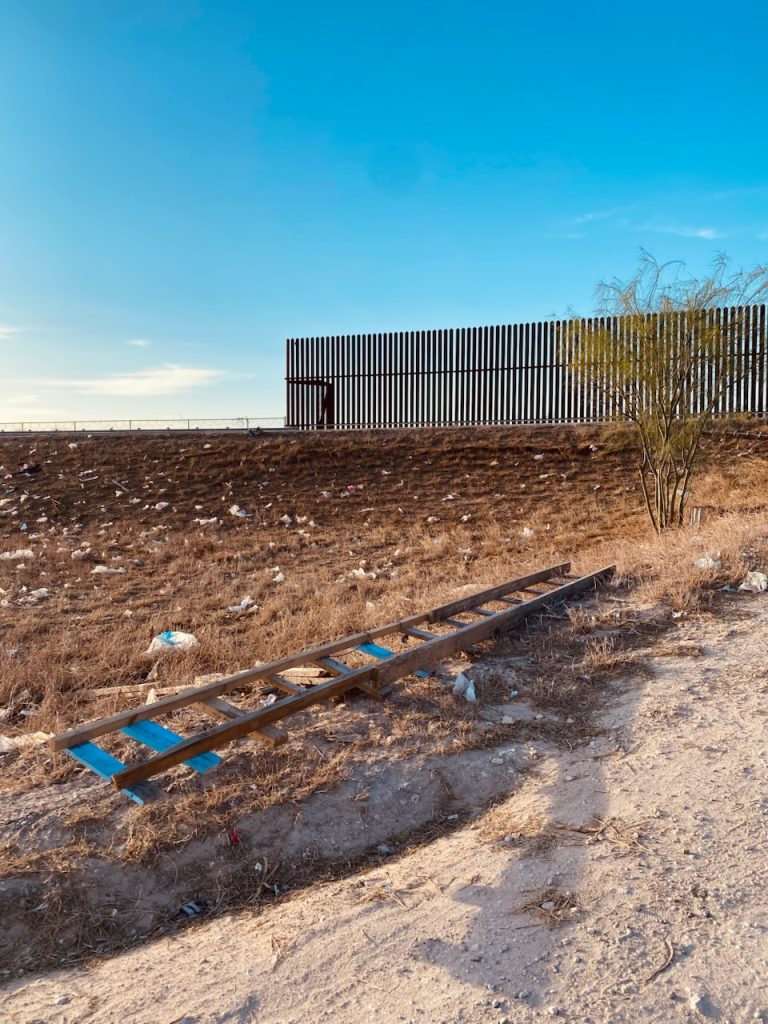
Ladder discarded by the wall.

We started driving back and decided to stop at Dr. Latham’s favorite tamale restaurant only located in South Texas: Delia’s. We ordered two dozen tamales and two of us got to try them for the first time (P.S. You’re not supposed to eat the husk if you didn’t know). Thoroughly satisfied and mouths on fire, we got back in the car to drive back.
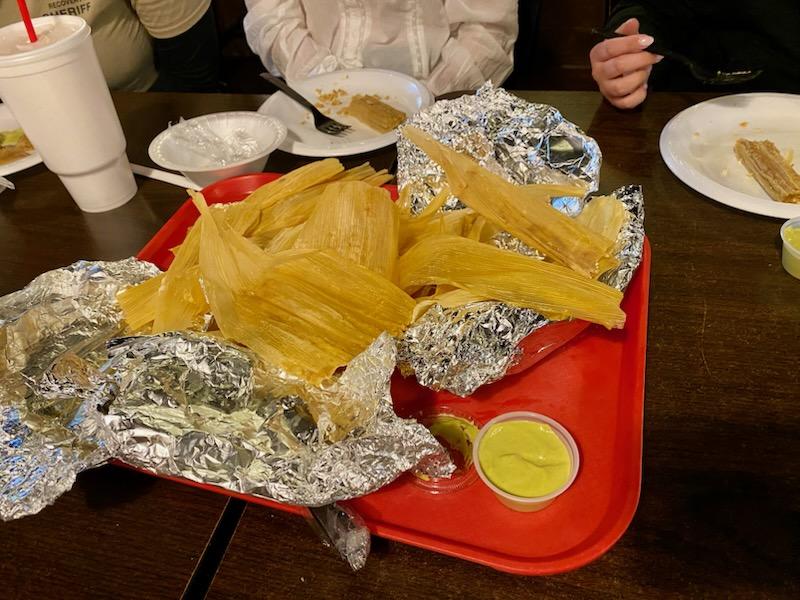
Tamales for dinner.
Tamales for dinner.

When we arrived we had our nightly debriefing. Although we didn’t have as many recoveries as last year, I had to remember that this trip was completely different. Last year every ranch we went to we had coordinates showing there was someone there at some point. This year we took on a role of more searching for activity and general clearing of areas for Don. This trip was just as successful, just for different reasons.
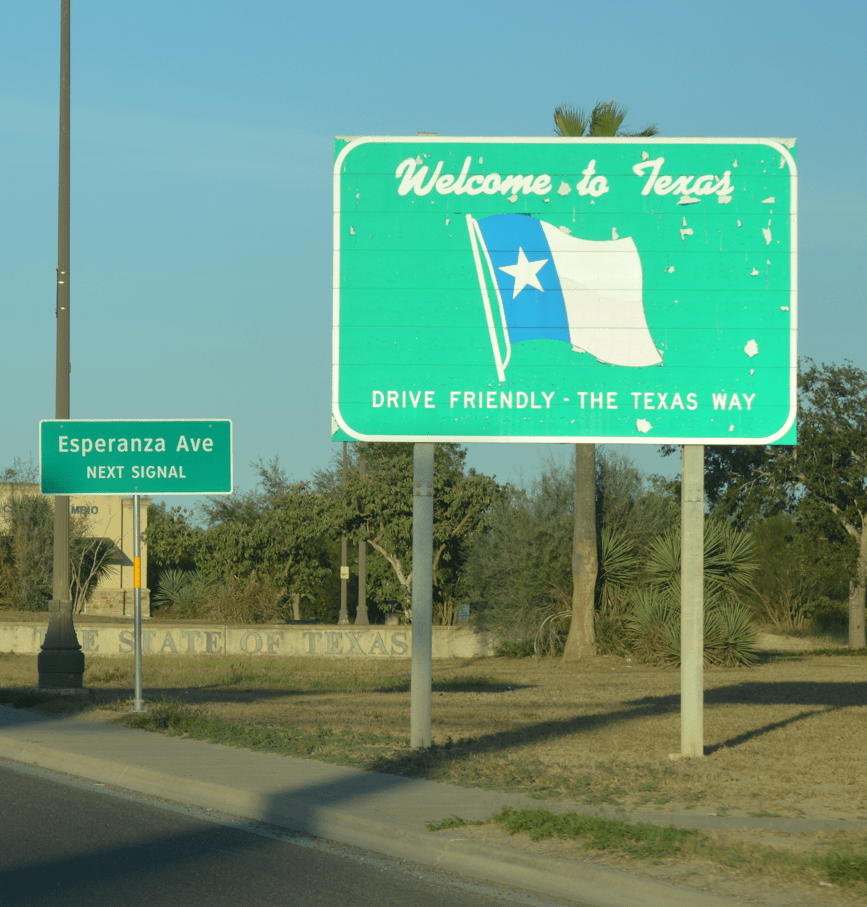
Welcome to Texas sign.

Fully realizing that tomorrow will be our last day, we returned to our room to make sure we got as much rest as possible. Recovery or not, I will never forget this experience, and I’ll cherish every single moment.
Chastidy

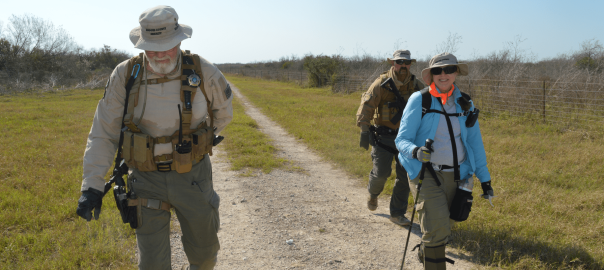
Dr. Latham, Don, and Ray on a walk through the ranch.

Day 3: A Day in the Heat

When I woke up this morning the first thing I realized was just how tired I was. Not only did my eyelids feel heavy, but my feet and back had begun to ache more than they had the past two days. This wouldn’t normally be a problem for me, I would just put on a comfy pair of socks and go, but given the fact that it was our hottest day (a sunny 86 degrees), adding more layers for comfort really wasn’t the best idea.

It was also the first morning that I didn’t know what to expect. We had known the night before the previous two days what we would generally be doing, but today we had less of a clue. It wasn’t until Don and Ray got to our hotel that we learned that we would be heading out to a ranch where previous recoveries had been made. There were no specific coordinates or locations we were searching at, but Don had done recoveries at some of the surrounding ranches, and this one had not been searched in a while, so we set off.

Day 3 of our time in Falfurrias would start about an hour or so from where we were staying, and for the first time, we got to take the minivan out onto the ranch. I’ll be the first to say that I was surprised we got as far as we did without being in one of Ray or Don’s massive trucks, but we managed! The drive along the ranch roads was also filled with interesting things to see, from fences to pipeline trails to even a larger number of nilgai (a type of antelope from India) and deer. The spot we stopped at was quiet (save for the whipping wind that made it hard to hear what anyone was saying): a two-track road with thick brush on one side and a fence line on the other.

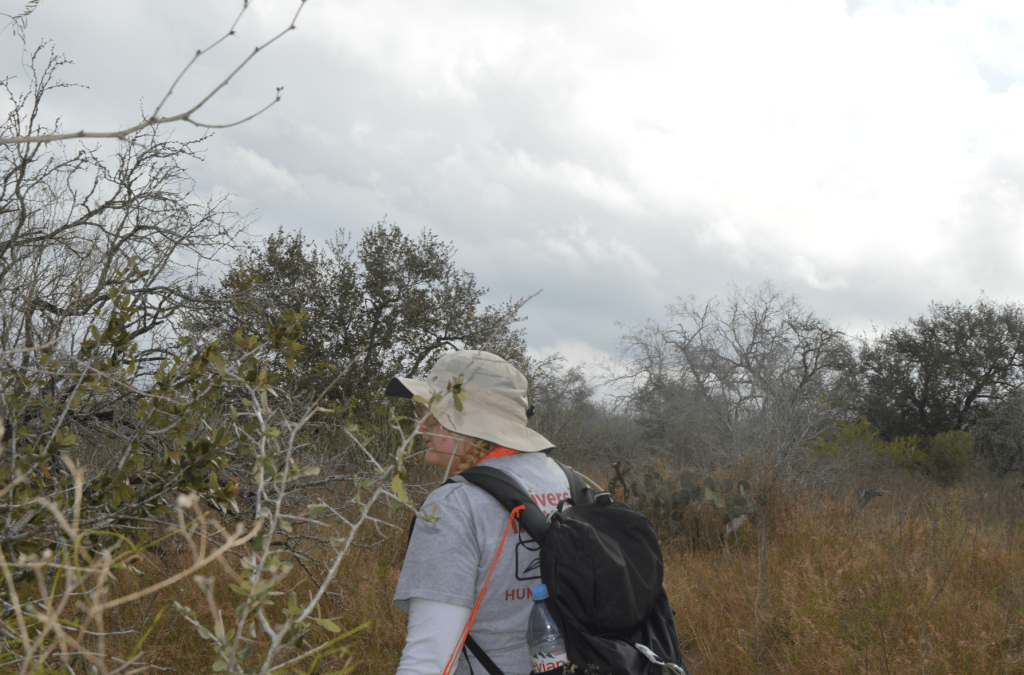
Two members of the team searching the surrounding area.

The moment we stopped along the two-track it was time to begin, and we started by just prepping our gear and putting on lots of bug spray and extra sunscreen, both necessary for the type of thick brush we were looking at examining in this heat. Don took off into the brush to look for evidence of people, whether that be tracks or food wrappers or otherwise, and we started by beginning a line search along the grassy area between the two-track and the brush.

A little side note here: line searches are harder than they look… especially if you are acting as an anchor! I offered to be the anchor for our first line searches of the day, which essentially means that I stood at one end (in this instance along the two-track) and set the pace and direction of our walking. The job of the anchor is to make sure that we all stay in a line and an equal distance apart so that the area is thoroughly examined. Sounds simple right? Well, the hard part is how many moving parts there are to it. If I spent all my time looking at the members of my team and making sure that they were all in line and at a good pace, I found that I kept forgetting to check the area I was walking in, and vice versa. I’m also admittedly not the loudest individual, so offering directions loud enough for the entire team to hear was a big challenge for me, but we managed all right in the end (I hope!).

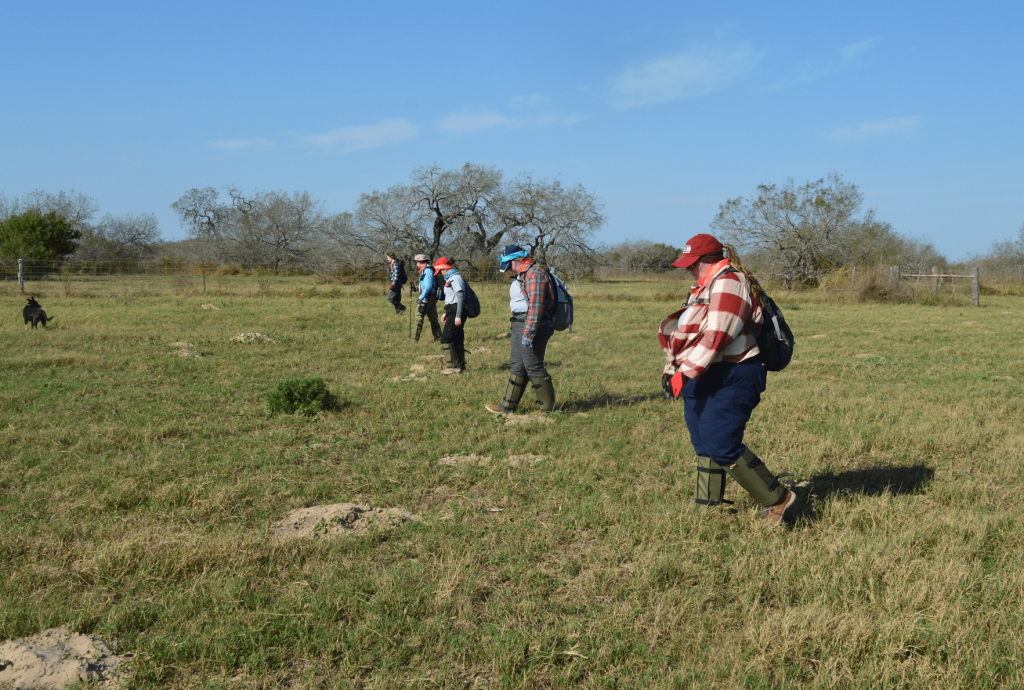
The team during a line search.

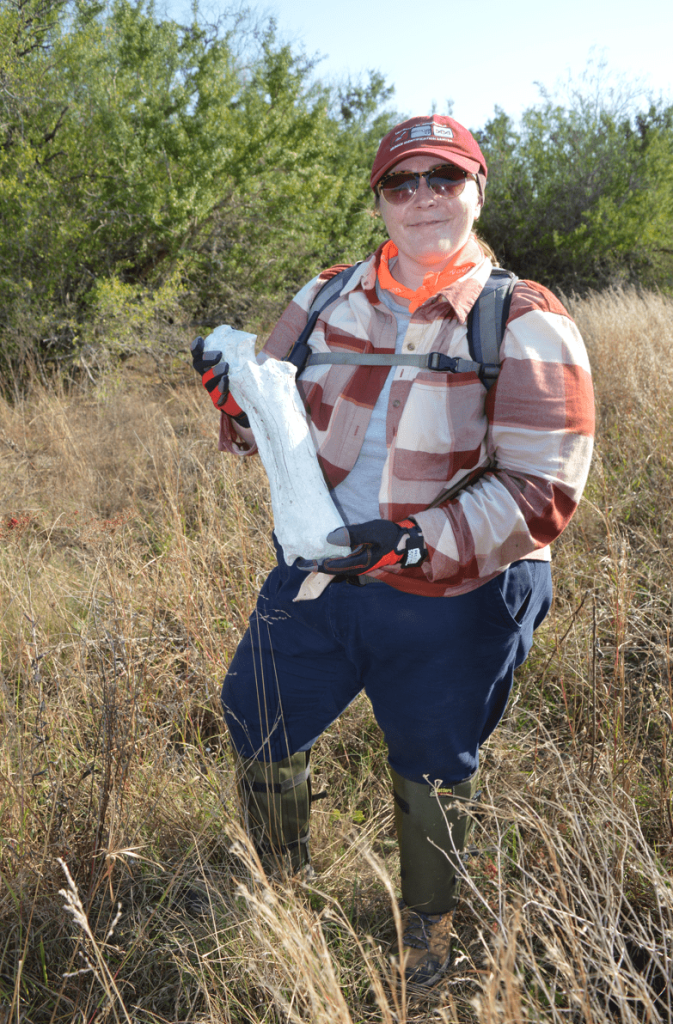
Our search didn’t yield much evidence of people, but it did yield a great number of animal bones, namely cow bones and deer antlers. Among these cow bones, we found many vertebrae, femurs, scapulas, and more- all massive in comparison to the human skeletons I am used to seeing in the osteology lab and the anatomy classroom. It was especially interesting to see how they differed from human bones, and how similar some bones were.

Dr. Eriksen with a fused cow radius and ulna.

Dr. Eriksen also quizzed us on what some of the bones were and what side they were from, which was a fun challenge (though it did show me that I have a bit of review to do before taking osteology in the spring).

We found many areas in our searches today that had larger remains of nilgai and cow, and many deer antlers which were especially cool to see. It was also really interesting to hear Ray call out things like “4 point” and “6 point” any time we found them, and I learned that this has to do with the number of tines on a deer’s antlers (either on one antler or in total among the two antlers).

After walking a good ways from the trucks and doing some small searches, the sun was high in the sky and I think we were also feeling more than a bit fatigued, so we began to head back to the trucks. Ray suggested Dairy Queen for ice cream and a late lunch, which was a welcome break from the heat. It wasn’t until later in the evening during our debrief that we learned the real reason we had left in such a hurry: border patrol was actively pursuing a group of migrants not far from us.

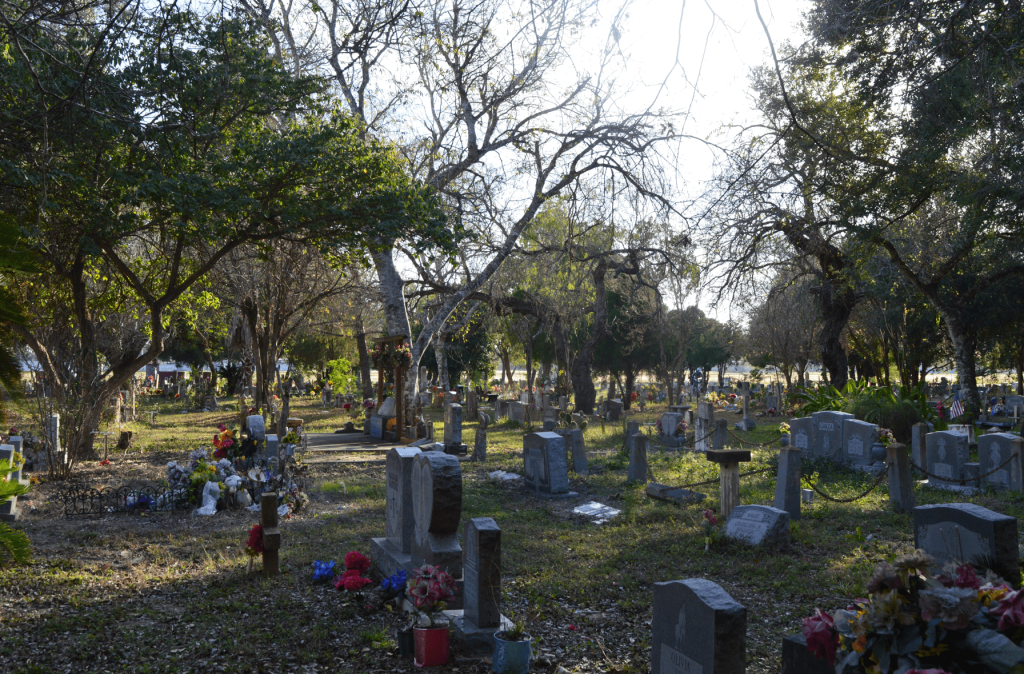
After we left the ranch, Dr. Latham took us to the Sacred Heart Cemetary in Falfurrias, and we got to hear a bit of the history behind her work here in Texas searching for unidentified migrants.

Sacred Heart Cemetery.

She began taking students to Falfurrias in 2013 after being invited by a professor from a different university, and at first the work involved going to the cemetery to look in unmarked plots of land for unidentified migrants who had been buried there in hopes of possibly identifying them. When we got to the cemetery I remember how calm it felt, even with the amount of people there visiting their loved ones. But one of the biggest things I noticed was how different it was from the cemeteries I was used to visiting, and I was really struck by the difference in the cultural view of death and life. For one, the headstones were decorated with beautiful flowers and figurines, and many of the sites had benches for people to sit at and windchimes in the trees. Some had food placed there, and others were decorated for the holidays (many had Christmas decorations still up). In this area, a grave didn’t feel like a somber scene, but rather one to celebrate those who had lived.

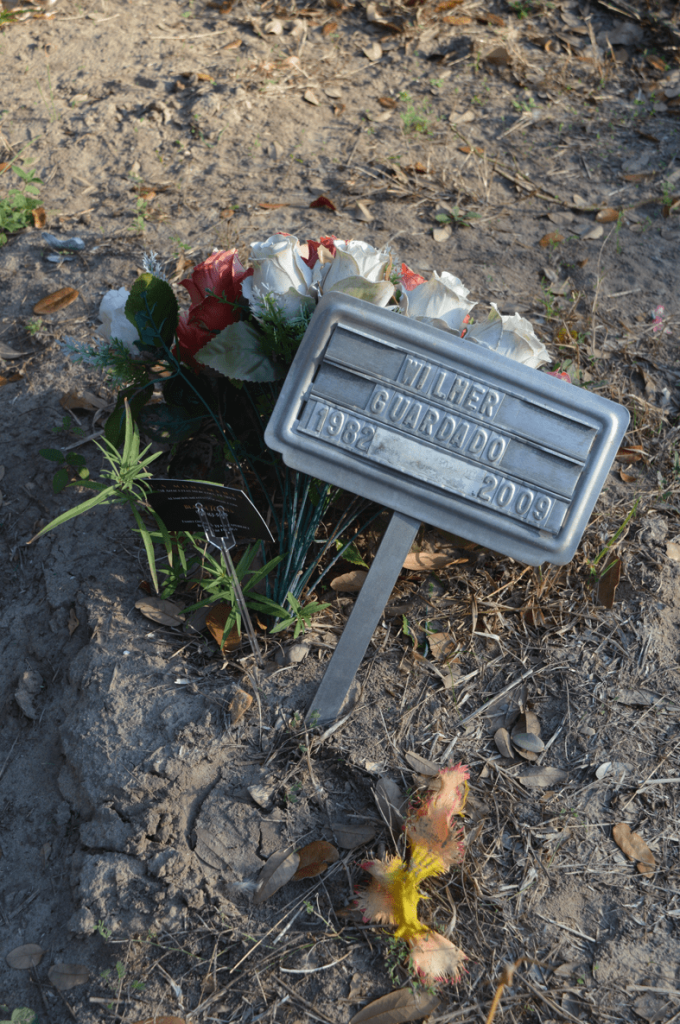
Grave marker of Wilmer
Grave marker of Wilmer Guardado.

Dr. Latham showed us a small marker for Wilmer Guardado, a previously unidentified man with a small marker to commemorate his burial, and even that was decorated with beautiful flowers. She brought up that there is still a bit of uncertainty regarding whether or not his family even knows that he’s been identified, and it really put everything into perspective for me. We collectively use the term “migrants” to describe those who cross the border, but they really are people like any of us. People with lives and passions and families, and people who deserve to have identities known and stories told. Dr. Latham has been coming here since 2013, and just knowing all of the work and change that has been done because of people like her and Don and Ray and numerous others shows how important and necessary this work is. I’m really proud to be a part of something greater than myself.

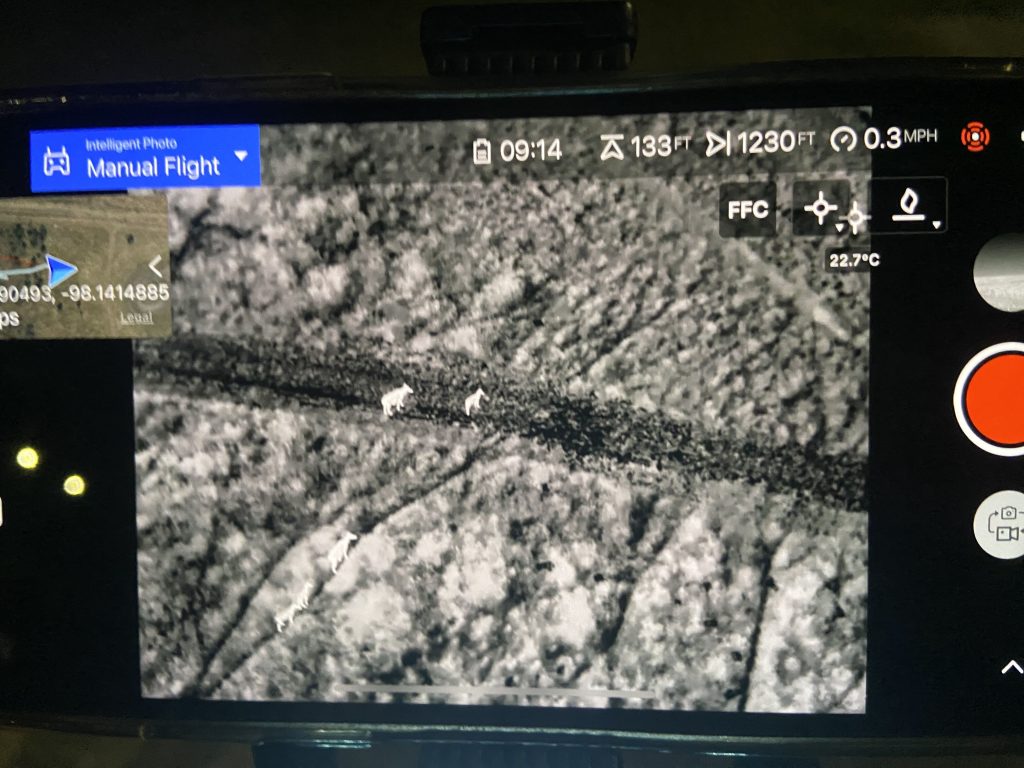
Infrared image of a herd of nilgai seen on Don's drone.
Infrared image of a herd of nilgai seen on Don’s drone.

We ended the day with tacos from Laredo Taco Company and taking out Don’s drone to one of the more heavily wooded areas on the side of the road. It was a nice way to decompress after a long day in the heat, and it was interesting to see how the infrared camera on the drone picked up various wildlife like wild hog, nilgai, and more via heat signature. One thing I didn’t know was that even things like trees and bushes can hold onto heat until early in the morning, and Don even talked about how he had used the drone to locate spots for recovery.

Altogether, today was a day of learning, and a lot of reflection, and I don’t know that I’ve perfectly articulated it all here. Even on days like this where we don’t make a recovery, there is still so much to say. But, what I do know is that I’m excited to head back into the brush tomorrow with the team by my side.

Makenna

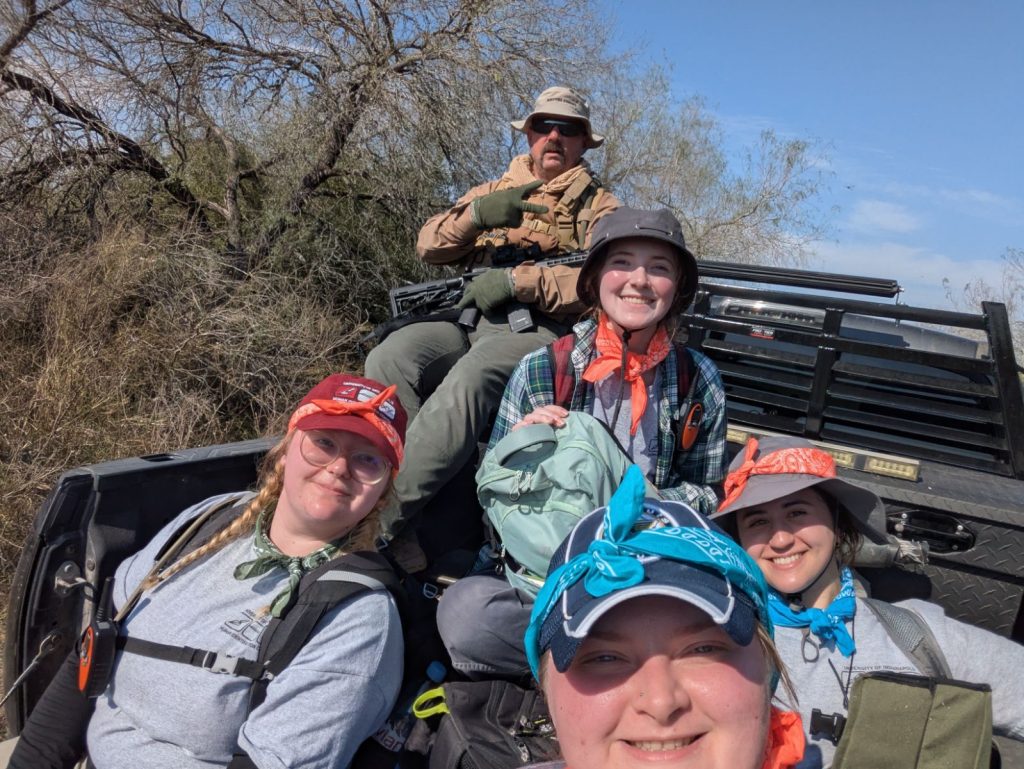
Lilly, Frankey, Chastidy, Ray, and Makenna in the back of Don's truck.
Lilly, Frankey, Chastidy, Ray, and Makenna in the back of Don’s truck at the end of the day.

Day 2: Our First Recovery

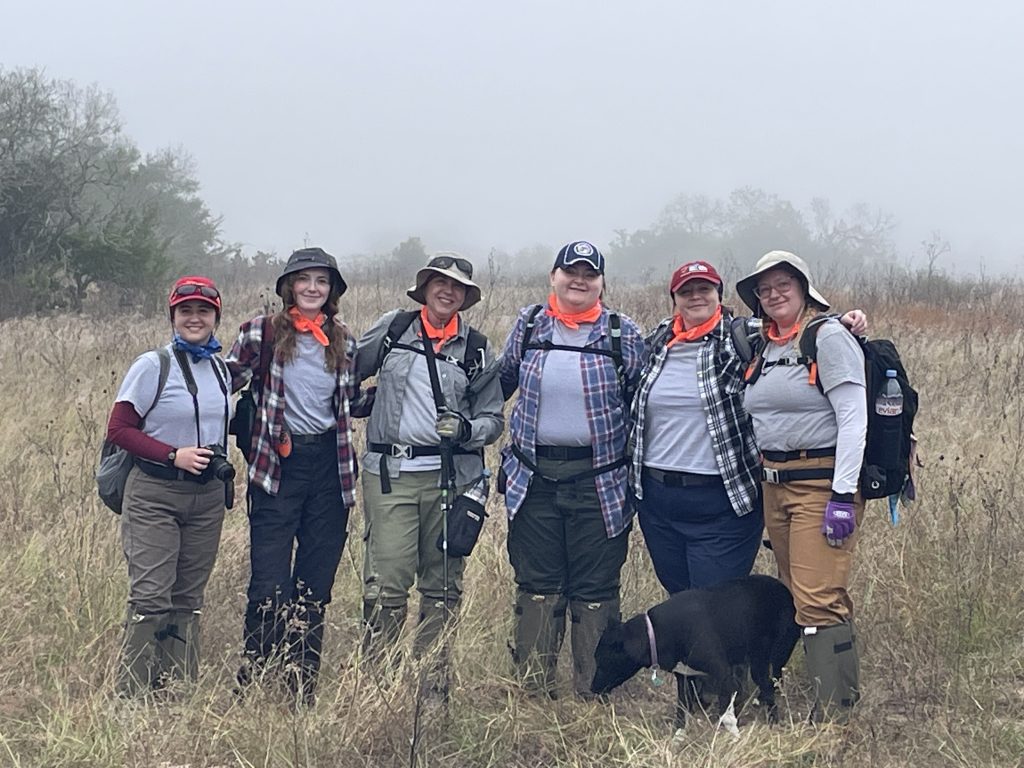
Beyond Borders 2025 team from left to right: Frankey Leggio, Makenna Mizell, Dr. Krista Latham, Lilly Bucher, Dr. Amandine Eriksen, and Chastidy Gilbert

It was a foggy morning. When we were walking to breakfast at 7 AM, it was still dark. You could barely see the other side of the hotel and as we walked I hoped that the ominous weather now was not a reflection of the rest of the day. As we drove down the highway towards La Copa Ranch to meet Ray and Don, the van was silent while we all woke up and adjusted to the dim morning. Part sleepiness part preparation for the day ahead, the music playing softly and the sound of the air conditioning filled the silence.

Day 2 of our mission would start about an hour and a half from La Copa, the ranch where Don and Ray are staying, and where we split between two trucks. The journey was less highway and more small caliche (sediment that hardens when dry and is semi-moldable when wet) roads that have been worn and traveled. It was a bumpy ride to our destination, as it was the day before and likely will be tomorrow. Because I rode with Don yesterday, I rode with Ray today and on our way, more stories and insight were shared. We had been on the road for an hour when we veered into the brush on what first did not look like a road. A short while later, a renewed carved two track path behind us, we reached our starting point.

The fog was still in full force when we stepped out of the trucks, with dew drops making the many spiderwebs in the brush stand out. Don began to explain that we were here because of a call that had been made about an individual who had went missing two years prior. There was also the possibility that another individual went missing in this area. They were supposedly at or around the coordinates Don was given (which led to a mot that was searched and cleared previously), and our goal was to fan out and search beyond the coodinates to potentially locate this individual.

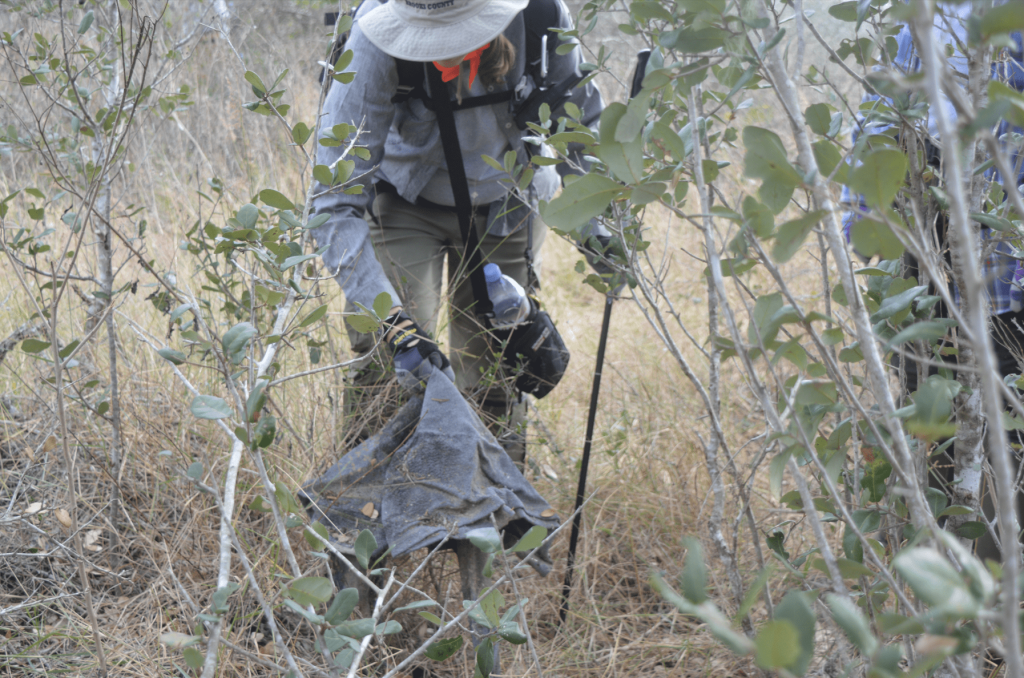
Dr. Latham picking up a sweatshirt found in a mot

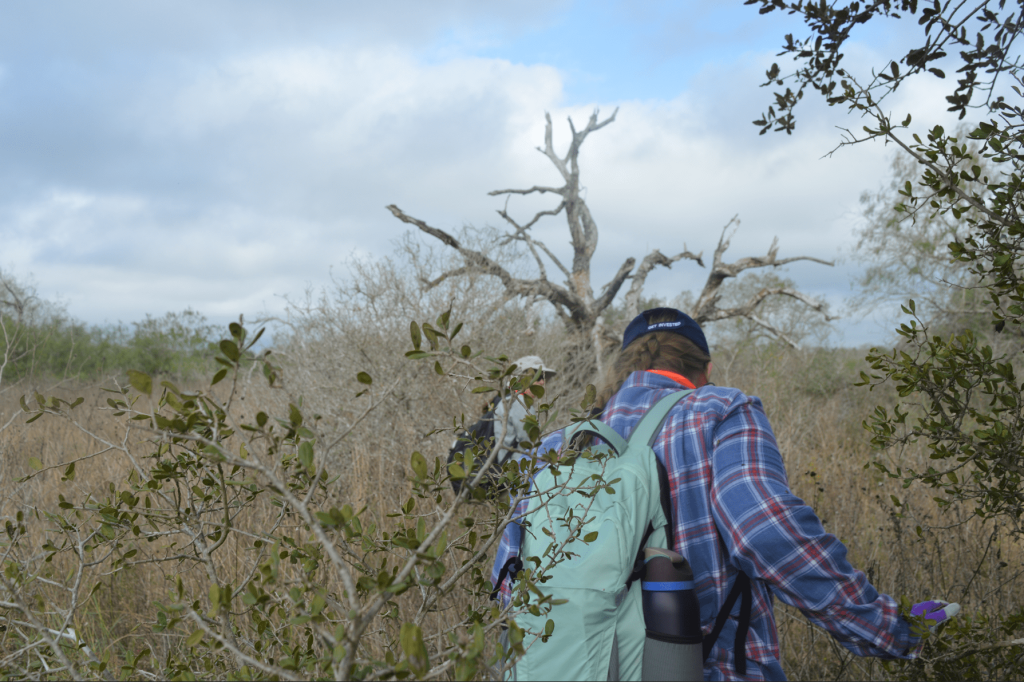
We began with line searches of the clearing we parked in and headed due North, sometimes scattering around and peaking into mots. In the beginning, we were not seeing any evidence of human activity, which could include trash or clothes, and it seemed that the day would have a similar result to Day 1. There were quail hunters on the property and every now and then, we would hear voices and gunshots. While we didn’t know a lot about quail hunting (the guns are short range) at the time, this was enough to make us nervous. As we neared the end of the search area, Don suggested we reach the tree line, peak in, and then turn around to line search the opposite side of the clearing on our way back to the trucks. By that time, the sun was starting to peak through and our pants were starting to dry from hiking through wet brush. Don had ventured a little further into the tree line, just where we couldn’t see him, and suddenly our walkies beeped and his voice rang out “ya’ll want to come look at this”. We headed in his direction, and after a few minutes of walking, there were Don and Ray smiling at us, knowing that we would soon be able to jump into the roles we traveled here to do and give this person’s family some long awaited answers.

Team members searching the brush

Our goal for Day 2 was realized, as our search resulted in a recovery. We cannot say for certain whether or not the recovery that was made was related to the call that Don had received, but based on the area and the time line of the related material artifacts found, he will be able to give as much detail as possible in his report to help with potential identification. We searched the surrounding area as thoroughly as possible.

Looking into a mott
Looking into a mott

By the peak of our process, the sun was out and bright, so staying hydrated was at the forefront of our minds. We had a 15 minute timer to remind us to drink water and take a break, and during this break, the consequences of hydration showed itself. While a couple of the team were taking care of their business, there was suddenly a noise from their direction. The rest of the team, sans Don who was searching the perimeter and Ray who had gone to get the truck, perked up as a high pitched howl rung through the air. One cry was joined by another, and then another and suddenly it seemed like they were coming from everywhere. The separated team members came running back towards the recovery site and it seemed like the howling only got louder. Was it getting closer? Where was Don? Where was Socks? Out of the thicket came Socks, who we were all yelling for, while Don went into the thicket to see what was going on. It turned out to be a pack of coyotes who had been startled and because Socks went to investigate, began to howl and cry in warning. The high pitch screams were so startling and so unlike anything we had experienced that for a good 10 minutes, we just stood at the site and waited for Don to come out of the brush.

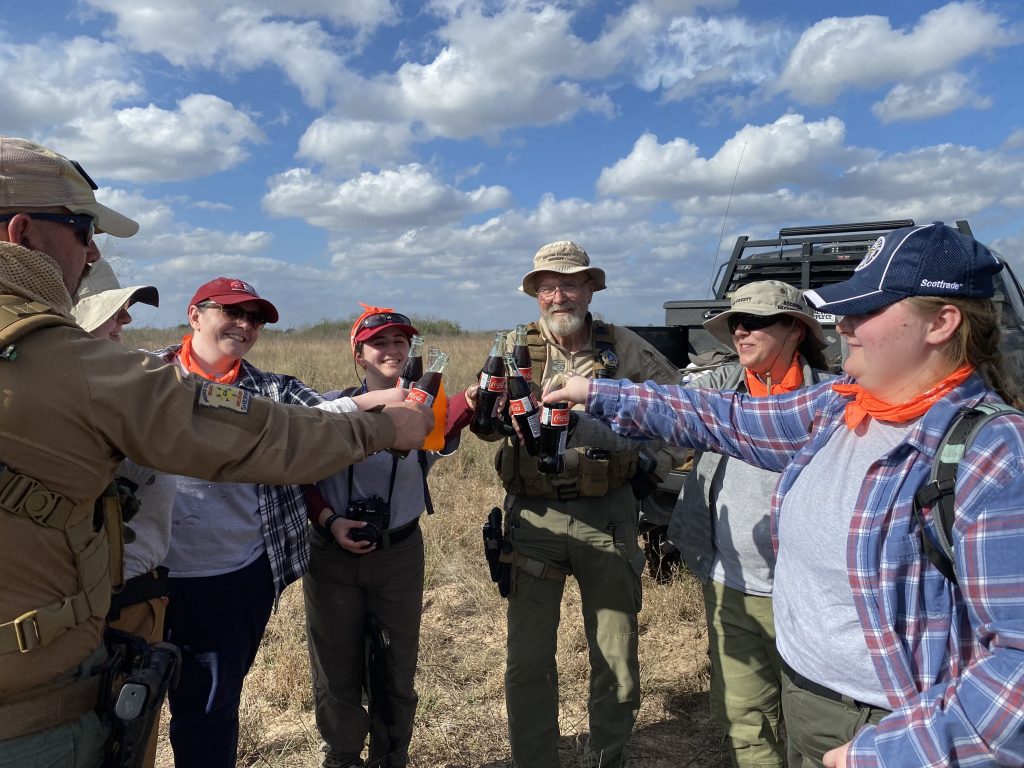
A toast to a successful day

We finished our part in the recovery soon after Don had given us the all clear, and from there we made our way back to the trucks. Ray had returned to his truck to drive closer to us, as the walk back was a significant hike. Once we were back at our starting point, snacks and Mexican Cokes were shared and we toasted to a successful day.

We did not see the coyotes despite their close range, and the situation turned out the best it could have, but it makes one think about how the individuals who are making the journey North would have handled the same situation, not only at night, but with no protection or point of reference. We were also lucky enough to not have to walk back to our starting point, and especially after our first recovery, it emphasized how lucky we are to be in this position and how important the work that we assist with is. The terrain is so different at each ranch, but all of it is incredibly difficult to traverse. It is difficult in full body gear with access to water, snacks, and eyes on your back, so I could not even fathom the hardships and trauma that the migrants who walk these paths undergo.

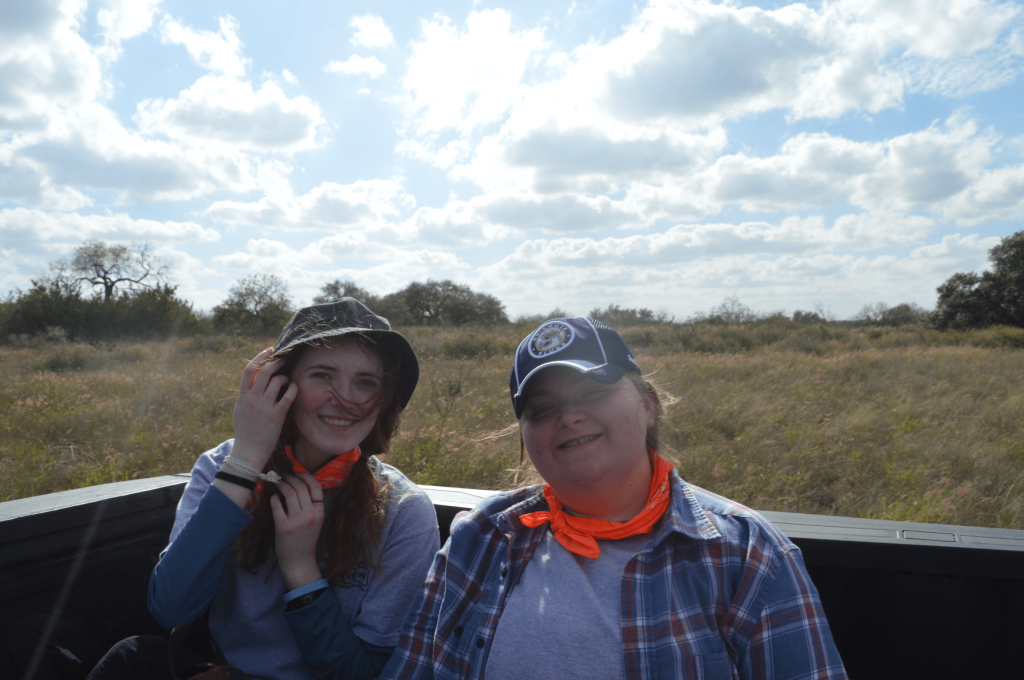
Makenna Mizell and Lilly Bucher in the back of Ray's truck
Makenna Mizell and Lilly Bucher in the back of Ray’s truck

Today was a success. The foggy weather in the morning did not define our day, and this is something that I will keep with me. Our days are subject to change and how it starts is not always how it will end. We might not have been able to give a positive ID at the moment, but we found somone who likely has family and friends that have been searching for them and a lot of things were learned. Each day will present successes whether or not a recovery is made and going into Day 3, remembering this will be especially important.

Lilly