Category Archives: Reflections

Reflections on how we feel and how the mission is changing us

Unpacking the Trip

We got back from our trip to Falfurrias late on Thursday night, but it didn’t feel like the trip was really over until I was back in my apartment, looking up at my ceiling as I tried to fall asleep. In a way, it still doesn’t feel like it has ended, as I’ve procrastinated unpacking my suitcase all of the way and it currently sits opened on my floor and blocking the door to my room–making me shimmy my way in and out every day.

The next morning there wasn’t much time for reflection either, as I headed straight into training for my job at 10am and didn’t have much time to think about the trip. It strikes me now that until this moment, as I write this, I haven’t had much time for reflection at all. I’ve been going from training to working to sleeping, and even when people ask me about how the trip was, I find myself at a loss for words for what to say.

How was the trip? What was it like? What did you find? Did you have a good time?

Members of the 2025 team preparing for a line search.

These questions and more have seemed hard to formulate responses to, and even now I’m not really sure how to answer any of them. The trip was good, I learned a lot and I still feel like I’m learning more as time goes on, but I’m not sure how to describe what it was like, and my answers feel much too simple.

It is hard to take the time to explain to others what it was that we did there and what that means when I’m still unpacking things myself.

I think when I am asked whether or not I had a good time, I find myself thinking about the team. Because, for approximately a week, they were the only people I was regularly interacting with. We woke up together, drove everywhere together, ate together, and fell asleep together. We enjoyed our Emergen-C packets at the start of every day (which I do miss, funny enough) and bonded in the evenings over how our days had been. It is easy to articulate your feelings when there are people alongside you, sharing the weight of those experiences.

My mind drifts to the migrants, their hardships, their lives, and the cultures that they are all leaving behind to come to the United States, and I feel a great sympathy for them. We spent days walking through the brush with gear, gators, compasses, and hats, drinking clean water, and dousing ourselves in sunscreen and bug spray, and even then it wasn’t an easy day of work. I find myself trying to put myself into their shoes, to think about what they experience and the hardships they face on their journeys, and I find it hard to think about. Because I’ve never experienced that, and I most likely never will.

The Brooks County Search and Recovery patch.

But above all I find myself thinking about their families, their friends, thinking about the graves that we saw at Sacred Heart Cemetery, and the beautiful decorations that adorned them. I find myself wondering about the lack of permanent gravesites for the individuals who have been lost on the journey, and what it can mean to make a crucial recovery like that.

But, as great as it can be to make a recovery, I have to remind myself that it isn’t something that happens easily and that not making a recovery is just as important as making one. While there, we made one recovery, but we also managed to clear out areas that Don was interested in searching, and I think that that is often overlooked. I know I overlook it when judging how “successful” our trip was, which seems a bit trivial in the grand scheme of things.

Beyond that, going on this trip changed my perspective on a lot of things. It is easy to think of these things as black and white, as that is often the way the border crisis is portrayed in many forms of media. Even with my own perspectives, which I once viewed to be very open and understanding, going on this trip showed me that much of my viewpoint ignores just how vast of a situation this is, one that has huge social and political implications that affect both the migrants and the people around them.

The border crisis is a multifaceted situation, one that is not easily solved by a simple law or a change in viewpoints. The work we did here may seem small in the grand scheme of things, and in a way, it may be. But the work we did here, the work Don and Ray do here, has lasting impacts on the way that the crisis is viewed, talked about, and dealt with.

It is important then to not view this as the end of my humanitarian work, but rather as the start of it. This trip wasn’t just a one-time experience–it was the start of a commitment to understanding, advocating, and helping wherever I can.

As I finally start to unpack it all–both my suitcase and my thoughts–I find myself grateful for the lessons learned and the connections made. I may not have all of the answers to the questions people ask me, and I may never be able to articulate the depth of what this trip meant to me, but I do know that the emotions felt and the perspectives gained will continue to influence me in ways I am only just beginning to understand.

The road on the way to one of the ranches.

I’m endlessly grateful to Don, Ray, Dr. Latham, Dr. Eriksen, Frankey, Chastity, and Lilly for helping me every step of the way.

Makenna

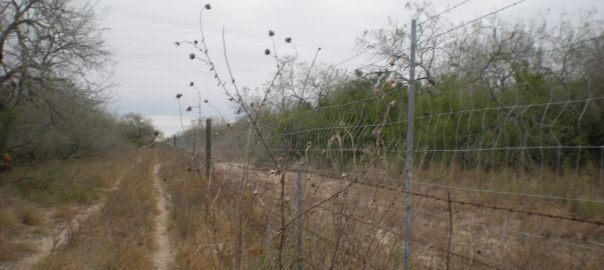
View of a two track road next to a wire fence marking the edge of a ranch.

Reflecting on the 2025 Beyond Borders Team

When I was invited to join the Beyond Borders team this year, I anticipated it would be an eye-opening experience. Despite having heard countless stories from Dr. Krista Latham and former participants, I had never fully grasped the depth of their experiences. With that in mind, I set out with two main goals: (1) to understand the history of the Beyond Borders project, and (2) to gain insight into the work my students and colleagues carry out each year.

From the very beginning of this trip, it was impossible not to imagine myself in the position of the individuals we were there to search for. Navigating the harsh environment—pushing through thorny shrubs and cacti—was challenging enough, but I am privileged to do so without the desperation or danger that migrants face. I will never truly comprehend the strength it takes to undertake such an arduous journey or the circumstances that drive people to consider this much risk.

Four UIndy team members walk through thick grass, looking at the ground, searching for a missing person.
UIndy team members walk through thick grass, searching for a missing person.
Example of large thorny shrubs in south Texas. A gloved hand is in the foreground for a size reference.
Example of large thorny shrubs in south Texas.

Throughout this trip, I became aware of realities I had never fully considered. For example, I learned that migrants typically travel at night, maneuvering through dense terrain filled with unpredictable vegetation, sinking sand, and wild animals such as large boars and coyotes. Travelers rest during the day, often seeking shelter under the low-hanging branches of thorny trees, leaving behind few materials nor any evidence of flashlights. The thought of moving through South Texas’ rough terrain without proper gear, light, or protection from wildlife is unimaginable to me.

A student examines several non-human bones.
UIndy student, Makenna, closely examines several non-human bones.

Some days yielded discoveries of numerous animal bones, which turned into impromptu teaching moments for the students to compare their knowledge of human and non-human skeletal remains. While this was engaging for a day, I soon realized that not everything needed to become a lesson, especially when it detracted from our primary goal of searching for missing persons and for signs of recent routes on which migrants might have been left behind.

One of the most rewarding aspects of this project was observing the graduate students adapt and support one another in the field. Experiential learning is a cornerstone of the Human Biology Master’s Program at the University of Indianapolis (UIndy), and this project exemplifies that. Beyond its humanitarian purpose, it fosters trust and strengthens relationships among UIndy and team members Deputy Don White and Paramedic Ray Gregory of Remote Wildlands Search and Recovery. Despite it being my first time in the field with this group, I was struck by how seamlessly we worked together. The students’ thoughtful daily reflections—both written and spoken—were a testament to their growth and the power of shared experiences.

I was especially struck by each team member’s strong qualities:

  • Chastidy’s openness: Though this was her second time on the Beyond Borders team, we shared several new experiences and her ability to verbalize her thoughts so poignantly was touching.
  • Frankey’s positivity: Even after long days crawling through thorny brush, she maintained a joyful demeanor, which uplifted the group’s morale.
  • Lilly’s resilience: After a minor mishap with camera settings during her turn as photographer, she embraced a second chance and captured the day beautifully.
  • Makenna’s responsiveness: As the line leader, she rose to the challenge, quickly implementing constructive feedback to keep us better aligned and doing an excellent job.
  • Krista’s leadership: Her ability to foster a strong team dynamic through daily exercises of reflection—what each member learned, excelled at, and could improve upon—was inspiring.
  • Don’s dedication: His commitment to helping others and in-depth knowledge of the key areas most in need of searching was invaluable. This was possible because of the relationships he built with ranch owners providing us with essential access to conduct searches.
  • Ray’s vigilance: As a paramedic, he took on the critical role of safeguarding our team’s well-being, ensuring we stayed hydrated and were safe as we navigated through remote and challenging terrain.
The team at the end of a day in the field, loading up in a truck to start the drive home. Five people sit in the back of a pick up truck bed while two stand to the left.
The team (from left to right): Krista, Ray, Makenna, Lilly, Chastidy, Frankey, and Don.

The week was not solely about fieldwork. On days when we left a ranch by mid-afternoon, we engaged in activities that deepened our understanding of the community and the project’s history. These included a guided tour of the Falfurrias cemetery where the project began, a visit to the shrine of Don Pedrito (a renowned faith healer), and a trip to the U.S.–Mexico border.

Four UIndy students take a walking tour of the Falfurrias Cemetery, guided by Dr. Krista Latham.
UIndy students take a walking tour of the Falfurrias Cemetery, guided by Dr. Krista Latham (right).

At the border, we encountered Border Patrol agents stationed at a large, gated fence. While speaking with an agent who welcomed our questions, we witnessed a patrol truck return to the U.S. carrying two individuals seeking asylum. This moment was profoundly impactful, knowing that such opportunities may soon become unavailable under the incoming administration. It left me wondering how many more people will attempt the long and dangerous trek across the South Texas plains willing to risk everything—including their lives—to seek something different and potentially better.

View of the US-Mexico border wall, with an open gate and two Border Patrol vehicles.
View of the US-Mexico border wall and gate.

There is no simple solution to this humanitarian crisis, but after this experience, I feel better equipped to speak about the Beyond Borders project with better understanding and compassion. I am deeply grateful to have been part of the 2025 team.

~AE

Thoughts from home

I woke up alone for the first time in seven days with absolutely nothing to do. 

Being back at home, it feels weird waking up without the rush of getting ready and moving around my teammates in the morning. No hotel breakfast or chatting about our plans for searching for the day, no vitamin C packets that we would drink every morning, and weirdest of all, having nothing to do. It feels wrong to not be going out and starting my day with the people I have been around for a week.

I find myself reflecting a lot about our trip. I am so proud of all of my teammates and everything we were able to accomplish over this short time. We successfully made a recovery and helped clear multiple areas of land in our searches on the ranches. Of course, the work we left in Falfurrias is never complete, and there will always be the ‘what if” feeling. What if we spent one more day, what if we searched a mile further or even just walked 20 more feet… There will always be a “what if” feeling, but we have to focus on what we did do, and use that to better prepare for future trips. Whenever I find myself thinking “what if,”  I try to think about how successful our trip was, and what if we had never gone? It is easy to get caught up in the “what ifs,” but there will always be something more we could do or could have done. It feels wrong to be here in Indiana, in my home with my heater on, with access to water, food and everything I need. Sitting here, knowing there are so many people that do not have those things, and thinking about the people who risk their lives everyday coming to the United States in hopes of a different life. 

The day feels heavy in my heart. I wish we could have stayed longer, but there will always be the idea of one more day. I am forever grateful for the days I was able to spend in Falfurrias. I learned so much about the wildlife, the area, the food, the culture, the people who live there, and more about the political climate and economy in South Texas. I was able to learn so much from Don and Ray, who are out in the field year round searching for the missing. 

Searching under the trees to find artifacts left behind

Although I will never truly understand what it is like for the people risking their lives to get into this country, I was able to see the artifacts they left behind, and how hard it was to find them. How socks, belts, bags and shoes were abandoned in the brush. Not in an open field or on a path, but underneath thorns and branches surrounded by cacti and scorpions. How food cans and bottles were left in spaces you could only crawl to get into. How the barbed wire fences were pulled down and articles of clothing were stuck in bushes. Even seeing all of those things, it is still impossible to understand how many people have made that journey and what each journey entailed. Where we were, there is no such thing as just crossing over. This trip not only opened my eyes to the situation, but changed my perspective on things I thought I knew. Although we were only there for a short time, I know this trip will stay with me and my teammates for a lifetime. 

Frankey