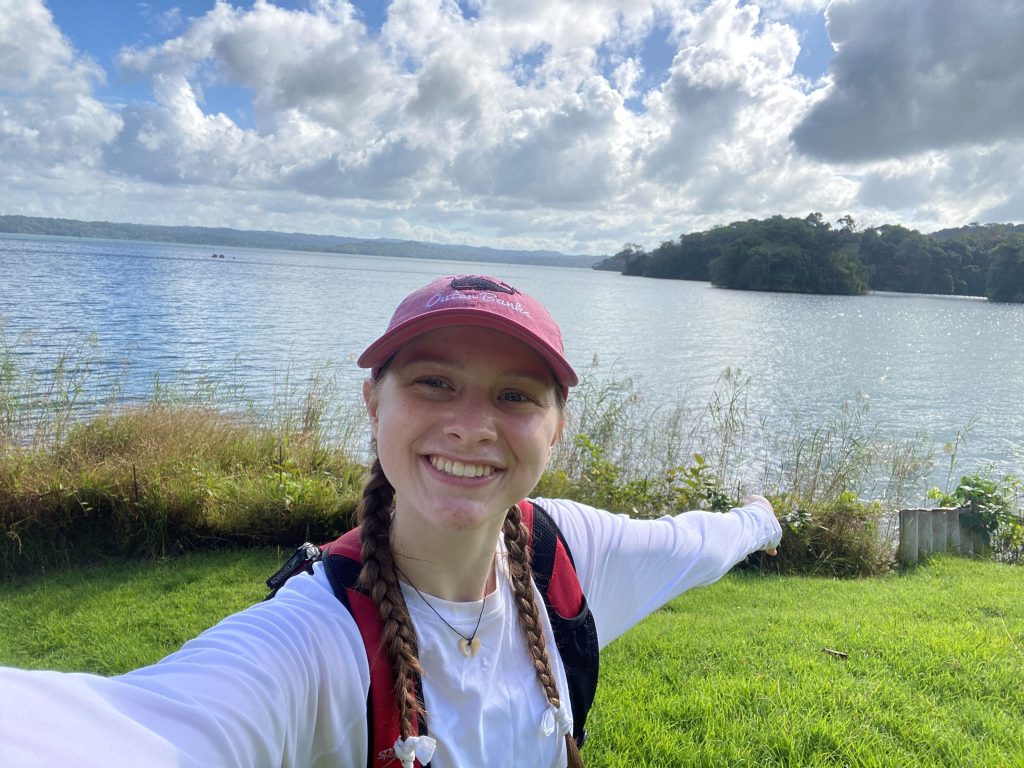
Amanda Walker
- Expert Role: Rookie
- Major: Human Biology
- Class: Graduate Student
- Hometown: Mineral, Virginia
Why is this humanitarian work important to you?
I will be the first to admit that I grew up extremely privileged. However, my parents worked hard to ensure my brother and I understood the importance of giving back to those in need. My father immigrated to the United States from England in his 20s under circumstances that allowed him a straightforward immigration process. I recognize that this experience is not universally shared; many experience systemic inequalities that make immigration more difficult and dangerous. For many people crossing the southern border, the process is anything but straightforward and is shaped by systemic barriers, instability, and dangers. Becoming more aware of this contrast has deepened my commitment to supporting humanitarian work with compassion and empathy. Through this work, I hope to help affirm that every human deserves basic human rights and to honor the identities of those who are no longer with us. I want to support the individuals and families whose lives have been impacted by the dangers within the system. Everyone deserves safety, dignity, and humane treatment, and the chance to live free. This work aligns with my core belief that every person deserves dignity in life and in death. Every lost life matters and deserves justice, and I hope to meaningfully contribute in any way I can to ongoing humanitarian efforts at the Texas border.
What do you hope to gain from this experience?
UIndy has a strong commitment to providing experiential learning opportunities to its students, as being immersed in the field is incredibly beneficial. I believe the opportunity to engage directly with the political, scientific, and social aspects of forensic anthropology will provide a level of experience I cannot gain in a classroom. I also think it will bring clarity to my future academic and career aspirations. One reason I love the work forensic anthropologists do is their constant dedication to helping people in need. I hope to deepen my understanding of the importance of this work and gain a better sense of how I can positively contribute to the field.
What are some of the biggest challenges you will face while in Texas?
I have never been to Texas before, or anywhere near the southern border, so I recognize I’ll be entering a community different from my own. I want to approach that with an open mind and resolve any preconceived notions I may have.
What’s one thing people probably don’t know about you until they’ve known you a long time?
When I was in high school, I made TikToks. A lot of them. I had one video that reached over 1 million views, livestreamed multiple times a week, and even made $9 from the app. If you thought that was crazy, I wrote my college essay about that one TikTok and somehow turned it into a success story of overcoming my struggles in high school (while adding in a few silly jokes). And if you thought that was crazy, I ended up being awarded a scholarship from my undergraduate school that was primarily based on that application essay. I am retired now, but it was definitely a fun time in my life.
When did you know you wanted to pursue human biology as a degree, and how did you become interested in forensics?
Ever since I was about 10 or 11 years old, I wanted to become a doctor. At this time, I was particularly interested in dermatology and later became interested in emergency medicine after becoming an EMT. I spent my high school years preparing to go to college as a pre-med/biology major. When I was accepted into Elon University, that is exactly what I did; I majored in Biology on the Foundations for Medical Sciences in the Human Discipline track and added on a Psychology major just for fun.
Throughout my time at Elon, I had always been interested in forensics, but never considered it as a career; it was more of a hobby. In my junior year, I was accepted into Elon’s study abroad program to go to Panama and study field biology for three weeks, and I was so excited. I knew I had wanted to study abroad, and this course felt right for me. I spent three weeks in the forests and oceans of Panama studying plants, insects, and coral reefs. When I returned to North Carolina and reflected on my study abroad experiences, I realized this trip had a bigger impact on me than I initially thought. I loved being in the field, collaborating with a team, and collecting data. Suddenly, my lifelong dream of working as a doctor in a hospital or office did not sound so appealing anymore.
As I struggled with the idea of changing my career path in my junior year, I thought about what other career paths would allow me to use my passion for biology, anatomy, fieldwork, and helping people. After a lot of research, I eventually realized the answer had been right in front of me. My interest in forensics already had me watching videos, researching cases, and scrolling through NamUs- so why not pursue it further? In my senior year, I took a forensic anthropology class and instantly fell in love. My professor and I became close very quickly, and she helped me search for and apply to graduate programs focused on forensic anthropology. I was accepted to UIndy and the rest is history! I love where I am, what I am studying, and the path I am on.
What advice would you give other students interested in pursuing a human biology degree at UIndy?
If you ever have the chance to do something outside of your comfort zone, take it! Don’t be afraid to change your mind or your career path; it truly will work out in the end. Also, don’t hesitate to ask our professors questions. They genuinely want the best for you and will do whatever they can to help. I sent so many emails with so many questions, and the professors were so thorough and thoughtful in their responses. We all love meeting prospective students and getting to know you, so definitely take the time to schedule a meeting or visit!
What makes UIndy’s human biology program distinctive?
UIndy’s human biology program had everything I wanted in a graduate program. I specifically chose it because of the integration of biology, forensics, and anthropology. I was interested in working with active forensic casework, expanding my knowledge of human anatomy, osteology, forensics, and learning the importance of the field of forensic anthropology. Our program attracts students from diverse backgrounds and prepares them for careers in forensic science, teaching, humanitarian work, higher education, and more. I love being able to customize my course load to fit my specific goals, take on leadership opportunities, and have the option of completing a thesis. I also love how close-knit our program is. There are six students in my cohort, and we are all incredibly close with each other, our professors, and students in other cohorts.