Category Archives: General

General Postings

The Stories I Carry Beyond the Border

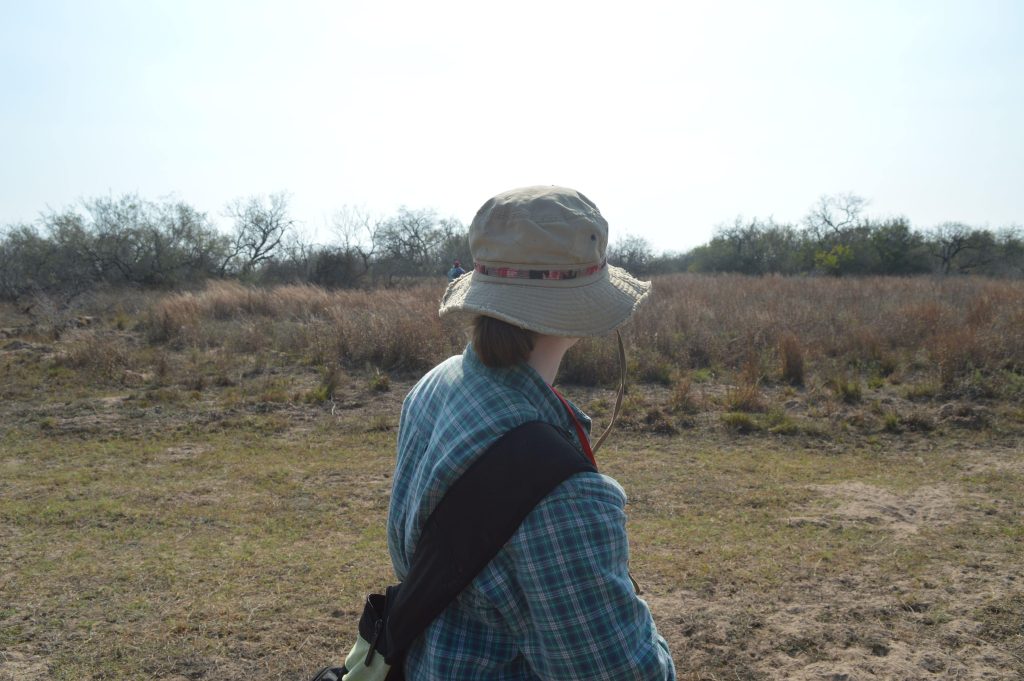
Taken from behind, Peytin stands looking out at the vast ranchland
Peytin looking out at the vast ranchland

Coming back to Indianapolis has been surreal. With the semester starting in just a few days, returning to a life of readings, laundry, and studying has felt trivial, knowing essential and valuable work continues to occur in Brooks County. My first thought waking up this morning was whether Don and Ray had geared up for another hot and grueling day on the ranches, hoping to provide families with more information about the status of their loved one(s). I was a bit saddened by this thought, thinking about how quiet it must feel for them after a week with a 10-person crew. Returning to my distraction-filled apartment has felt a bit isolating, so I can only imagine how lonely it must feel in the vast, seemingly infinite ranchland, filled with reminders of the trauma endured by those in search of a better life. Being amongst these spaces and seeing the residual artifacts left behind by migrants was extremely emotional. Having to grapple with these emotions while dealing with the physical exhaustion caused by traversing such rugged land has provided me with a greater empathy and respect for both migrants and individuals like Don who are committed to the search and recovery of migrant remains.
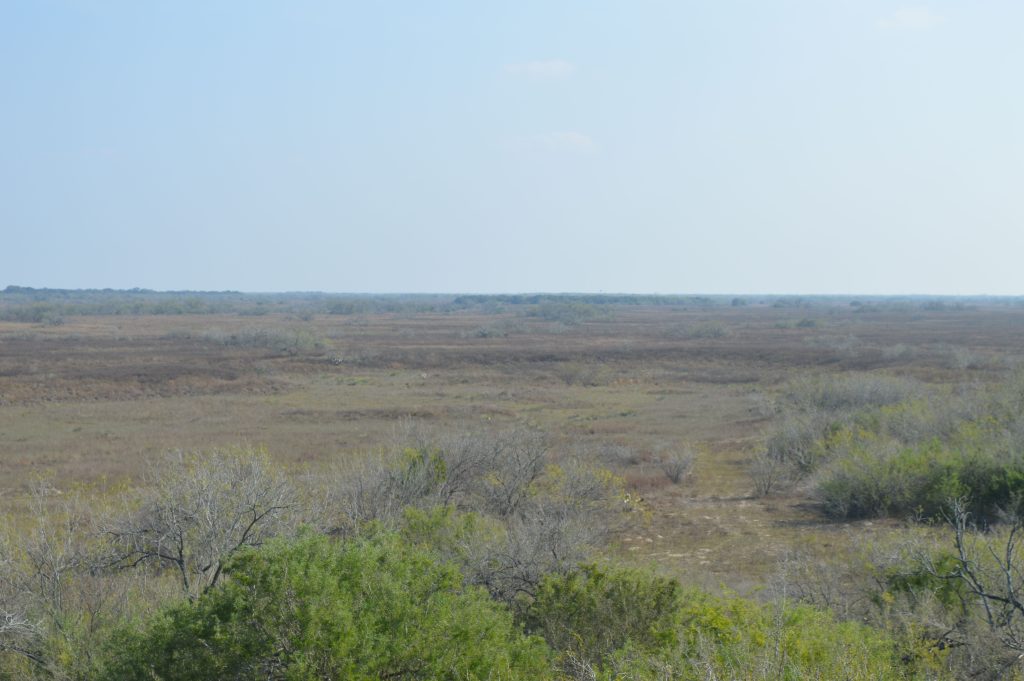
A view of the ranch from an observation deck, showing the ranchland traveling off into the horizon
A view of the ranch from an observation deck
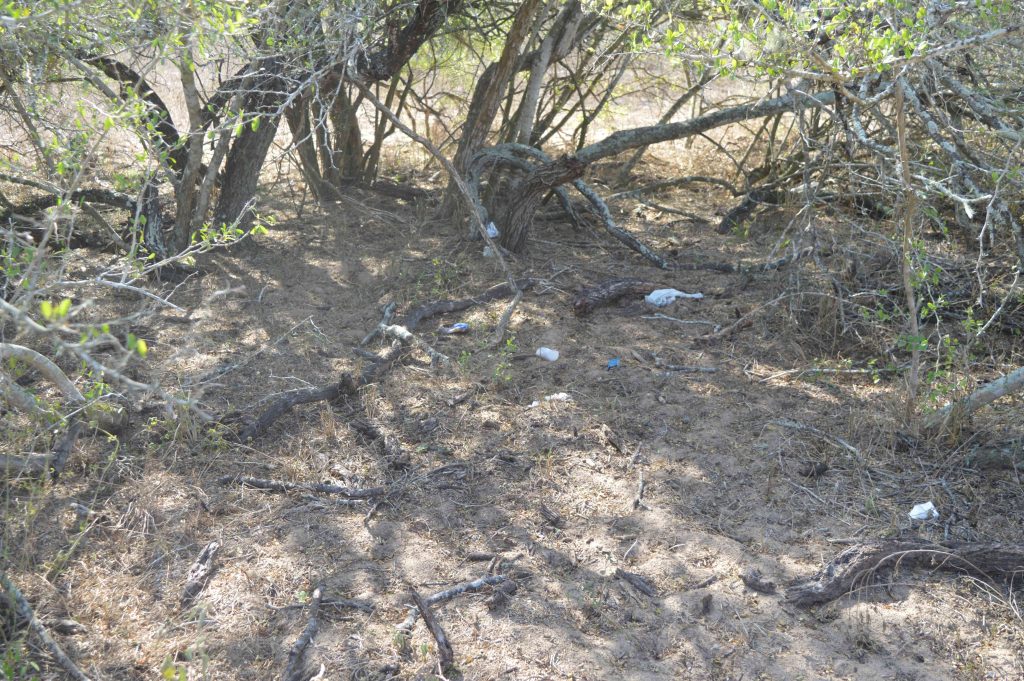
Motte that was used as a layup with discarded items left behind
Layup with residual artifacts present

Coming into this trip, I committed to preserving the stories of those I encountered, directly and indirectly, in Brooks County. To uphold that vow, I wish to share some of the most poignant moments from our trip and the emotions they stirred. Despite the previous knowledge I had regarding this humanitarian crisis, no level of research could prepare me for entering this harrowing space and seeing the reality of a migrant’s journey.

One of the most powerful experiences for me during the trip was on Day 5—our last day on the ranches. After several hours of not finding any signs of activity, Melissa alerted us to a layup she and Danny had located, containing black trash bags and a few pieces of clothing. Entering the layup, I expected the trash bags to look similar to the others we had found—discarded, brittle, and ripped. However, these trash bags were relatively new and had purposeful holes in them—one to go over the head and two to put the arms through. Don informed us that the bags were used as ponchos and likely discarded by a group of migrants as they exited the motte to continue their journey.
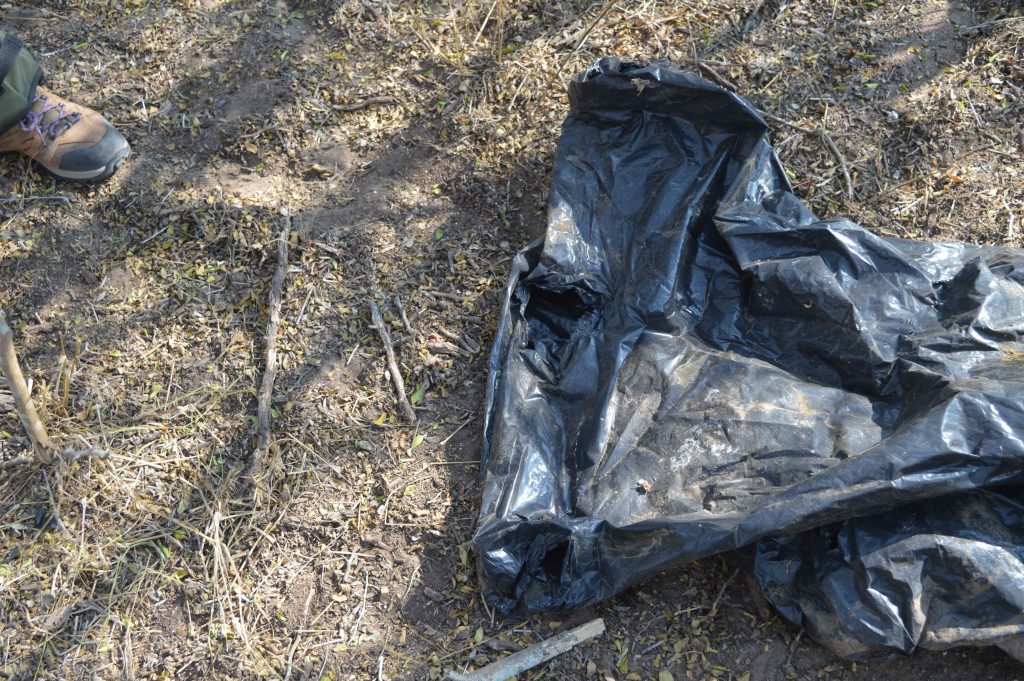
Trash bag found in layup with a hole in it to place one's head and two arms to place one's arms
Trash bag found in layup with holes in it to serve as a poncho

What struck me wasn’t necessarily the bags themselves, but their spacing. Rather than being thrown together in a pile or placed sporadically, the bags were organized in a somewhat circular shape, with bottles and clothing surrounding them. Standing there, I felt as though I could sense the people who once sat in that space, wearing those bags and taking a much-needed rest from their tiresome journey. This moment was very emotional for me, knowing these individuals had likely placed their lives in the hands of a coyote, accepting the likelihood of violence and potential for death. Given how far into the ranch we were and the conditions we had endured thus far, I hoped that wherever these individuals were, they were safe, healthy, and near the end of their journey. 
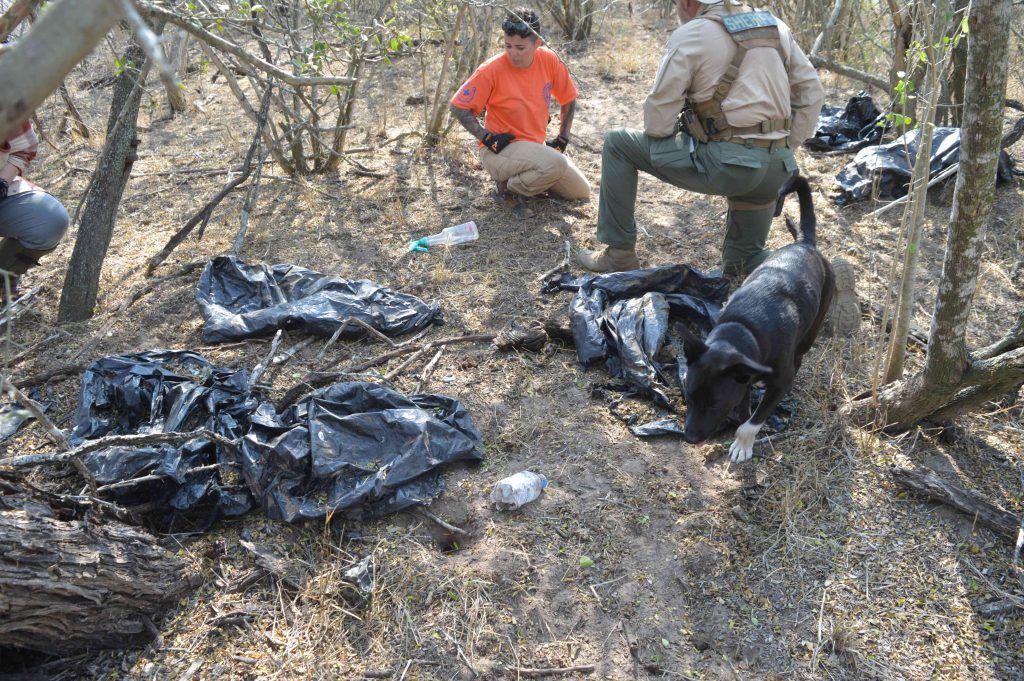
Melissa and Don look at trash bags within a layup
Melissa and Don looking at trash bags within a layup

Another profound moment for me was visiting the Sacred Heart Burial Park in Falfurrias, where the past Beyond Border teams had performed numerous exhumations of unidentified migrant remains. Stepping out of the van, I could feel the simultaneous love and loss radiating from the cemetery. The graves at the burial park were unlike anything I had seen before. They were heavily adorned with flowers, items the individual enjoyed during life, family mementos, and religious paraphernalia. Many graves often featured benches where family members could sit with their deceased loved one(s), indicative of how important and present these individuals remain in their families’ lives.
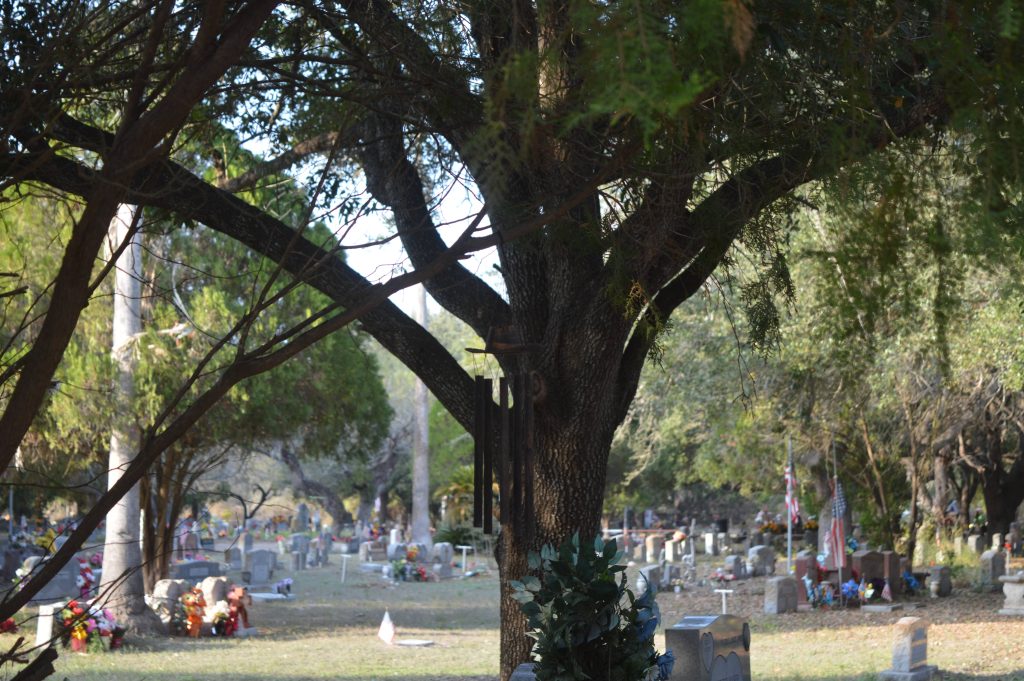
Wind chimes hanging from a tree at the Sacred Heart Burial Park with adorned graves in the background
Wind chimes hanging from a tree at the Sacred Heart Burial Park in Falfurrias

Witnessing this level of devotion, I thought about how many families are left without answers or the opportunity to properly grieve and bury their loved ones who have died while attempting to cross the southern US border. Dr. Latham taught us about Wilmer Guardado, a deceased migrant who was circumstantially identified due to an ID associated with his remains. Wilmer’s grave is still marked by the original temporary metal placard, pale and lonely in comparison to the graves around him. I found myself imagining how Wilmer’s grave might look if his family were aware of his death and burial in Falfurrias, and how both Wilmer and his family have been deprived of that connection due to the sociopolitical complexities surrounding migrant death.
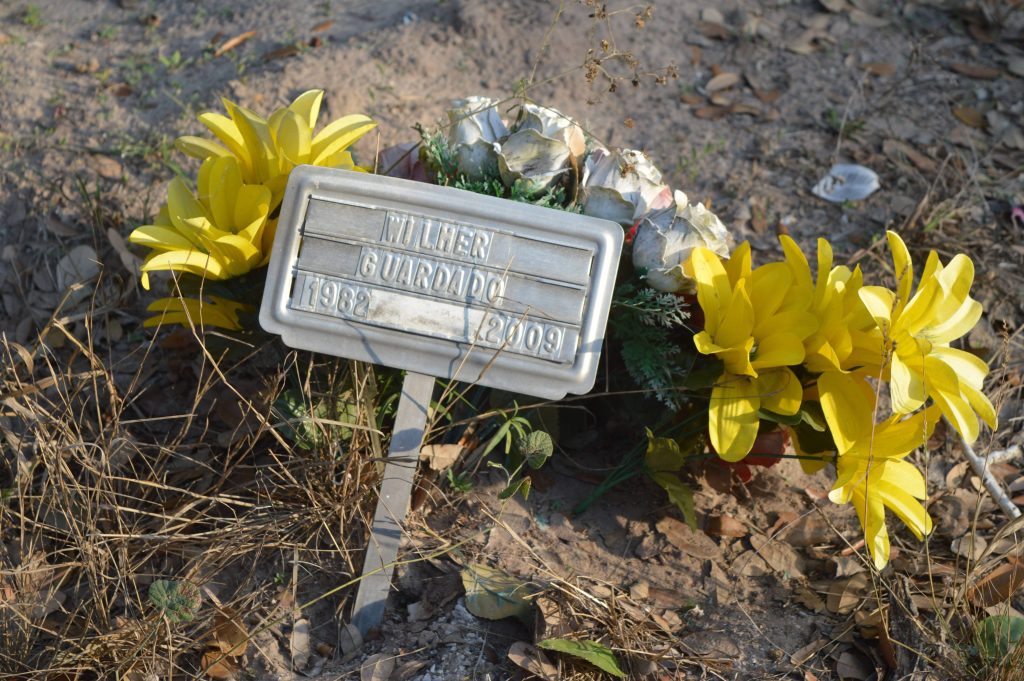
Metal grave placard with "Wilmer Guardado 1982-2009" surrounded by yellow and white flowers
Wilmer Guardado’s metal grave placard at Sacred Heart Burial Park

Without experiencing this complex sociopolitical environment firsthand, it is easy to question why more work isn’t being done to recover and identify these individuals. Coming into this trip, I had significant background knowledge about this humanitarian crisis and the variables that shaped the response of areas like Brooks County. Knowing that law enforcement and non-governmental organizations were overwhelmed in this area due to a significant number of migrant deaths, lack of funding, inadequate forensic resources, and privatized land composition, I expected Brooks County to be an area of neglect. However, this trip showed me that this is anything but the truth. I realize now that individuals like Don, Ray, and Melissa are doing everything possible to help reunite fallen migrants with their families. While their work may not be widely recognized, it does not go unnoticed by those they have helped reunite.

I feel extremely humbled to have shared this experience with Don, Ray, Melissa, Reed, and the 2026 Beyond Borders Team. Through the knowledge and experiences I gained on this trip, I hope to address the purposeful ignorance many Americans have regarding this humanitarian crisis. This intentional ignorance has allowed for the injustices occurring at the southern US border to continue for decades, separating families under the guise of border security. However, it is simply a lack of care for others that obscures the truth. While I cannot always be in Brooks County, assisting directly in the search and recovery of fallen migrants, I strive to care for these individuals by sharing what I’ve learned with others.
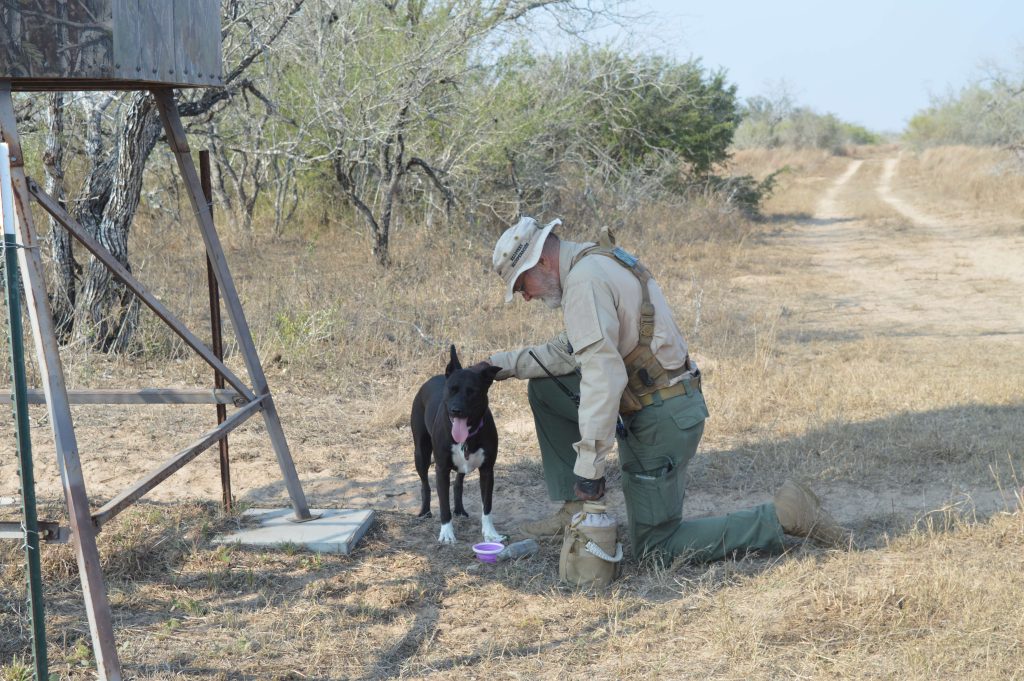
Don takes a knee to give Socks some water
Don and Socks

Peytin

What Is Left Behind and What We Carry With Us

Content Warning: This post contains references to sexual assault.

I woke up at 3:30 p.m. today. Yes, literally 3:30 p.m. I slept for 16.5 hours last night. After arriving back in Indianapolis, I felt exhausted and desperately in need of a shower. I decided that everything in my suitcase needed washing, even technically clean items, because everything felt like it was coated in dirt and smelled like sweat. That was after spending only five days intensely searching the remote Texas wildlands.

Every conversation I had opened my mind to perspectives I had never considered before. I intentionally asked Don and Ray difficult questions about what the journey for migrants entails, how coyotes operate, why people cross the border, and what they have witnessed through years of fieldwork. Each day, I learned about new hardships migrants face, including how they navigate the vastness of ranches and the challenges that follow.

Vastness of the ranches in the Texas border lands
Miles of remote Texas wildlands

The food, water, and belongings migrants carry are carefully calculated to minimize weight, conserve space, and remain essential. We saw countless empty tuna packets, cans, water jugs, discarded clothing, and other items. Every object brought serves a purpose, and once that purpose is fulfilled, it is often left behind. The less weight carried, the less energy expended. I also learned about the extreme measures people have taken in attempts to cross border checkpoints: hiding in small, concealed spaces inside vehicles, breathing through straws while submerged in barrels of sewage, and other dangerous conditions. Many of these attempts end when border patrol dogs detect them. Because of this, traveling through ranches is often viewed as the “safer” option, despite the prolonged exposure to heat, limited shelter, and scarce food and water.

American Eagle shirt turned inside out as to indicate it was taken off
American Eagle shirt turned inside out

One day, we came upon a very distinct tree. Certain items of clothing were on the ground and hung in its branches. I felt confused and unsettled. I didn’t even think about sexual violence. I was aware of the hardships of navigating the harsh environment and how physically and mentally exhausting it is to partake in the journey. I failed to consider how coyotes treated migrants during this journey. At this tree, a migrant’s personal items suddenly turn into a heinous message, a system to warn others what happens when someone disobeys the coyote. 

Blanket tied to a tree

Coyotes are supposed to be the ones to protect and help migrants cross the border. However, if a migrant pays them upfront, they become expendable and their payment can be used against them. If they wait to pay in full later, a migrant may be extorted for more money than initially agreed upon and forced into a human trafficking situation. Neither is a safe option. The thought about being tired, dehydrated, and afraid, only for one’s autonomy and dignity to be stolen, has stayed with me. Migrants are aware that this major risk exists and that it is common. Some even take preventative contraceptives before embarking on the journey- just in case. It is painful to confront how broken the system is when individuals feel compelled to place themselves in such vulnerable positions, enduring the abuse by those who hold power over them. Migrants often know the risks and still proceed to leave their current situation. It forces me to reflect on how desperate their circumstances must be to make risking their lives feel like the only option. Migrants do not want to cross the border illegally; many feel they have no other choice. From the stories shared by Don and Ray, when a migrant is found alive in the field, many are done and want to be turned in so they can go home. 

Finding remains adds another complex layer to this work. I have learned how bone scatters may appear, how sand, brush, and cacti may conceal bones, and how animals transport them. Rats often carry long bones to build their nests. Larger predators tend to move bones into protective spaces for eating. Some predators will ingest bones altogether, making it unlikely to find certain bones. I was surprised by how easily bones can be hidden. Bones can roll from strong winds, be stepped on by animals, or even be covered up by natural debris like blowing sand. The movement, location, and condition of the bones tell a story. I also did not fully understand how bright-white a sun bleached bone looked until seeing them for myself, as they closely resembled the bone casts we use in class. 

Non-human bones scattered in the distance

Throughout the trip, I felt an immense amount of privilege to be surrounded by my team every day. We all looked out for each other while also serving those who lost their lives on the journey. Every day, I had proper gear, plenty of water, protection, and nutritious food, and I was still struggling. By midday, I was usually already physically and mentally exhausted. However, I stayed grounded in my values. I showed up every day ready to work and empowered to make a difference. 

Amanda with Texas brush around her
Amanda hiking through tall grasses

The conversations, emotions, and experiences from this trip will stay with me. I will carry them forward to educate others and shape my future work. I told someone today that there is absolutely no combination of words that could truly convey what I experienced. You will never fully understand until you’ve experienced it for yourself. I left nothing behind on this trip, as every part had an impact on me. I will move forward with intentionality and respect, not only those who cross the border, but those who search for them. I will cherish my memories with Don, Ray, Reed, Melissa, and the 2026 UIndy Beyond Borders Team. I am deeply grateful for this opportunity and cannot put into words the emotions and growth I have experienced this trip. This experience has changed me; I have a responsibility now to continue to learn, educate, and stay up-to-date on what is happening at the Texas border. Ultimately, I strive to carry what I have learned forward in ways that continue to make an impact and ask hard questions to think deeply and reflect on my time in the Texas borderlands.

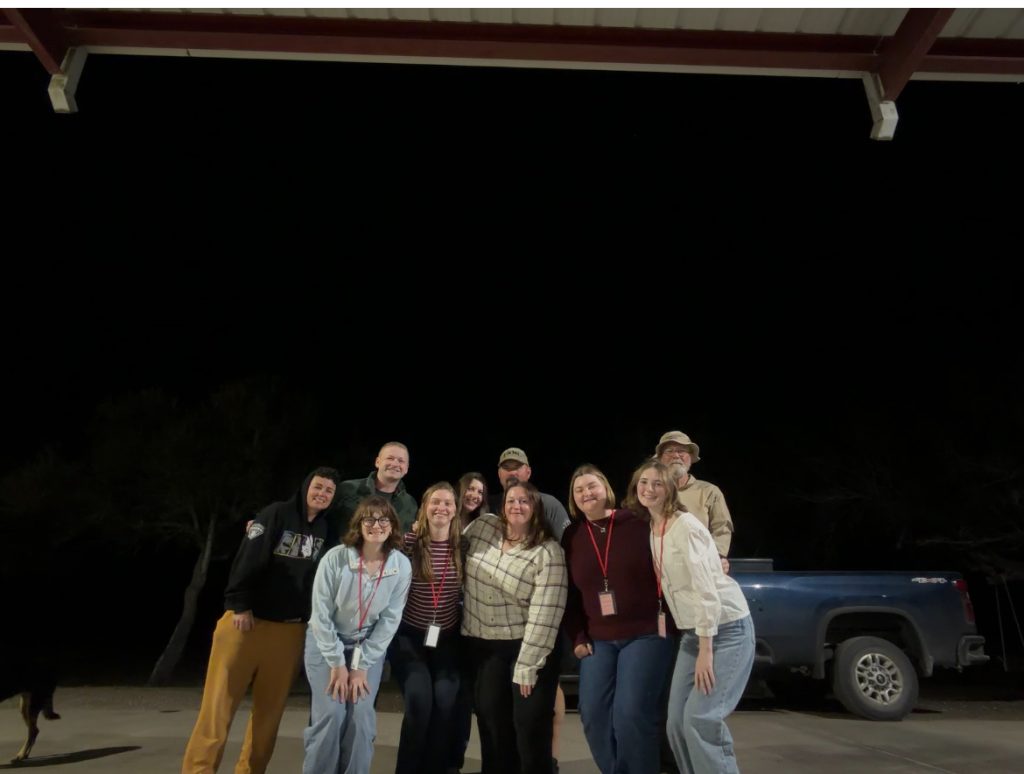
The Beyond Borders 2026 Team poses under the night sky for the last time
The Beyond Borders 2026 Team

Amanda

P.S. I did get plenty of dog time through Socks and Oakley, who were both very cute and sweet girls.

Amanda and Socks
Amanda and Socks

She is just so cute!

Day 4: Looking Beyond a Border

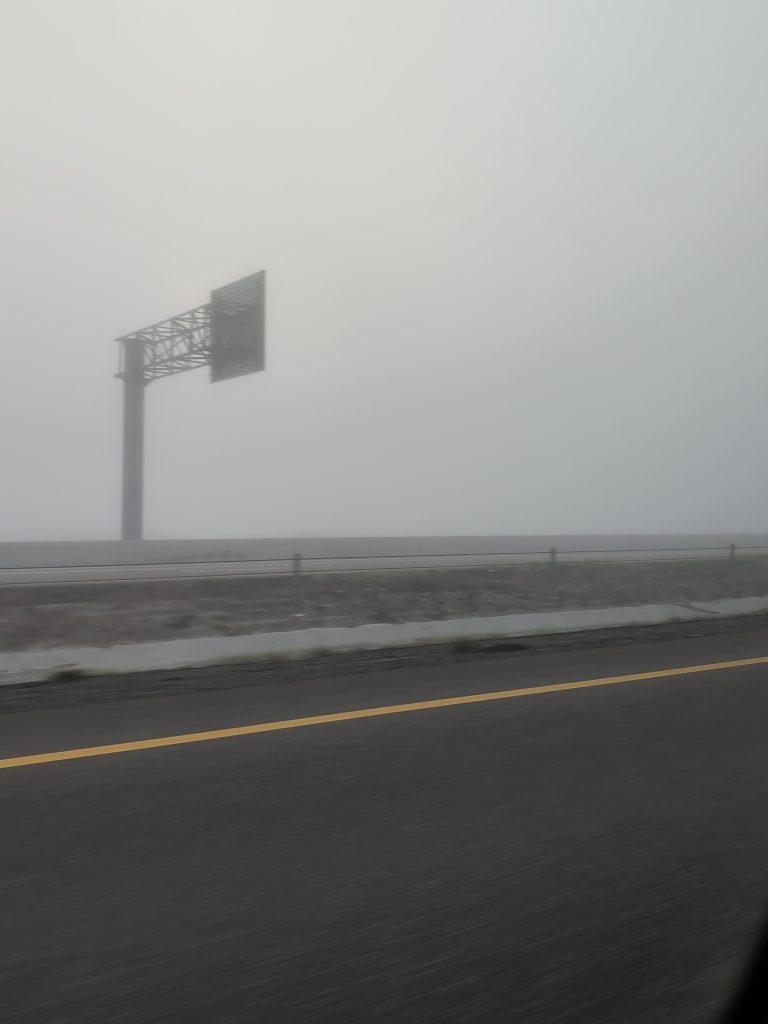
Similarly to yesterday we had a later start than we did the first work day. As soon as we walked out of our hotel room this morning, we were hit with a dense fog so thick we could barely see the adjacent hotel rooms. Even the entrance of the hotel wasn’t visible as we made our way to breakfast. Where we would usually discuss what ranch we were going to go to that day and the circumstances surrounding the search, we were informed of a change in our typical day. Because of the changing ranch availability, there was an opportunity to begin our day by visiting the border and searching in the afternoon. So after breakfast, we went to pick up Reed and then we began the hour and a half drive south. 

Fog obscuring the drive to the border.
Fog obscuring the drive to the border, blocking the view of ranches that are next to the highway.

As we drove, I examined the ranches we had passed on the highway for the past three days and thought about the constant barriers that exist to individuals who are trying to traverse these massive expanses of land. Because the land is mostly flat, coyotes will lead migrant groups through easily identifiable structures such as power lines, gas lines, and wind mills. On a perfectly clear day (as our trip has been thus far) being able to locate these identifiers was still extremely difficult unless you were very close and not under the brush cover. Looking out onto the highway and the ranches, where we could only see about 50 feet in front of us because of the fog, I couldn’t help but reflect on the shifting circumstances migrants face while walking. We are lucky that we have Don and Ray who know the terrain and can guide us when we feel lost (which I do most of the time) but migrants who are left behind by their group don’t have anyone to tell them what to look for. And if they cannot return to the path their group was taking, they may wonder indefinitely. 

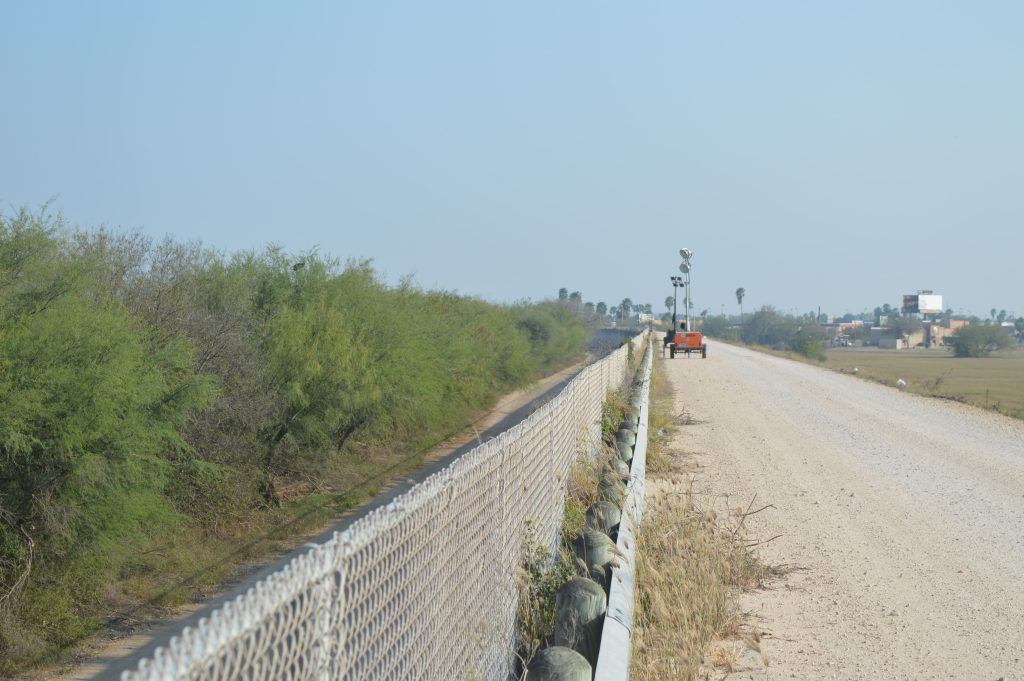
The fence located at the southern US-Mexico border.

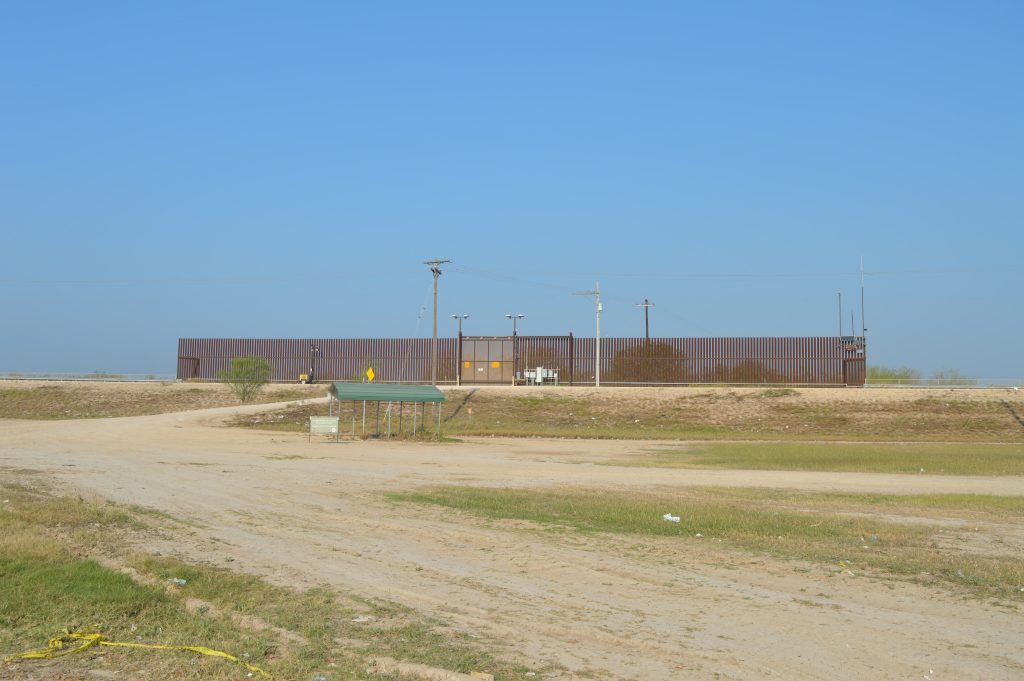
Having this on my mind when we arrived at the border provided a more introspective experience than I was expecting. Unlike last year, when we arrived there was no one at the gate. We parked and were able to walk all the way up the hill that the gate and fence sits on to look through. While we were able to see Mexico, the other side of the fence we were looking to was still US territory, with the actual border being about a mile away. As we looked, a border patrol agent started to drive towards us. We worried that we would be told to leave or questioned about why we were there, but he told us that since traffic over that area of the border had been very slow, we could walk to another gate in the distance for a chance to see the Rio Grande river. We headed to the other gate on the dirt road that runs along the fence, but we couldn’t see the river. However, we could see the incredibly tall and dense vegetation that lay on the other side of the fence.

A checkpoint at the US-Mexico border.

This was the beginning of a migrants journey in the US, and seeing how hostile it is from the get go was hard to imagine. In our searches, where we are equipped for dealing with the vegetation, the heat, the vastness of the land, and the chance of changing weather conditions, migrants are not. We see the proof of their adaptability in the artifacts we find on the ranches and at the wall itself. This is another moment in our trip that I found myself affected by the evidence of trauma and resilience migrants face in their journey.

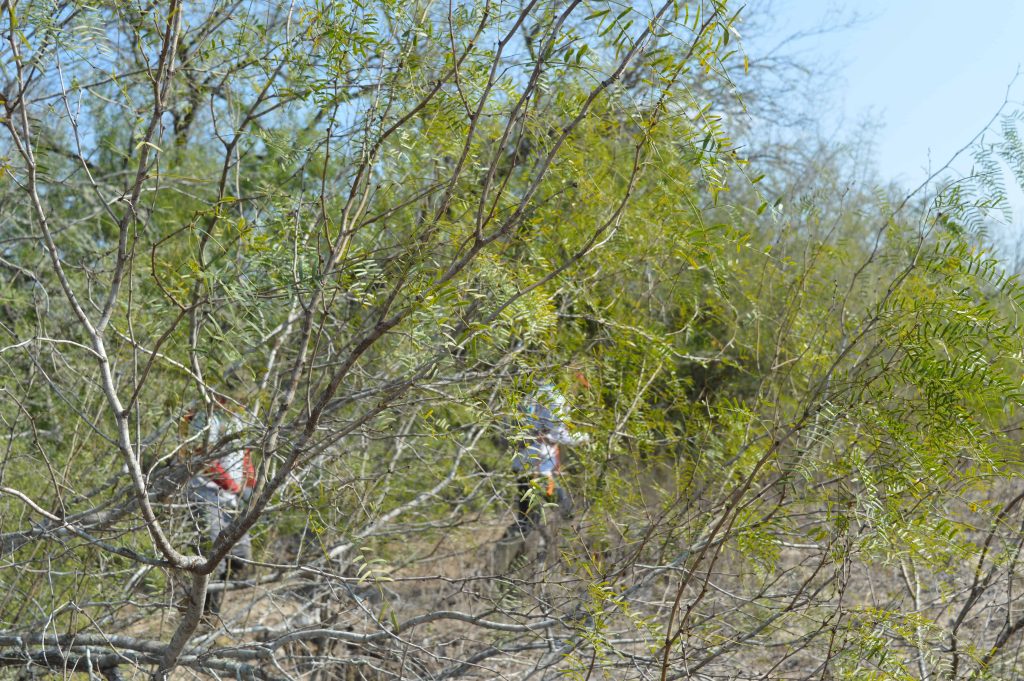
Thorny trees in the field.
Thorny trees in the field, almost obscuring team members from view.

While we were at the border, we had to continue the tradition of stopping at Delia’s for fresh tamales. We needed to be back at the ranch to meet the rest of the team at noon, so with our tamales, we headed back to Falfurrias. The ranch we were going to search had hunters coming in at 3:30 pm, so as soon as we got back to Don, Ray, and Melissa, we headed out. Don brought us to an area where he had searched the base of a hill, but had not been able to check the hill itself. There had been previous recoveries to the south and to the east, so it was important to clear this middle section of land.

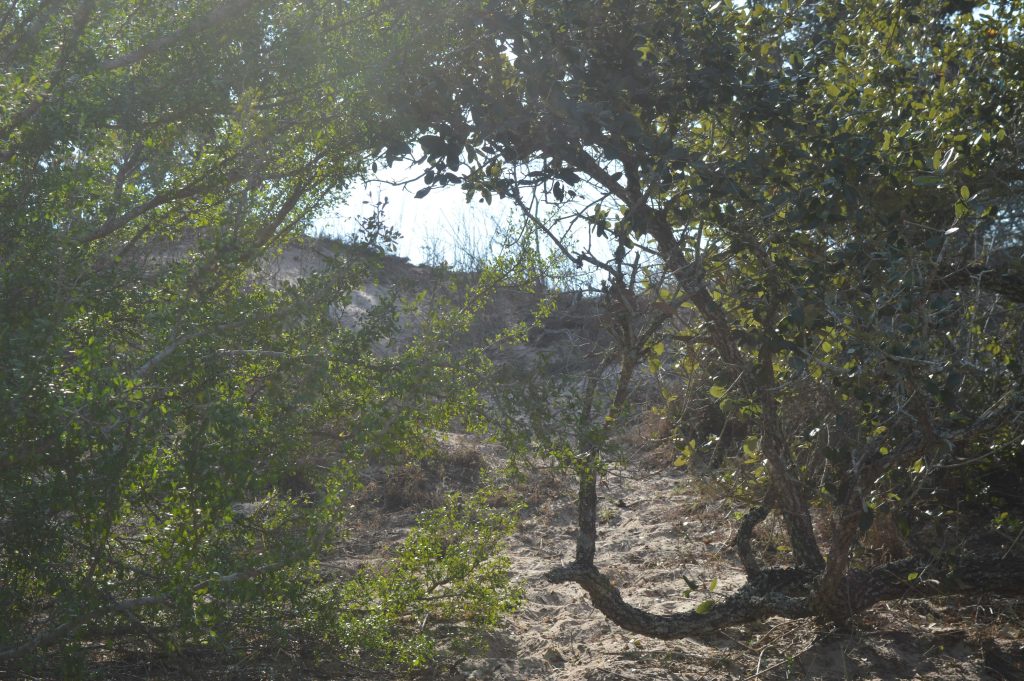
A thicket leading to a sandy hill.

The terrain was immensely different from what we have covered thus far, with the landscape being hilly while still being covered in sand. The brush was dense and thorny and any flat land that we encountered was covered in dense high grass. We conducted an unsystematic search of the hill, as the vegetation was too thick to effectively get through in a line search. So today it was crucial to keep an eye on at least one member of the team while thoroughly searching. We were able to systemically line search the open areas to assess the presence of artifacts. There were a few items found along our search, proving that this had been an active pathway. We reached the time we were allotted to search this ranch, and returned to the ranch Don, Ray, Reed, and Melissa were staying on to divvy out our tamale haul and replenish our energy.

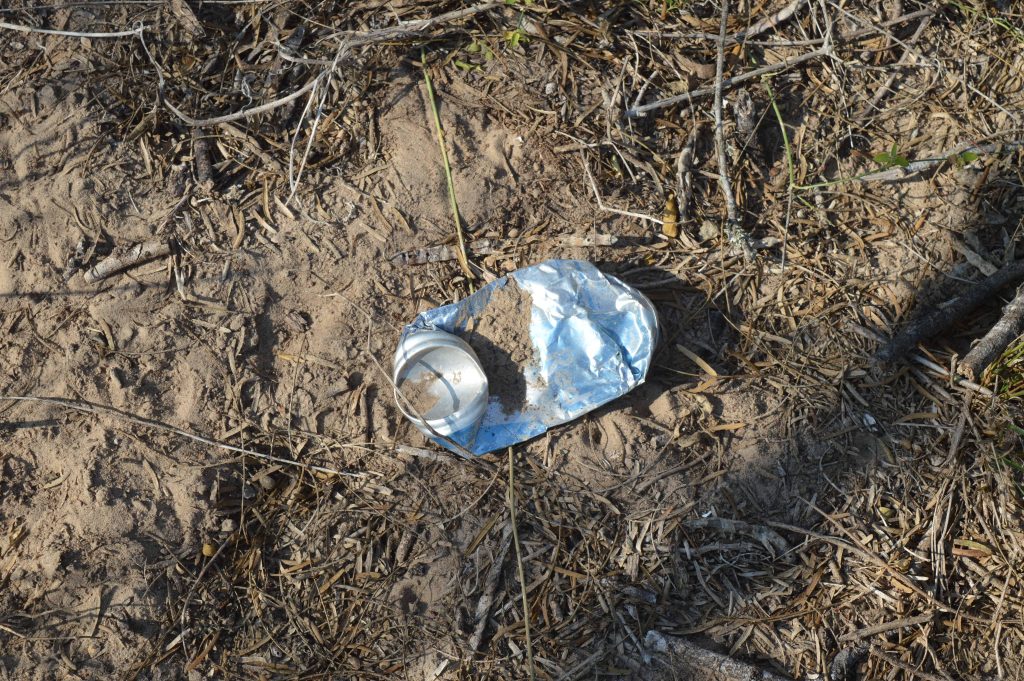
An older can found in the field.
An older aluminum can found in the field.

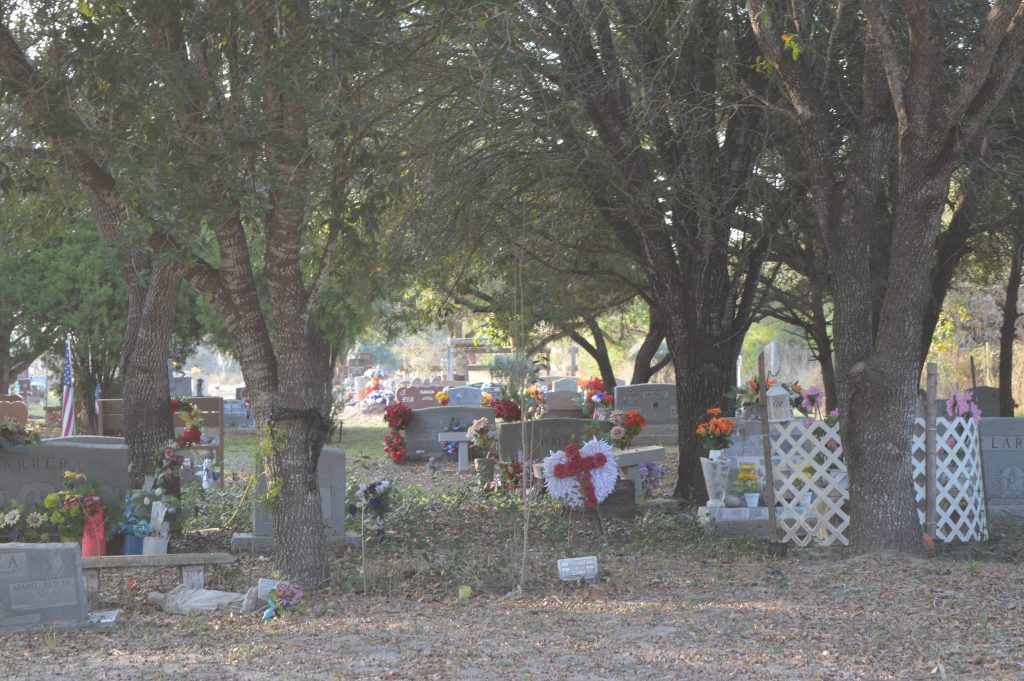
We finished searching earlier in the day, which gave us time to visit the cemetery that started it all. Sacred Heart Burial Park was the very first place UIndy was able to work at in Falfurrias. Dr. Latham showed us each place where UIndy had excavated and took the time to explain the circumstances surrounding each excavation. We started by visiting the grave of Wilmer, a migrant who was potentially identified. We put flowers on his grave and gave a moment of silence and remembrance to the individuals found in the earlier excavations. Each grave is decorated with things that that person enjoyed in life, bright and beautiful flowers, and a multitude of arches and decorations to show how loved each individual is. Even though I had visited the cemetery before, it was still an experience that elicited strong emotions in me. Knowing that UIndy was brought here because people cared so much about the migrants who died here and seeing this community that cares so much for their loved ones is beautiful and puts our shared and differing experiences into perspective. 

Sacred Heart Burial Park

After the visit to the cemetery, we returned to the hotel to clean up from the hot day and get ready for our evening plans. Tonight, we were able to take out Don’s drone. He taught us how to fly it and how to spot different animals in the brush using infrared vision. Bonding with the whole team, where we could share stories and discuss our lives in an informal setting was memorable and was a great bonding experience. 

Beyond Borders 2026 team at the end of day 4.
Beyond Borders 2026 team at the end of day 4. From left to right, Amanda, Peytin, Makenna, Lilly, Amandine, Krista, and Reed.

Today was an unexpectedly busy day. Not only were we able to search, we also went to places where we were able to reflect more on the work that we traveled here to assist with and the individuals that we are doing it for. All of our experiences from this trip and the people I have met have made this field season incredibly unique and this has been a great group of people to work with. Our experiences have been incredibly memorable so far, and I have learned a lot from them. I will carry these reflections with me as we continue into our last day and beyond as we return to Indy.

Lilly