Category Archives: Reflections

Reflections on how we feel and how the mission is changing us

Once More Unto the Breach

I have been given the extraordinary privilege of travelling back to Texas with the University of Indianapolis team.  Once again, I must prepare myself for the trip.  Some of the preparations are simple.  Packing is easy.  I do it the day we leave, so I usually only forget a couple of items.  Coordinating travel and hotels is effortless, mostly because Dr. Latham does all of that work (so I literally put in no effort, Thanks Krista!).  For me, the difficult part is preparing my mind for the journey.  It is a strange mix of emotionally taxing and immensely gratifying.   In order to plan, first I need to know what we’re up against.

Even with Dr. Latham’s meticulous planning, much of our agenda in Texas is up in the air.  This is an intentional decision that allows our schedule to be fluid and adapt to whatever circumstances arise.  The first leg of our journey this year will take us to Texas State to assist with the cleaning and analysis of the remains that we helped excavate over the previous years.  I really look forward this part.  Over the last couple of years, I had the pleasure of getting to know some of the amazing students and professors from Texas State, and I am honored to have the opportunity to work with them again.

Missing In Harris County Day flyer with dates
Join us May 14

From there, we will be travelling to Houston to participate in the second annual “Missing in Harris County Day”.  We will be helping to collect family DNA reference samples and taking missing persons information.  Until now, our field work in Texas has revolved around unidentified border crossers.
What is amazing about this opportunity is that it is open to anyone in Harris County that is missing a loved one.  Hopefully our efforts in Houston will help provide answers to families and loved ones.

For more information on Missing in Harris County Day, please click here.

Falfurrias sign with pink flowers and "Land of Heart's Delight" written beneath it
The Land of Heart’s Delight

The last leg of our journey will take us back to Falfurrias to volunteer at the South Texas Human Rights Center.  Over the last few years, we have cultivated an incredible relationship with the wonderful people of Brooks County and I look forward to seeing everyone again.  We’re not exactly sure what we will be doing, but I know the STRC will put us to work.  I guarantee it will be both physically and mentally exhausting.  I have grown to consider myself a small part of the community, so I expect this segment of our trip to be the most challenging and also the most rewarding.

Since I ended my last post with a quote from William Shakespeare, it seemed only fitting to begin this journey with another.

“I see you stand like greyhounds in the slips,

Straining upon the start. The game’s afoot:

Follow your spirit…”

Henry V – William Shakespere

~Justin

The Immersion Experience

Last week we had a group visit all the way from New Zealand. They spent a week or so at the border helping in various outlets before coming to Brooks County for a day to volunteer at the South Texas Human Rights Center.

We spent the morning in conversation around the table. Eddie discussed the various roles that the STHRC plays, all while taking care to deeply engage each separate perspective so that questions could be asked and a sense of understanding could be built.  This, of course, took the entire morning but it was extremely important because it allowed all of us to examine each root with the respect that each deserved, regardless of the amount of prior knowledge of the crisis,.

At what we thought would be the end of the conversation, Eddie asked for questions, comments, or just simply what comes to mind. And I think this was one of the most exciting parts of the day, because these questions and comments were coming from those who had, in comparison to us at the STHRC, not much experience with migration in Texas. And yet, the insights they had were, in my opinion, some of the most important insights pertinent to this crisis; a reminder that it can be easy to lose sight of the forest among the trees.

“To me, what keeps coming to mind is when we visited the border the other day and we saw the fence. It just seems like if there was any kind of solution, it would be to think about where the people are coming from, and what is making them come in the first place. Because you said they are mostly fleeing violence, and are migrating simply to survive, right? It just doesn’t seem like building a fence a thousand miles away from the problem would really do what it’s built to do in the first place.”

“I was thinking about when we visited the fence, too. But to me I was just shocked that the land on both sides looked the same. In New Zealand, our border is the ocean, so obviously it’s a bit different of a scenario. Didn’t the land on both sides of the fence here used to all belong to the same people? It just seems odd to build a huge fence in land that all was the same at one point.”

Yes! Exactly! To me, these conclusions that they came up with were extremely logical. I was reminded that, while the complexities will always exist, it is important to remember the logical questions that need to ultimately be addressed.

What is the role of the fence at the border? What is its intended purpose? Does it achieve its intended purpose? If so, how? If not, why not? Who owns land? Does it belong to the people, and if so, who are they and what is their history? What was this land and this river used for before it was used solely as a border? Are these questions only to be addressed relative to the current day? Should history be considered?  Our conversation easily lasted another hour or so discussing these questions.

The group then spent the afternoon with us building a new water station that will hopefully save the lives of anyone distressed who finds the station. We experienced a glimpse of the heat, terrain, and environment that this water station was intended to combat.

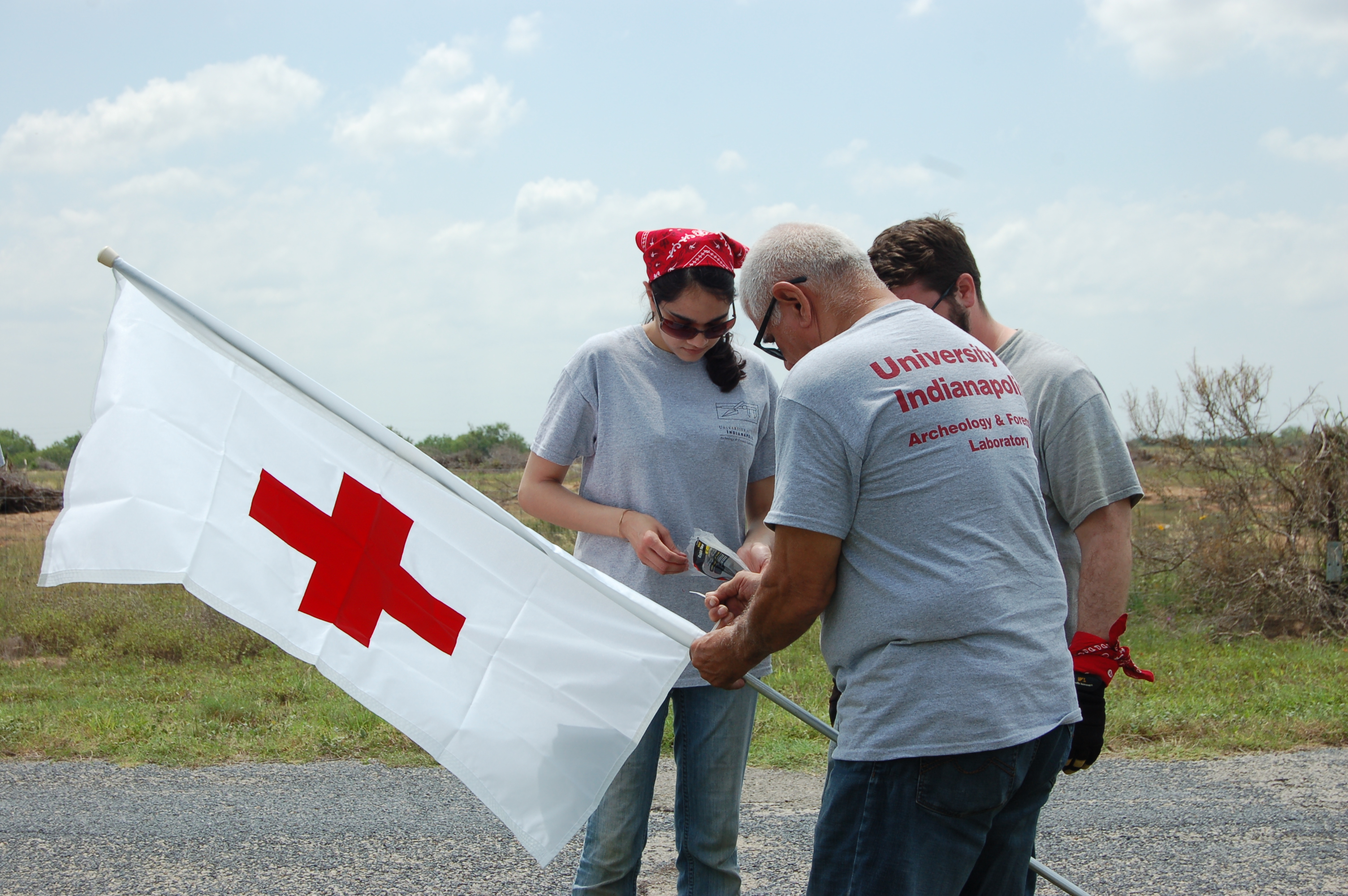
New Zealand group putting together a flag for the water station

This was an immersive experience for all involved.  For the New Zealanders, they were immersed in our perspectives and complex issues as well as our environment. For us at the STHRC, we were immersed in the intrigue and insights of the New Zealanders, as well as their stories and perspectives of migration in the South Pacific Islands. But for all of us, we better understand issues through exploration of similarities and differences from other perspectives. Being here in South Texas is imperative to understanding what is happening here, and we are extremely thankful for anyone and everyone who comes to visit for any type of immersion experience.

New Zealand group finishing setting up a flag at a water station

~Ryan

The Internship at STHRC: It begins!

Ryan's work station with a computer and some paperwork

I have started my internship position as the Forensic Anthropology and Administrative Fellow at the South Texas Human Rights Center in Falfurrias, TX and I can easily say that I’ve hit the ground running. I hadn’t even been in the state for a week before Eddie called and asked if I’d be interested in joining him at the Texas State Capital to observe a meeting. Fortunately, I only live a couple of minutes away from the Capital in Austin, TX, and so of course I jumped on the opportunity. For the sake of brevity, the meeting was mostly about the progress being made and the next steps that will be taken to keep the ball rolling.  It was an exciting experience to say the least.

Last week I began making the 4hr commute from Austin to Falfurrias to begin the internship. I take back roads instead of the traffic-jammed highway, and I’ve loved the drive every time. Mentally, it serves as a reminder that while the humanitarian crisis might feel far away, it’s extremely close.

I have huge shoes to fill. The amount of work that Hailey was able to accomplish in such a short time is mind boggling. I’m extremely thankful for and inspired by the amount of data she’s collected, collaborations she’s created, standard procedures she’s developed, and wheels of progress that she’s set in motion. I’m determined to meet the bar she’s set, and set the bar higher if that’s even possible.

I’m in my second week now. I meant to write something last week, but my brain was exhausted after the first week here. I spent the week looking over spreadsheets of data and folders of missing persons reports in order to figure out the standard procedures Hailey set in place for me. I kept getting distracted by each individual missing persons report; each story was extremely intense and it was hard to put a report down without wanting to research every detail. I found myself following highways on maps, researching cell phone companies, and jotting down notes that I could research later when I had time to look through other databases. I know that right now that my goal is to help centralize information, and so I’m trying to stay focused, but it’s so easy to get distracted by each individual’s story.

A side project that I’ve become interested in involves the water station project put in place by Sister Pam. If you’ve been following our blog, you’ve probably read about the strenuous task of building and maintaining the water stations throughout Brooks County that are used as potential humanitarian aid. I asked Sister Pam if I could start analyzing her logbooks of how many jugs of water are being taken, when they are being taken, and from which areas to see if there are any patterns. I know that this entails a ton of assumptions (one being that a missing water jug is only assumed that it’s being taken by someone in need, and there are tons of other assumptions), but in my spare time I’m working on creating ‘heat maps’ that can be used to visualize this data.  It’ll take some time before we’ll know if it means anything, but I’m enjoying working with some cool data.

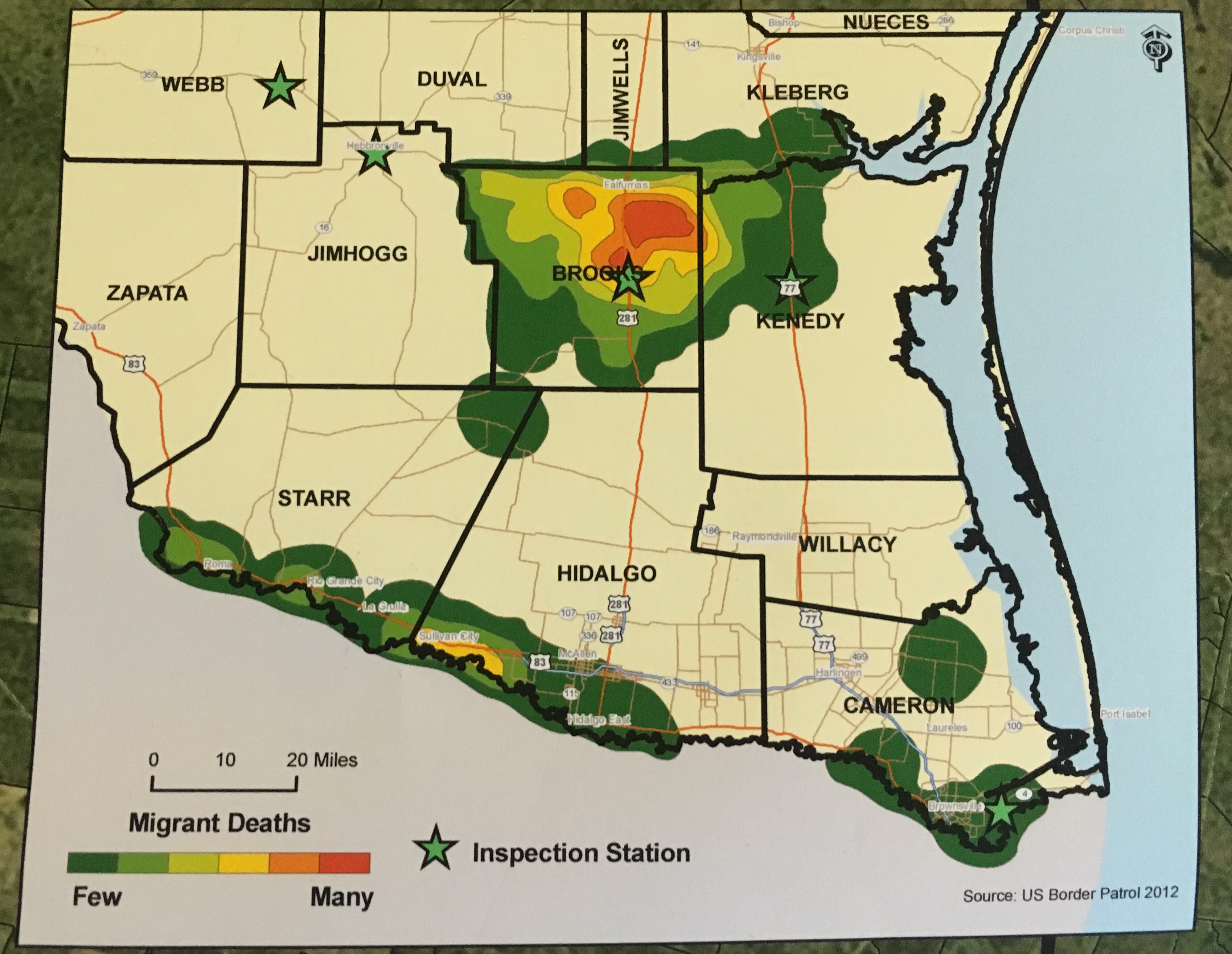
A small heat map over the area of Falfurrias depicting water stations and some data showing some red hot spots
A quick heat map generated (with only a few water stations and a few months of data) as an example of what we’re hoping to create

There’s no telling what the rest of the week will look like. Every day involves new volunteers, impromptu meetings, and news to adapt to. We have a lot of events coming up in the next few months that I’ll make sure to keep everyone updated on. If anyone has any specific questions on the internship or what we’re up to at the South Texas Human Rights Center, feel free to email me at sthrc.ryan@gmail.com  and I’d be more than happy to chat!

Ryan