Category Archives: Reflections

Reflections on how we feel and how the mission is changing us

Different Perspectives

Today had its highs, lows, and in between.  Once again late to breakfast I will be on time tomorrow (maybe).  Once we got to the site we got started right away, we set a goal and we were able to accomplish our goal by the end of the day.  However there has been a controversy among our group.  This has started to be a serious issue among our team.  There are two types of shovels on site, a tall shovel and a short shovel (with a handle).  You see, I am considered an average height individual and the tall shovel literally comes to my head. So why use a shovel almost taller than me.  I have been trying to convince the team that the short shovel is better and they should all convert to the short shovel.  However they constantly disagree and persist on using the tall shovel.  But little do they know they will slowly start to change their minds and eventually before the trip is over they will all convert to the short shovel.  I already have witnessed Dr. Latham using the short shovel and I personally think it’s a good look.  Other than that everything is great on scene and this is a great group of people.  After the work on scene I was ready to take a nap and get ready to for the amazing dinner at Arturo’s house I have been told about.  But before I was able to take my nap I was offered a chance to go to a ranch. 
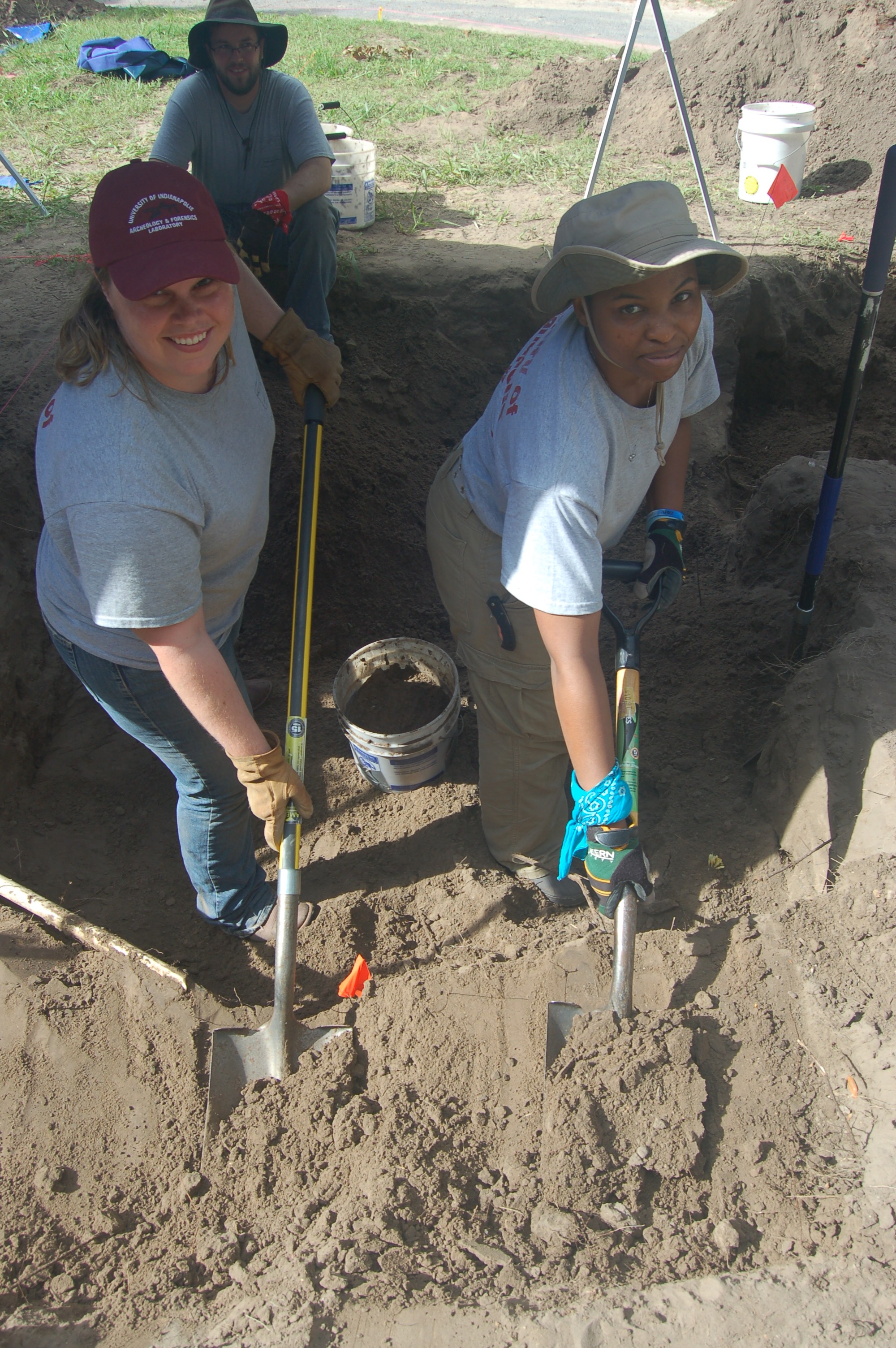
UIndy team members smiling at the camera while shoveling inside a burial

I had my own idea of what a ranch looked like and I was so far off.  The idea of a ranch that I always imagined was wide open green acres, horses roaming freely, and a picture perfect landscape.  When we got out there I saw high grasses and random spots of small trees with spiny thorns and areas of gathered wood.  Nothing orderly or systematic about the land. I was able to freely explore and learn about. Lavoyger (the security manager) took us  to an area where migrants come and camp for the night.  A couple of the members of the group and myself walked through the area and gazed at all the torn clothes and empty bags on the ground.  Empty jugs, cans, and bottles were scattered around the area.  All of this was such an eye opener.  We were discussing this scene and expressing how sad the situation was and how hard it would be to imagine being in this situation.  And then it dawned on me that when the migrants make it to that area they are feeling a sense of accomplishment.  They are so close to their destination and know that they have possibly made it through the worst of their travel.  When I realized the perspective difference of the situation it was mind boggling.  Something so bizarre and incomprehensible to us is welcoming and achievable to them. 
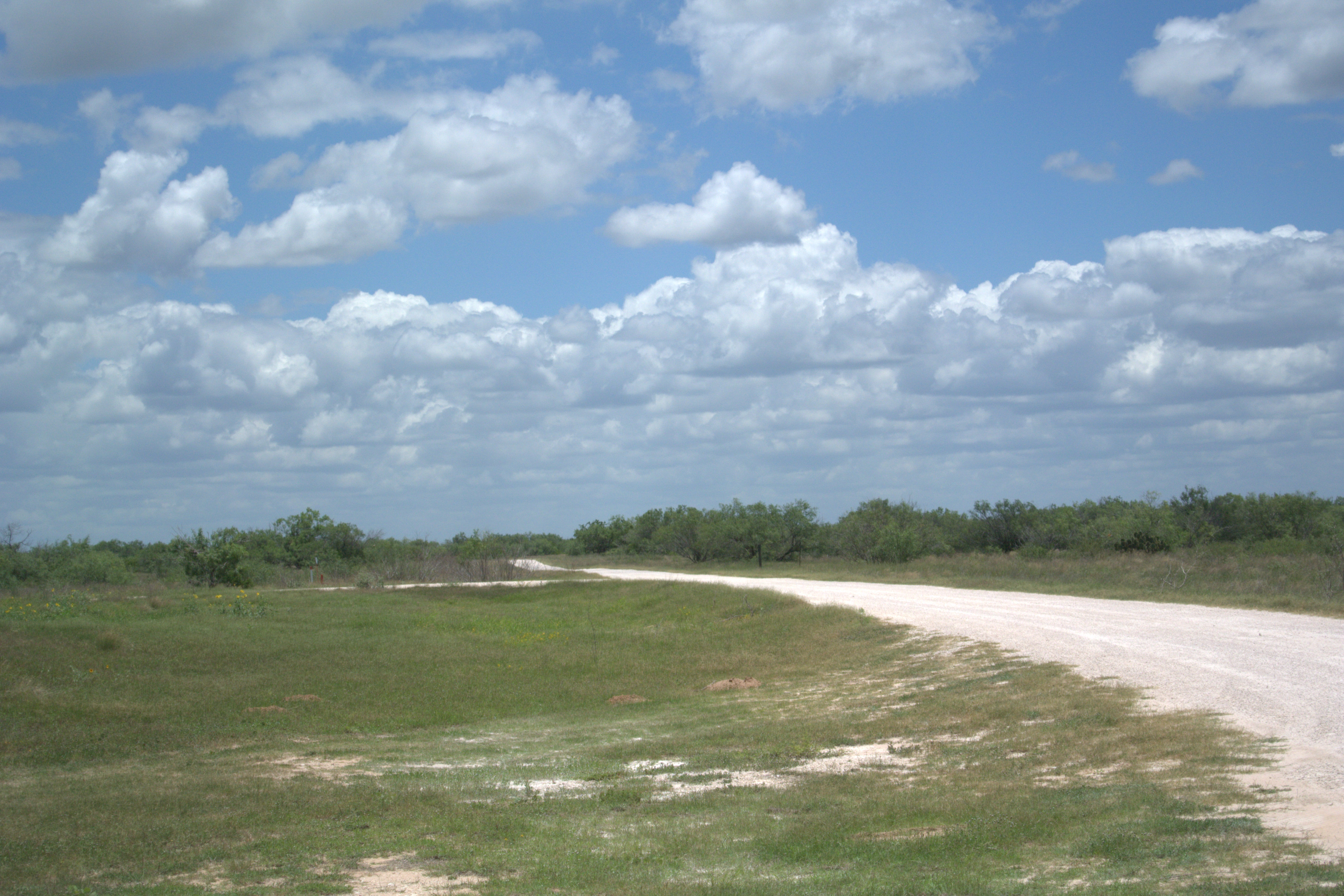
A white dirt road extending into the brush with blue skies aboveAfter the ranch we were invited to the constable’s house for dinner.  It was quite an experience.  The food was amazing and I am glad I was properly introduced to cowboy bread.  The hospitality that we have received is so welcoming and I am grateful to everyone who has lent a helping hand.
Cheneta

Documentary Filmmakers Become Part of the Team

I’d like to introduce our readers to a phenomenal team of documentary filmmakers who have been following our work this week in Falfurrias, TX. Meet Sarah and Esy.

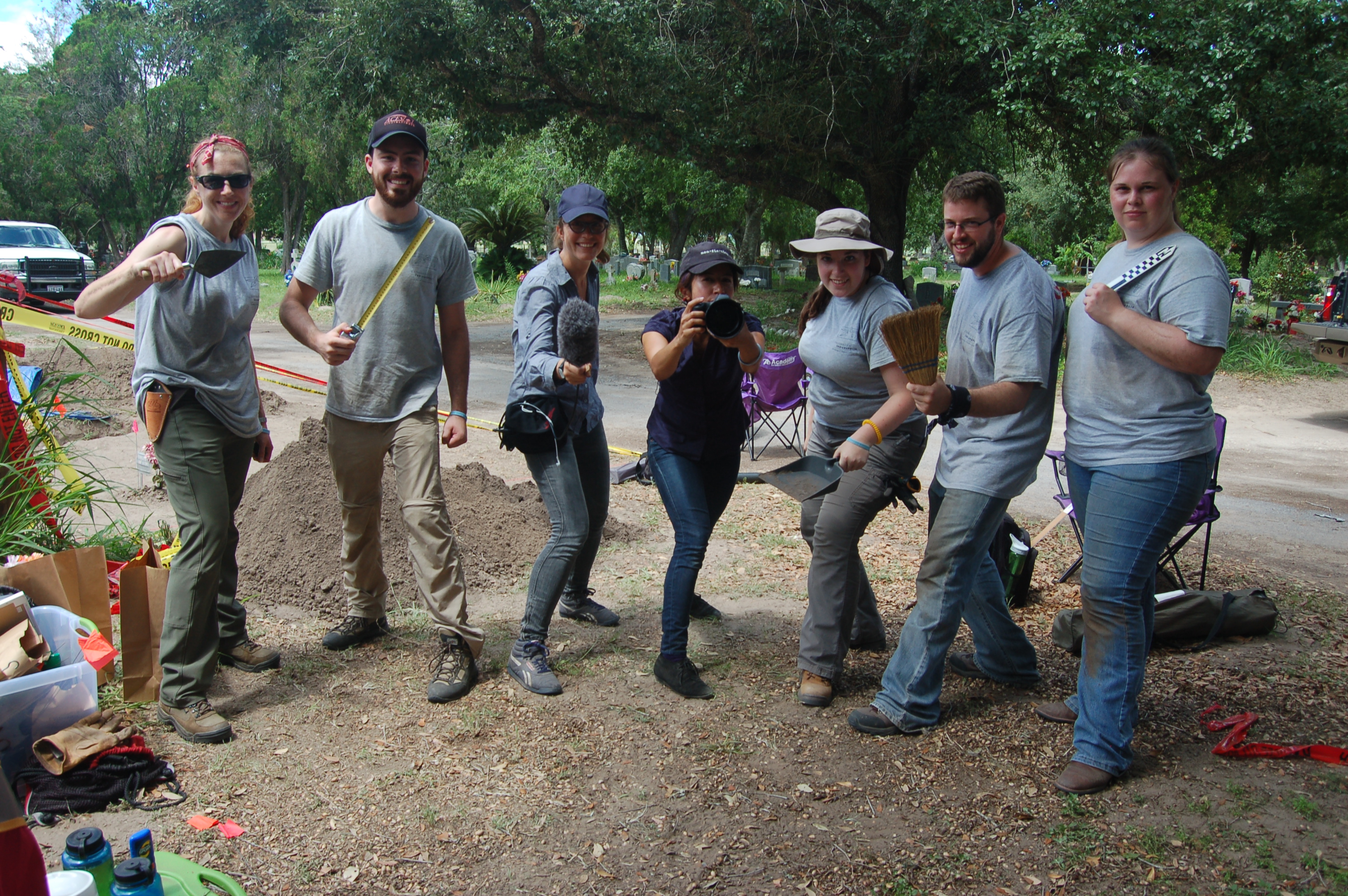
Team UIndy strikes a pose with Sarah and Esy, the documentary filmmakers.As graduate students working in a forensic anthropology lab, we learn very quickly how to interact with media. Sometimes news stations get the story right, and sometimes they don’t. Often times we are misquoted or taken out of context. And in order to get the story, cameras are often intrusive, getting in the way of forensic analysis and building an annoying stereotype for themselves. These young filmmakers couldn’t have been any farther from this description.

Sarah and Esy were at the scene before we arrived on Sunday, greeting us with smiles and handshakes. The filmmakers told us of their project to create a documentary about the various ways Americans memorialize the deceased, currently entitled MEMORIALS. Arriving at the cemetery before sunrise and leaving only after the last crew has packed up and taken off, Sarah and Esy have seen nearly everything we have at the site. They join us for debriefings and listen to us as we talk through our progress, hoping to capture much of the behind-the-scenes of our work.

But what really impresses me about this duo is their raw style and manner of filming. Neither of them has approached us asking for an interview. Instead, they rely on the sounds and vocals that they capture. They stand from afar and film unobtrusively. No cameras in faces, no mics right next to the grave as we dig. In fact, the filmmakers became a seamless part of the group, moving buckets and supplies for us and sharing lunch with us daily. Esy told me that she often makes sure while filming to dedicate an equal time with the camera off. They aren’t there to just film; they are there to experience, to learn, and to become immersed in our project, which is impossible to do with an eye through the viewfinder. She discussed her annoyance with watching people spending so much time using cell phones to capture awful video footage of an experience that can’t be recreated. The immersion into these rare experiences must be valued.

I talked to Esy during lunch about their film, and I asked her about the competition for topics among independent filmmakers: what if someone else beats them to it with their topic on memorials? Can’t they just change the vocal overdubs and commentary and keep their same footage, allowing them to adapt to the competition? Esy said absolutely not, because they don’t provide any commentary. They let the footage narrate itself, allowing the viewer to draw their own conclusions from the footage rather than using commentary to tell the viewer the facts straightforward.

The human rights crisis that the country is facing can’t be fully described  or narrated with facts and commentary because there are so many perspectives to take into account. Instead, each person has their own take on what is happening from their unique perspective. There is no wrong or right solution to the crisis. By presenting our work in such a raw style, Sarah and Esy have safely avoided forcing any bias or perspective on the viewer, which I deeply admire. It is up to each one of us to decide what we can do to help. At Sacred Heart, we are contributing our expertise towards only one angle of the issue, but we have been fortunate to see other angles that broaden our perspective and make us more aware of what can be done to help.

I highly encourage our readers to explore Sarah and Esy’s previous work. I’ve watched their trailers for many of their films and can’t wait to see the full features. Follow their vlog at www.perinspire.com for information on films such as Jeepney, The Rink, and Thing With No Name that deeply explore important social issues around the world.

Thanks Sarah and Esy for temporarily joining our team, and best of luck in the future with your films!

Ryan

Thanks to the Baylor Bears

Baylor and UIndy group photo with some sitting, squatting, and standing in 3 rows

The UIndy & Baylor teams

This field season we were very fortunate to be able to have specialized positions that allow us to interact with the Baylor students in a very different way.  The Baylor students are divided into 5 different teams and each team was assigned to their own quadrant (a 4 meter by 4 meter area of the cemetery).  We have had more of an instructor role this season and have been responsible for explaining and showing how to use certain archeological techniques to best utilize the equipment and document what each team is uncovering. I have been amazed by how well the teams are doing,  these students are incredibly inquisitive and enthusiastic and continue to work hard in this hot Texas sun.  Just a few days into this season and it is evident how much the students have learned and still want to learn.  It has been great to see the teams work together to brainstorm strategy and support each other and the other teams. The teams quickly learned that the quadrant distinctions are being blurred as the burials cross the set grid lines.  However the teams were able to quickly adapt and are doing an excellent job working together to coordinate people, equipment, and documentation.

Going into this field season we knew that this section was going to be more challenging and it has already proven to be different from last year’s section as far as soil density, burial depths, and burial types.  We would not be able to complete this excavation alone, this is a large site that we would not be able to tackle without all of the help from Baylor University.  They provide so much support in the field and they truly make this project possible.

The more we become invested in this human rights issue, the more we are seeing the many different organizations, universities, and individuals that need to work together to solve this daunting issue.  I am honored to work with Baylor University and I look forward to seeing the students further progression throughout the next week in the field.

Erica