Category Archives: Reflections

Reflections on how we feel and how the mission is changing us

Falfurrias Flashback: Texas Flood 2

In the first installment of Texas flood I told the story of how the UIndy crew braved the elements.  It ended with every one of us drenched, dirty, and triumphant.  That is usually how the story ends, but it is actually where the story becomes interesting.  As we walked back to the minivan, still chirping from our victory and doused from our day, we were faced with an obstacle.  We were filthy and the minivan was a rental.  In the picture above you can see four sopping souls, none of whom you would let into your own car.

So what could we do?  At that point we were the only people left in the cemetery.  None of us had brought a change of clothes or even shoes for that matter.  The first suggestion was that we just remove our clothes so we could keep the van clean and dry.  Here is a question, what do you call a PhD and four master’s students undressed in a minivan?  A tailor, maybe?  Definitely a lawyer.  What if we got pulled over?  The next idea was to have someone back at our hotel bring us clothes.  This had its own problems.  No one had access to our rooms to get our clothes, plus we were asking them to drive through a storm into an area that was prone to flooding.  With all other options exhausted, we got creative.

In my first post I mentioned how Baylor supplied us with Tyvek suits.  They are synthetic suits that cover the whole body and are made to keep hazardous materials out, but in this instance we re-purposed them to keep the hazardous materials in.  We took turns in the field trailer stripping down and suiting up for the ride home.  Our new team uniform consisted of a white space suit and maybe a choice undergarment or two.    The best part of all is when we returned to the hotel someone was there to document our embarrassment.
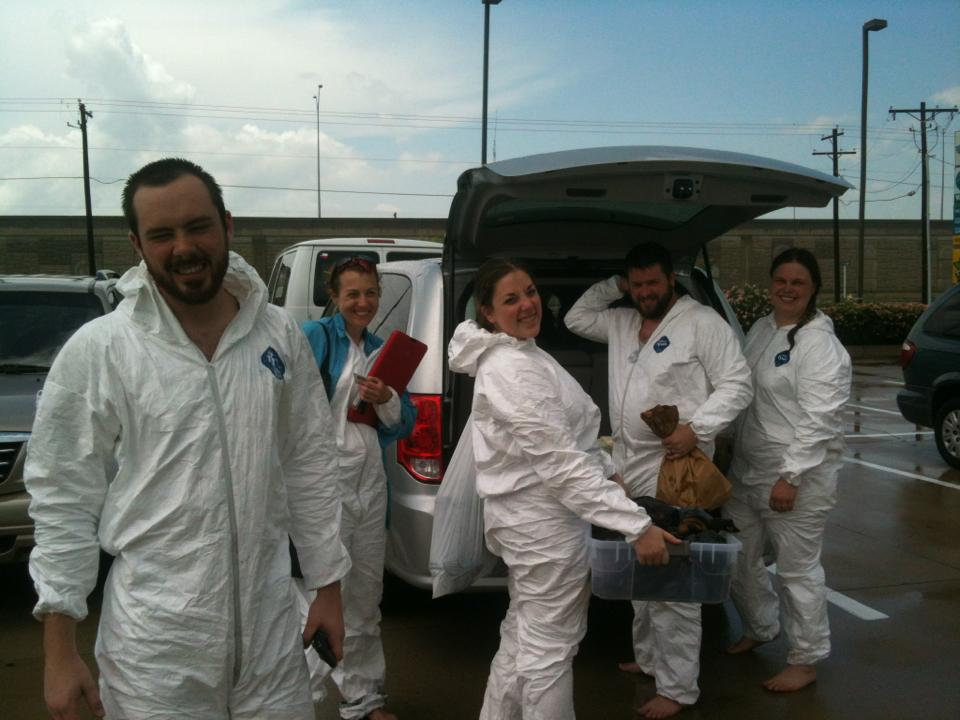
Group photo of the UIndy team in full body PPE suits

“What are y’all wearing under there?”

The cliché “a picture is worth a thousand words” is an understatement.   In this photo you can see us all tightly zipped up into our Tyvek suits for modesty, with our bare feet poking out of the bottom.  If you look closely you can see us carrying bags and bins of our soaked clothes.  Everyone also has a sly look on their face, as if to say, “I know something you don’t know.”  Now the whole world knows the answer to that question.  You’re welcome!
Justin Maiers

Stepping Towards Repatriation

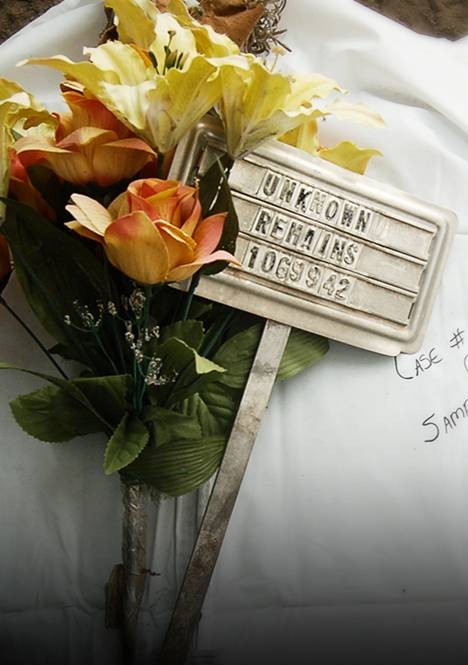
As we gear up to return to Falfurrias, I can’t help reflecting on the past year.  Our first trip didn’t end with our return to Indianapolis, it was just getting started.  If you had asked any of us at this time last year, before we traveled south, if we truly knew what we were getting into, we of course would have answered “Yes!”  But the truth is we didn’t have a clue.  The magnitude of the project floored all of us. Metal grave marker with "Unknown Remains" on it with orange and yellow flowers over a white body bagEven with Baylor University and Texas State University also working towards identification of the exhumed individuals, there were far more unidentified than what we anticipated.  So, after last year’s trip, we received thirteen individuals from the 2013 exhumations at the UIndy Archeology and Forensics Laboratory (AFL).  The AFL is a dedicated working and educational lab for the analysis of skeletonized remains.  Dr. Latham organized a formal class that would train us in every aspect of the process, which for many of us was an opportunity to put all of our previous training to use from start to finish.

In the AFL, we train on forensic cases when they are received, and we share the process with all graduate students.  For the thirteen individuals from Texas, we had no idea what we were going to receive.  With five advanced graduate students and Dr. Latham overseeing each case, we were each assigned two or three individuals to focus on.

After cleaning, we each went to work on establishing a biological profile which would hopefully provide an indication of age, sex, ancestry, and stature.  These factors can help to initially narrow down a search by eliminating the people who don’t fit the specific combination of traits.  We also looked for any other factors that could help in the identification process.

University of Indianapolis Archaeology and Forensics Lab LogoThis was also the first time for many of us to take case photographs, which turned out to be more challenging than we expected.  We even participated in a special two part photography workshop to train us on lab photography. The pictures had to be clear and capture every unique feature that might potentially aid identification.  With so little to work with, every detail matters.

After the full analysis was completed and reviewed by Dr. Latham , we compiled a report for each individual.  This report served as our “final exam” for the class, and it also would serve as a template for Dr. Latham’s official reports that would be submitted for each case.

Recently, we also scored stress indicators that could help us to understand a bit more about the health history of each individual.  We also cut samples for DNA and stable isotope analysis that will be sent to the University of North Texas and Chico State University, respectively.

Through all these collaborative efforts,  plus a few more I haven’t mentioned yet, hopefully we are a step closer to the identification of the exhumed individuals, and a step closer to returning them to their families and loved ones. We are grateful that we have the skills, resources, and support to move progressively towards this goal.

A pink Thank You with the beyond borders logo below it reading love, human rights, and peace

Jessica Campbell

More News, More Perspectives

The longer I’m involved in this human rights project, the more I learn about the magnitude of the project and how far it extends. As we’ve talked about before, not only are so many people involved directly in the project, but many experience the unfortunate tragedies as a result of the crisis. Fortunately, awareness of the crisis is becoming more widespread. I’m torn when I open my internet browser, check the multiple news sites, and see a major headline about immigrant deaths across the nation. It hurts to read the stories of pain and tragedy. I do my best to sympathize for the individuals affected by the crisis. I also try and see the glimmer of positivity in the fact that these stories are being broadcast both nationwide and worldwide through these major news sources. Each story that makes the headlines provides more awareness to a broader audience, which will hopefully bring in more support for this human rights crisis.

I thought I would share some of the links that I have come across in these past few months leading up to our trip. These are articles that I have stumbled upon, read, and quickly shared with other people involved in the project. Each one is equally important and unique, and provides a different perspective of the same human rights crisis. It is imperative for us who are directly involved in the project that we read any news we can and attempt to understand every possible perspective.

The first story is an encompassing article that describes the difficult process of identification. Our trip is only a beginning step in identifying individuals. Identifications can be made using dental records, but DNA matches are often necessary. Contrary to popular TV shows, DNA matches are not instantaneous and require comparison samples that are difficult to obtain. This article details that process using stories with real families. I highly recommend this article for anyone trying to comprehend the lengthy and emotional process of identification: http://www.cnn.com/2014/05/17/us/immigrant-desert-deaths-dna/index.html?hpt=hp_bn1

Another story reveals the changing demographics of border crossers and some of the politics behind helping these individuals. The numbers of children crossing the border are astounding and scary, and I know that many of us were shocked at the facts. These are innocent children seeking help: http://www.nbcnews.com/news/latino/children-crossing-border-strain-facilities-n109401

Finally, two other articles focus on border crossers who have survived the difficult migration, but have not escaped the human rights crisis. These articles really showed me that this crisis extends well beyond the borders and deaths and includes those forced into modern day slavery and inhumane conditions. One is a compilation of photographs that highlight victims: http://cnnphotos.blogs.cnn.com/2014/05/20/victims-of-modern-day-slavery/?hpt=hp_c2. The other is a news story about finding survivors within a stash house: http://www.cnn.com/2014/03/19/us/texas-immigrants-stash-house/index.html?hpt=hp_t2

Colibri Center for Human Rights Logo with an orange and red hummingbird
                     Colibri Center For Human Rights

Of course, there are more stories coming out every day, and it’s impossible to find and read every story that is important to this project. Fortunately, the Colibri Center for Human Rights has a website dedicated to providing information about the project. The website shares every story they find surrounding the issues of migrant death. It also has information about how to help and contribute information that could save lives. Please check out http://colibricenter.org/ for more information.

And finally, we would love to read any and every story about this issue. If you have information that you’d like to share, please email me at strandr@uindy.edu or Dr. Latham at lathamke@uindy.edu with links to the articles. I will make sure to share them with everybody through this blog in a separate post as well as through social media. Thank you!

Ryan Strand