Latest Posts

Falfurrias Flashback: Texas Flood 2

In the first installment of Texas flood I told the story of how the UIndy crew braved the elements.  It ended with every one of us drenched, dirty, and triumphant.  That is usually how the story ends, but it is actually where the story becomes interesting.  As we walked back to the minivan, still chirping from our victory and doused from our day, we were faced with an obstacle.  We were filthy and the minivan was a rental.  In the picture above you can see four sopping souls, none of whom you would let into your own car.

So what could we do?  At that point we were the only people left in the cemetery.  None of us had brought a change of clothes or even shoes for that matter.  The first suggestion was that we just remove our clothes so we could keep the van clean and dry.  Here is a question, what do you call a PhD and four master’s students undressed in a minivan?  A tailor, maybe?  Definitely a lawyer.  What if we got pulled over?  The next idea was to have someone back at our hotel bring us clothes.  This had its own problems.  No one had access to our rooms to get our clothes, plus we were asking them to drive through a storm into an area that was prone to flooding.  With all other options exhausted, we got creative.

In my first post I mentioned how Baylor supplied us with Tyvek suits.  They are synthetic suits that cover the whole body and are made to keep hazardous materials out, but in this instance we re-purposed them to keep the hazardous materials in.  We took turns in the field trailer stripping down and suiting up for the ride home.  Our new team uniform consisted of a white space suit and maybe a choice undergarment or two.    The best part of all is when we returned to the hotel someone was there to document our embarrassment.
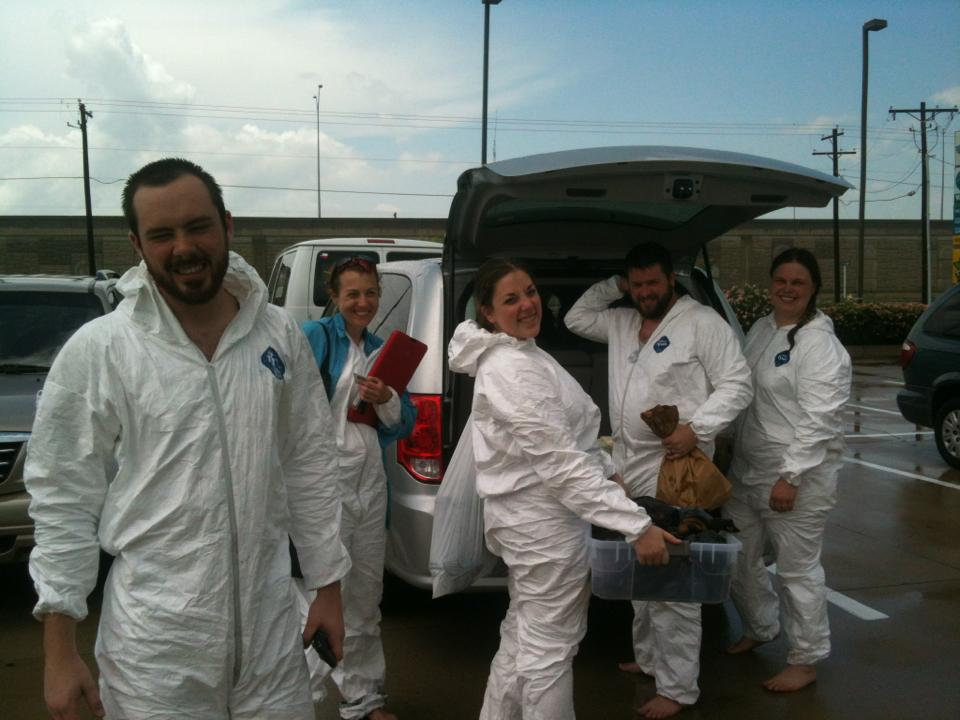
Group photo of the UIndy team in full body PPE suits

“What are y’all wearing under there?”

The cliché “a picture is worth a thousand words” is an understatement.   In this photo you can see us all tightly zipped up into our Tyvek suits for modesty, with our bare feet poking out of the bottom.  If you look closely you can see us carrying bags and bins of our soaked clothes.  Everyone also has a sly look on their face, as if to say, “I know something you don’t know.”  Now the whole world knows the answer to that question.  You’re welcome!
Justin Maiers

Stepping Towards Repatriation

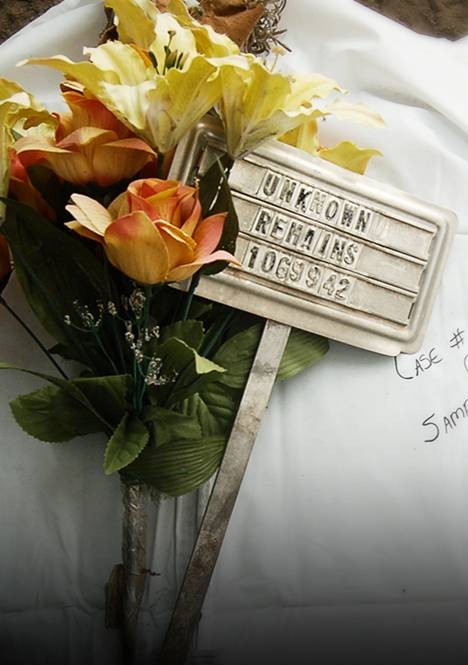
As we gear up to return to Falfurrias, I can’t help reflecting on the past year.  Our first trip didn’t end with our return to Indianapolis, it was just getting started.  If you had asked any of us at this time last year, before we traveled south, if we truly knew what we were getting into, we of course would have answered “Yes!”  But the truth is we didn’t have a clue.  The magnitude of the project floored all of us. Metal grave marker with "Unknown Remains" on it with orange and yellow flowers over a white body bagEven with Baylor University and Texas State University also working towards identification of the exhumed individuals, there were far more unidentified than what we anticipated.  So, after last year’s trip, we received thirteen individuals from the 2013 exhumations at the UIndy Archeology and Forensics Laboratory (AFL).  The AFL is a dedicated working and educational lab for the analysis of skeletonized remains.  Dr. Latham organized a formal class that would train us in every aspect of the process, which for many of us was an opportunity to put all of our previous training to use from start to finish.

In the AFL, we train on forensic cases when they are received, and we share the process with all graduate students.  For the thirteen individuals from Texas, we had no idea what we were going to receive.  With five advanced graduate students and Dr. Latham overseeing each case, we were each assigned two or three individuals to focus on.

After cleaning, we each went to work on establishing a biological profile which would hopefully provide an indication of age, sex, ancestry, and stature.  These factors can help to initially narrow down a search by eliminating the people who don’t fit the specific combination of traits.  We also looked for any other factors that could help in the identification process.

University of Indianapolis Archaeology and Forensics Lab LogoThis was also the first time for many of us to take case photographs, which turned out to be more challenging than we expected.  We even participated in a special two part photography workshop to train us on lab photography. The pictures had to be clear and capture every unique feature that might potentially aid identification.  With so little to work with, every detail matters.

After the full analysis was completed and reviewed by Dr. Latham , we compiled a report for each individual.  This report served as our “final exam” for the class, and it also would serve as a template for Dr. Latham’s official reports that would be submitted for each case.

Recently, we also scored stress indicators that could help us to understand a bit more about the health history of each individual.  We also cut samples for DNA and stable isotope analysis that will be sent to the University of North Texas and Chico State University, respectively.

Through all these collaborative efforts,  plus a few more I haven’t mentioned yet, hopefully we are a step closer to the identification of the exhumed individuals, and a step closer to returning them to their families and loved ones. We are grateful that we have the skills, resources, and support to move progressively towards this goal.

A pink Thank You with the beyond borders logo below it reading love, human rights, and peace

Jessica Campbell

Connections

Last week over 40 forensic anthropologists and their students converged on Boulder City, NV for the 34th annual meeting of the Mountain, Desert & Coastal Forensic Anthropologists.  This provided the backdrop for amazing connections and motivation for the UIndy team that is focusing on issues of migrant death.  While the meeting emphasized scholarship and casework in all areas of forensic anthropology, the team was able to connect with some prominent people working in the trenches of this human rights issue.

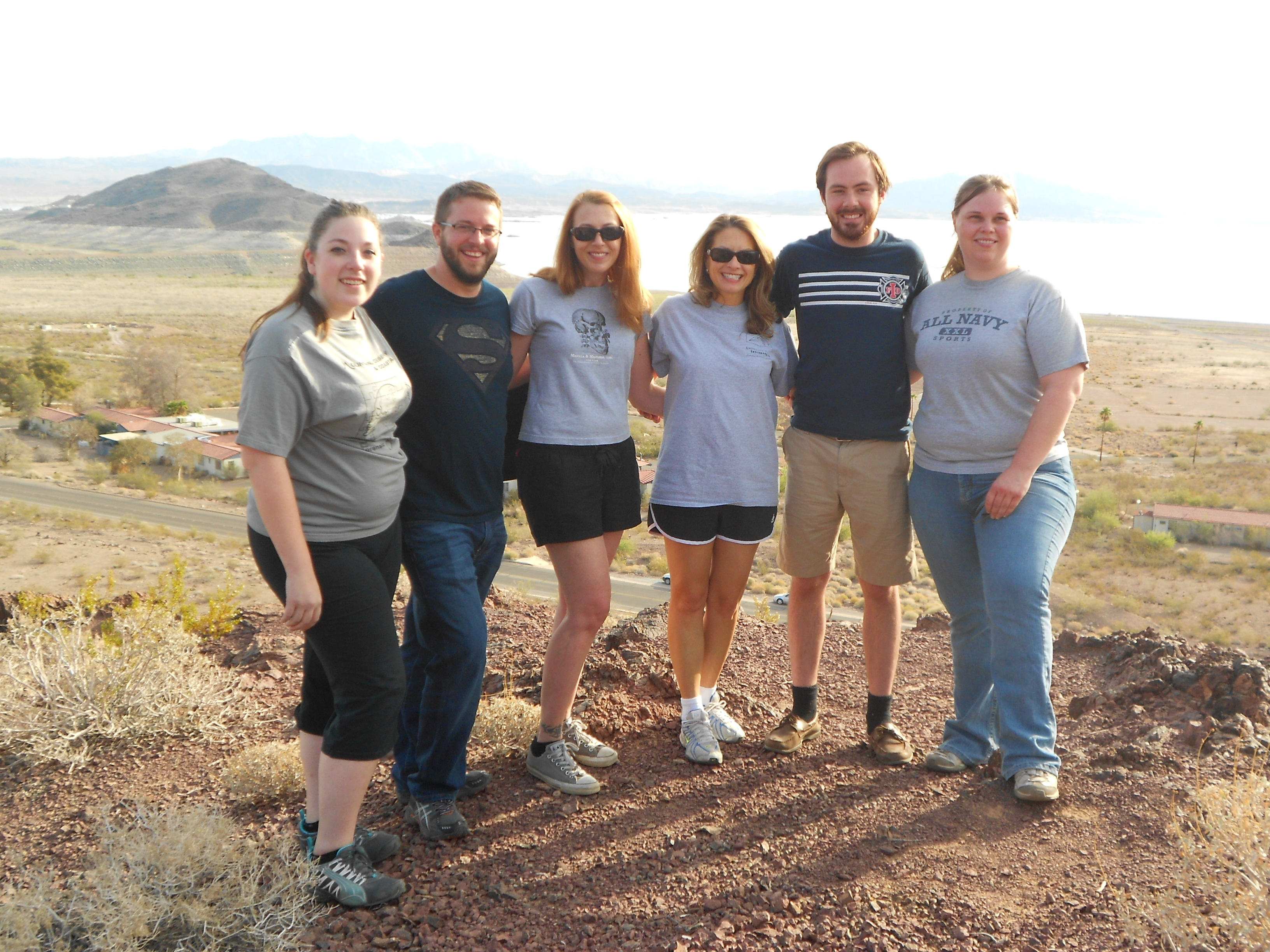
UIndy group photo with Dr. Lori Baker

The Uindy team with Dr. Lori Baker

The UIndy team was able to spend quality time with Dr. Lori Baker, the director of the identification efforts in Brooks County.  This allowed us time to formulate an archeological plan for the field efforts that will begin next week in the Sacred Heart Burial Park. Ryan suggested that each student group do daily presentations on their progress in the field during our evening debriefings, an idea favored by Dr. Baker.  Each UIndy student team member will have a leadership role this field season and they were ecstatic to share their ideas with Dr. Baker.

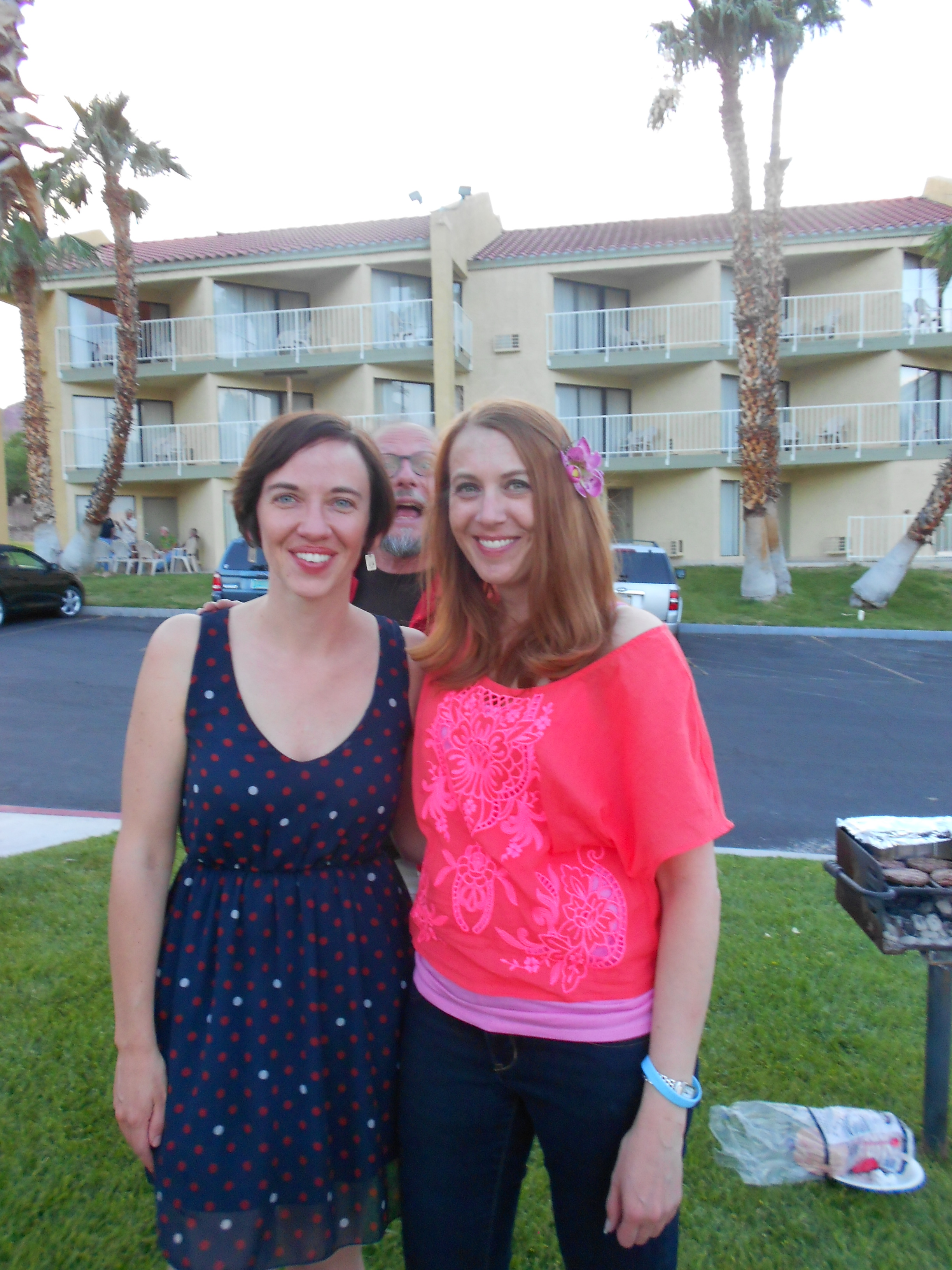
Robin Reineke and Dr. Latham smiling

Robin Reineke and Dr. Latham

We were also able to connect with Robin Reineke, executive director of the Colibri Center for Human Rights.  The mission of the Colibri Center is to improve the identification of human remains found on the US-Mexico border and to inform the public of this human rights issue by building a unique system for the collection, management, and sharing of data about the deaths and disappearances. Robin and her team are instrumental in reaching the families of the missing and collecting invaluable missing persons information to aid in the identification efforts. I tried to get a nice photo with Robin, but notice we were photo bombed by prominent forensic anthropologist Dr. P. Willey from California State University, Chico. You can’t say forensic anthropologists don’t have a sense of humor! 

We spent time interacting with Dr. H. Gill-King, Dr. Wendy Potter McQuade, and John Servello of the University of North Texas center for Human Identification. This Texas laboratory will be generating DNA profiles from all of our unidentified individuals with the hope of matching the genetic information to a family reference sample.

Dr. Bartelink, Dr. Baker, and Dr. Latham smiling for a picture infront of a mountainous background

Drs. Lori Baker, Eric Bartelink and Krista Latham

Dr. Eric Bartelink of California State University, Chico graciously offered to run isotope analysis on the 13 individuals currently being analyzed at UIndy. This type of molecular analysis has the potential to identify the country of origin of these migrants and will provide a geographic reference point to begin searching for families of the missing.  Dr. Bartelink is providing a valuable service and important step in returning these unidentified individuals to their families. He offered to cover the cost of supplies (which will run over $2000) out of his own pocket. Our hope is to continue our fundraising efforts to help compensate him for his efforts.

Our team was most humbled and most honored when Dr. Bruce Anderson of the Pima County Office of the Medical Examiner proposed that the MD&C donate some of it’s annual fundraising efforts to our mission.  Each person at that meeting has noble missions they support and the sincere gesture and assistance for our mission was overwhelming.  It gave us a boost of confidence and assurance that we are doing the right thing and making a difference.

Dr. Krista Latham