Category Archives: Human Rights, Migrant Death

Talking about the project itself

Southern Hospitality

Metal grave marker reading "Unknown Female Remains"

What I do is not very glamorous.  I specialize in forensic anthropology, in short I deal with dead things (specifically bones).  When I tell people that I specialize in forensics, I am usually greeted with a disgusted “Why?”  Occasionally, people are intrigued.  In Falfurrias, the community has been nothing but appreciative.

I don’t know what I was expecting the first time we travelled to Falfurrias.  Initially I thought we would be faced with hostility.  Immigration and border issues are a hot-button issue.  Border concerns are incredibly politically volatile and polarizing.  I was certain that our human rights work would not be well received or at the very least misunderstood.  I could not have been further from the truth.  Instead of fear and animosity, the community has truly embraced our work.  I never could have anticipated the reverence given by this far-away community that I now love as my own.

The people of Falfurrias never asked for death at their doorstep.  They are merely the victims of circumstance.  The community had no means of dealing with a tragedy of this magnitude.  Our work, however slight it may be, helps to ameliorate this crisis.  While what we do is no quick-fix, we offer whatever assistance we can.  Our work is not a solution- it is but a bandage on a very deep wound.  Hopefully, more exposure will bring more assistance and discourse to help solve this problem.

We could not do this work alone.  In fact, we are tourists in this problem.  We are here for a few weeks a year to lend whatever assistance we can.  We stand shoulder to shoulder with a force of amazing individuals; the people of Falfurrias, the professors and students of Baylor and Texas State, and the local police and border patrols.  They face these issues every day, and should be recognized as the true heroes for this cause.
Justin

Surrendering to the Heat

This heat is real.

The weather was good to us yesterday in the field. Clouds blocked the sun for most of the day, and so we were able to work until noon without the heat slowing us down. We weren’t so lucky today.

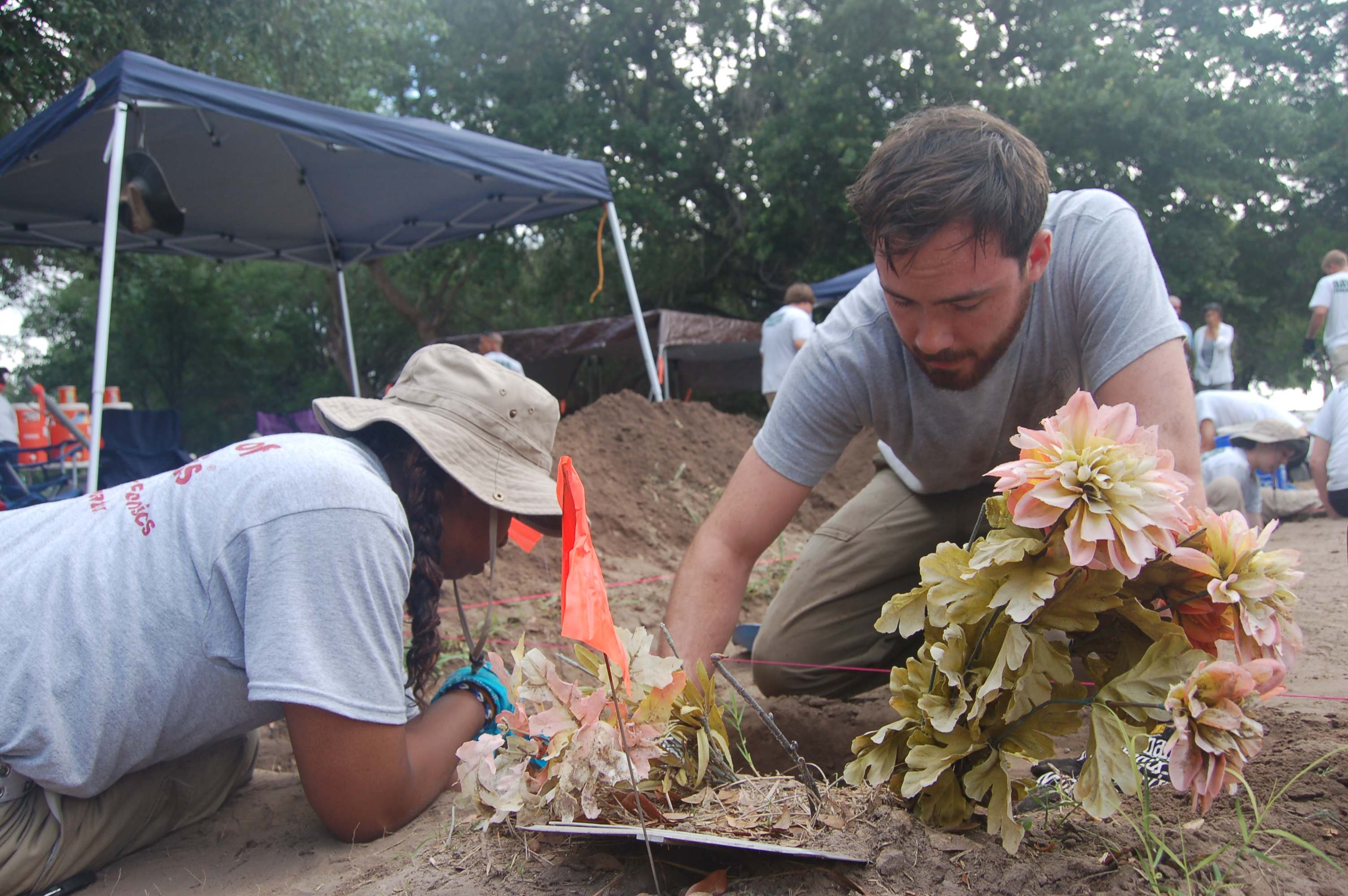
We arrive at the site every day around 5:45am to get a head start before the sun comes up. The humidity and accompanying mosquitoes are always around, but these factors don’t slow us down. Today, however, the clouds were scarce and the sun was fierce by 10:30am. Spending most of our time with our knees on the ground and our heads near the dirt, our immobile positions left us extremely vulnerable to the sun and it wasn’t long until our backs and arms began to cook. We quickly moved the tents we had over our quadrants to protect ourselves as we tediously troweled our trenches. With the tents overhead and our water bottles nearby, we were able to work efficiently and carefully in the rough environment. I moved from group to group to monitor and assist different teams of students. Sometimes I ended up helping for over half an hour without a break. It’s easy to lose track of time at the field, and I learned quickly after lunch that my carelessness had gotten the best of me.

After lunch, I started working on our quadrant again, shoveling and carrying buckets full of dirt as we continued our excavation. But I was only able to carry about two buckets before I knew that I wasn’t feeling quite right. I stepped off to the shade, chugged half of my bottle of water, and sat with some Baylor students under the tent. I knew I was likely sunburned and that I had worked a little too long. But I knew when to stop working to avoid heat exhaustion, and as I rested up, my brain began to work again and I really started thinking about this heat.

Two Beyond Borders Team members working underneath a burial marker to not disturb it on the ground levelI looked at my water bottle and thought about how fortunate I was that I could refill it at will.

I looked up at the canopy over my head and thought about how fortunate I was that I could easily escape the sun’s brutality.

I looked towards our rental van and thought about how fortunate I was that I could go back to our hotel and take a cold shower after our work today.

This heat is real, and every day migrants are making the extremely real decision to brave the sun and fight their way through this environment for a better life, either for themselves or for their family. Many who have perished are found with only a small water bottle. I can’t imagine walking for more than half an hour in this environment with only that much water and without a constant source of shade. As we continue to work, I will make sure to let the environment constantly remind me of the bravery of these people that we are trying to identify. Every time I refill my bottle or step in the shade, I will remind myself of how lucky and thankful I am for my accessible family, for my safety, and for my good health. And I will never underestimate the danger of this environment or the courage of the migrants who fight this danger.

Ryan

Day 2

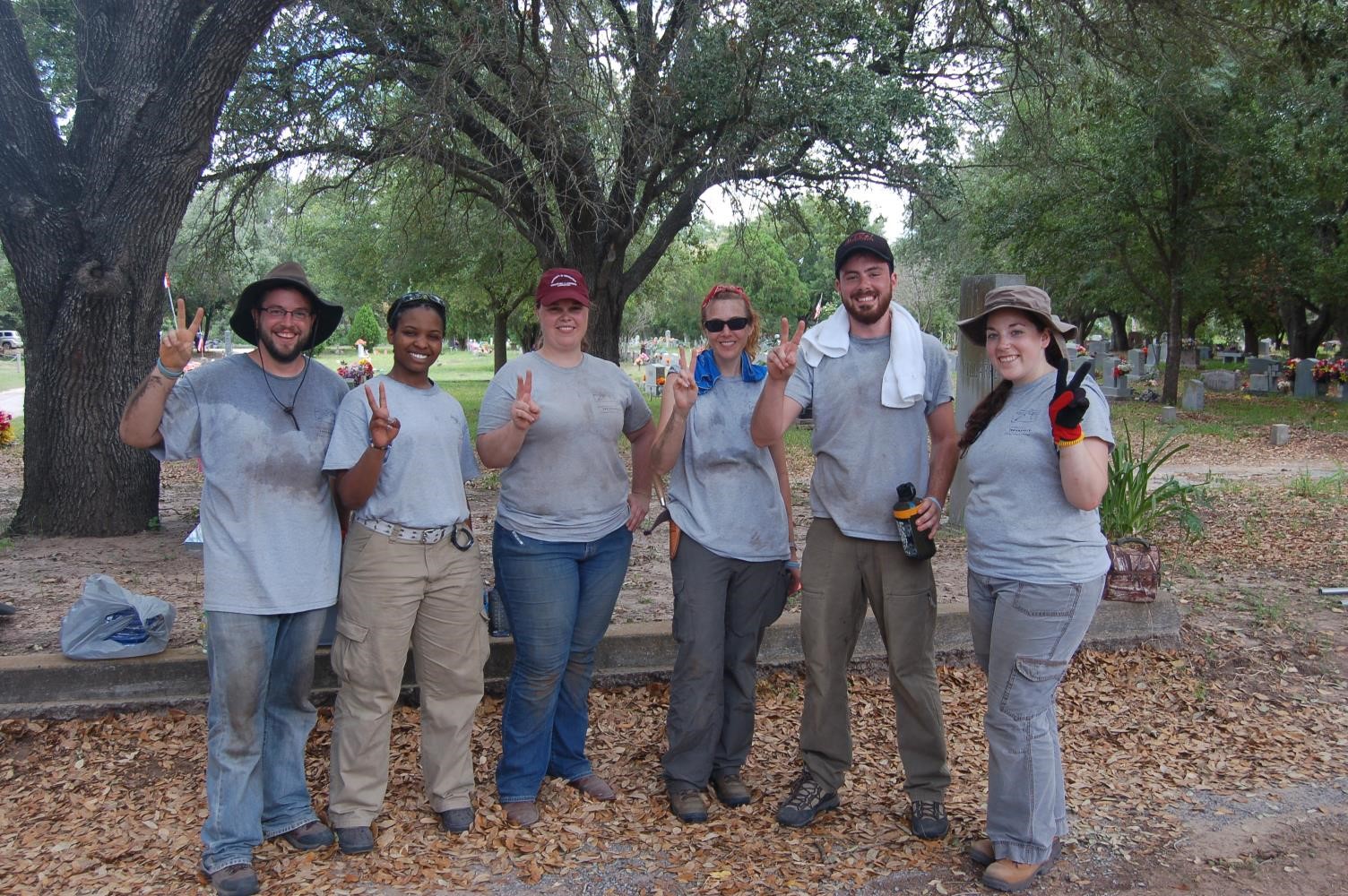
Day 2 Uindy Group photo with two fingers in the air

Our second day in the field was charged with anticipation.  Everyone had a feel for the area and set-up tasks so we had a very smooth start.  Yesterday we cleared and prepared our work area in order to get a clearer picture of what we might encounter today.  This prep work allowed us to develop a plan for how to approach each individual quadrant.  With six groups (five from Baylor University as well as our UIndy crew), we started systematically excavating designated quadrants.

Our UIndy crew started the day by presenting some archeological techniques each group would be using throughout the next two weeks.  Afterwards, we split up to coach and help the undergraduate groups and to answer any questions that may arise as they started digging.  It was a great experience because we gained field teaching experience and also built positive relationships with the other students, which encouraged them to come to us with questions as they progressed through the day.

When we regrouped in our own assigned quadrant, we naturally fell into our routines and were able to work very efficiently.  It was hotter today, with no clouds or breeze to offer a little relief.  We had to take more breaks and make sure everyone was drinking enough water and Gatorade to replenish all the fluids we inadvertently lost.  The mosquitoes are also pretty aggressive this year, so we are going through large quantities of sunscreen and bug repellant.

Two members of the Border Brotherhood also stopped by today interested in learning what all we were doing and how they might approach future recoveries when we are not in Falfurrias.  The nine Brotherhood members are serving as volunteer deputies for the Sheriff in Brooks County, serving the county for absolutely no compensation.  They see the need in Brooks County and seek to help in any way they can.  Sergeant Daniel Walden said their mission is to save lives and get government attention focused on the crisis in Brooks County.  Walden is currently Chief of Police at Donna ISD Police Department, is an EMT and an expert in human trafficking.  While their main goal is to rescue and aid the living, they also help recover the dead from the vast private ranch land surrounding Falfurrias in Brooks County. The deputies supply their own equipment and protective gear, and serve long hours in their free time (time not working in a different paid job).  Their visit at the cemetery today was an effort to improve their knowledge of recovery techniques so that they can incorporate them in their own recoveries if ever needed.  Learn more about their efforts here: http://www.krgv.com/news/border-brotherhood/

We are always happy to provide any information that can help prevent or address migrant deaths.  It is part of our mission, not just to be a reactive service, but to provide better information, resources, and alternative systems to help bring awareness and accountability that will prevent the need for our return to Falfurrias.  As much as we love the town and community (we love them a lot), the human crisis that brought us here in the first place can be prevented by establishing an infrastructure specific to identifying and repatriating the unidentified migrants in Brooks County.

Jessica