Latest Posts

Visiting El Tule Ranch

Today was hot and challenging.  We say this every day.  Yet, after 3 straight days of the South Texas sun, today we needed a motivator.  It came at the end of the day.  Freelance writer Ananda Rose, who has been visiting for a couple days, invited a few of us to join her on a ranch visit.  We were hosted by security manager Lavoyger Durham on the El Tule Ranch, just west of Falfurrias city limits.

The 13,000 acre ranch land sees a lot of traffic.  El Tule runs right up to Highway 285, which runs East-West.  Lavoyger informed us that the migrants crossing the ranch are headed directly to the highway to catch a ride for the next leg of their trip.  The ones in Falfurrias, he said, head mostly to Houston and disperse from there.
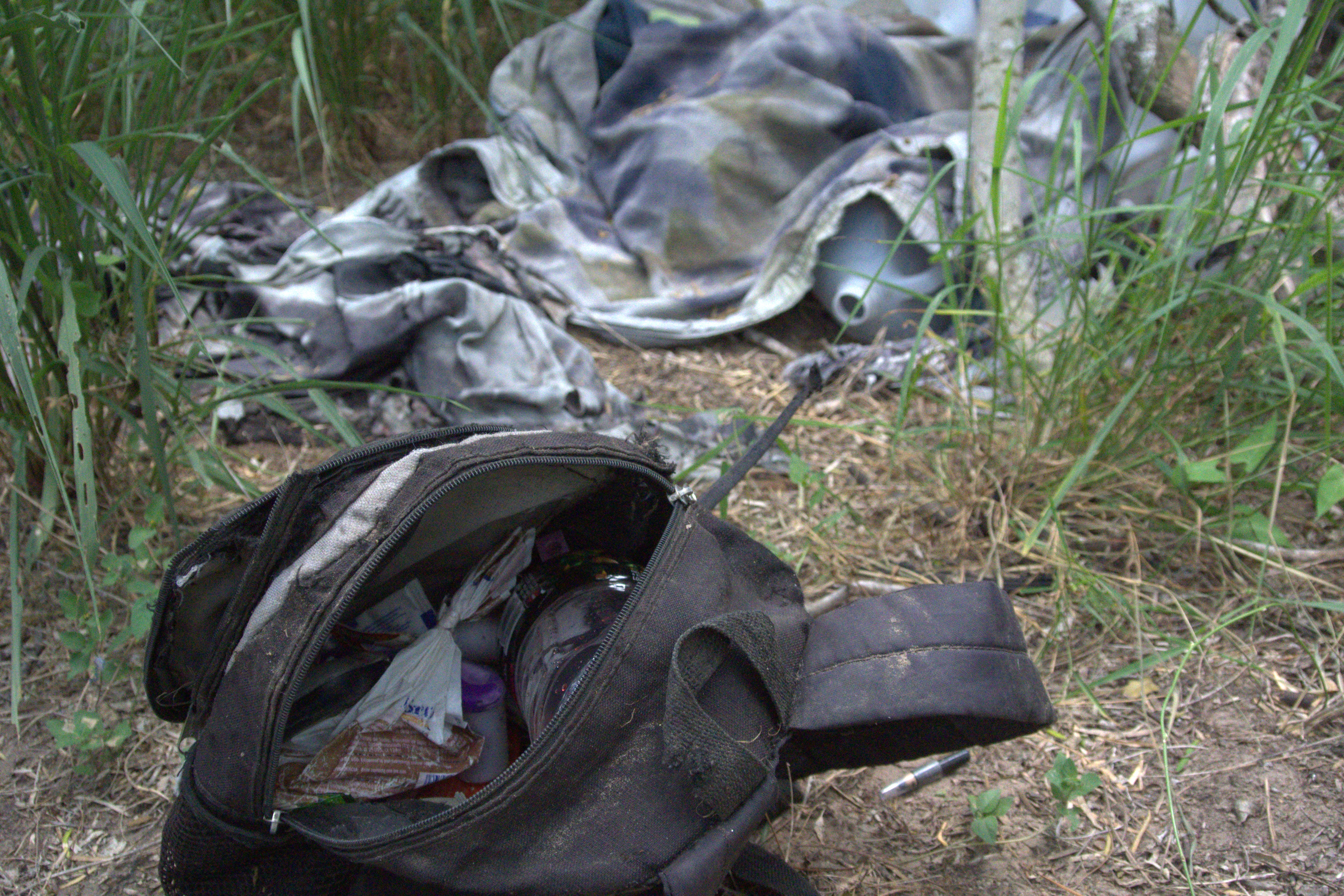
A discarded backpack, torn clothes, and a water jug in the brushLavoyger was also able to show us several places close to the highway that offered some sort of shelter from the sun, but the trade-off was thorny branches and mesquite so thick we could barely see each other 20 feet away.  The area was littered with backpacks, hats, blankets, jackets, and empty gallon water jugs.  It was disheartening and drove home some of what these migrants faced.

The land we were comfortable driving across was beautiful, but it was deceiving.  There were black-eyed and lazy daisies spotting the landscape, and birds soaring around.  Grass spurs, little sharp burrs that stick to and puncture all manner of clothing and skin, were unavoidable.  The sand was so deep, it was difficult to drive through let alone walk through.  And very little shade was offered by small patches of short trees and bushes that could protect one or two people.
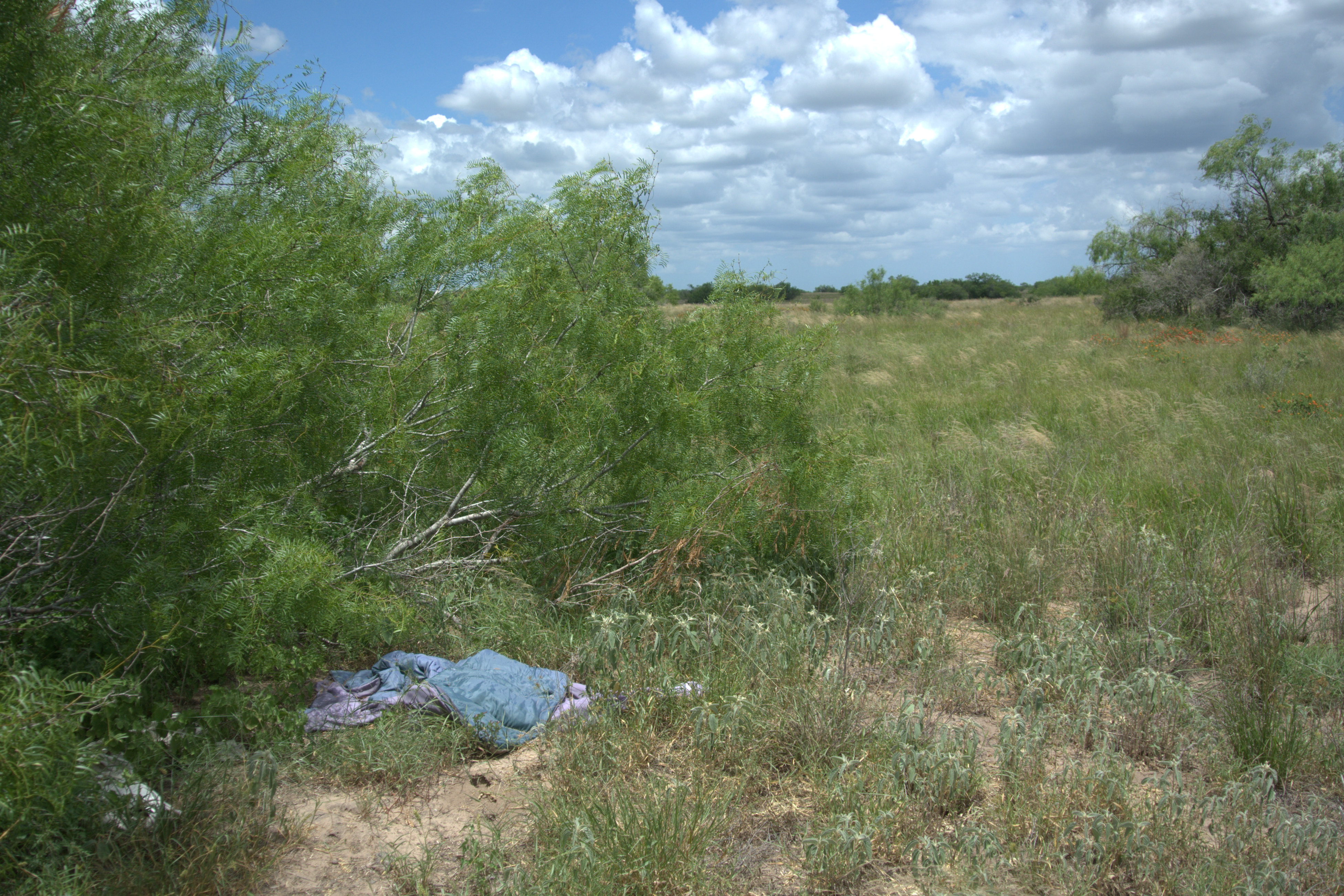
Cloth under a large piece of brush On top of the terrain and environment, we went in the early afternoon when the Texas sun was at its best and we were eager for some shade and air conditioning every time we stopped the vehicle to inspect various sites.  I can’t imagine walking in this draining heat.  I wouldn’t make it very far at all.

Next, we stopped at a handmade cross Lavoyger had put up to mark the place a migrant had died some time ago.  It was simple, merely two sticks tied together.  But it was a reminder of the value of human life.  While he was recounting the controversies surrounding migrants, he was adamant that that we are all human and the priority was always human life and preventing deaths.
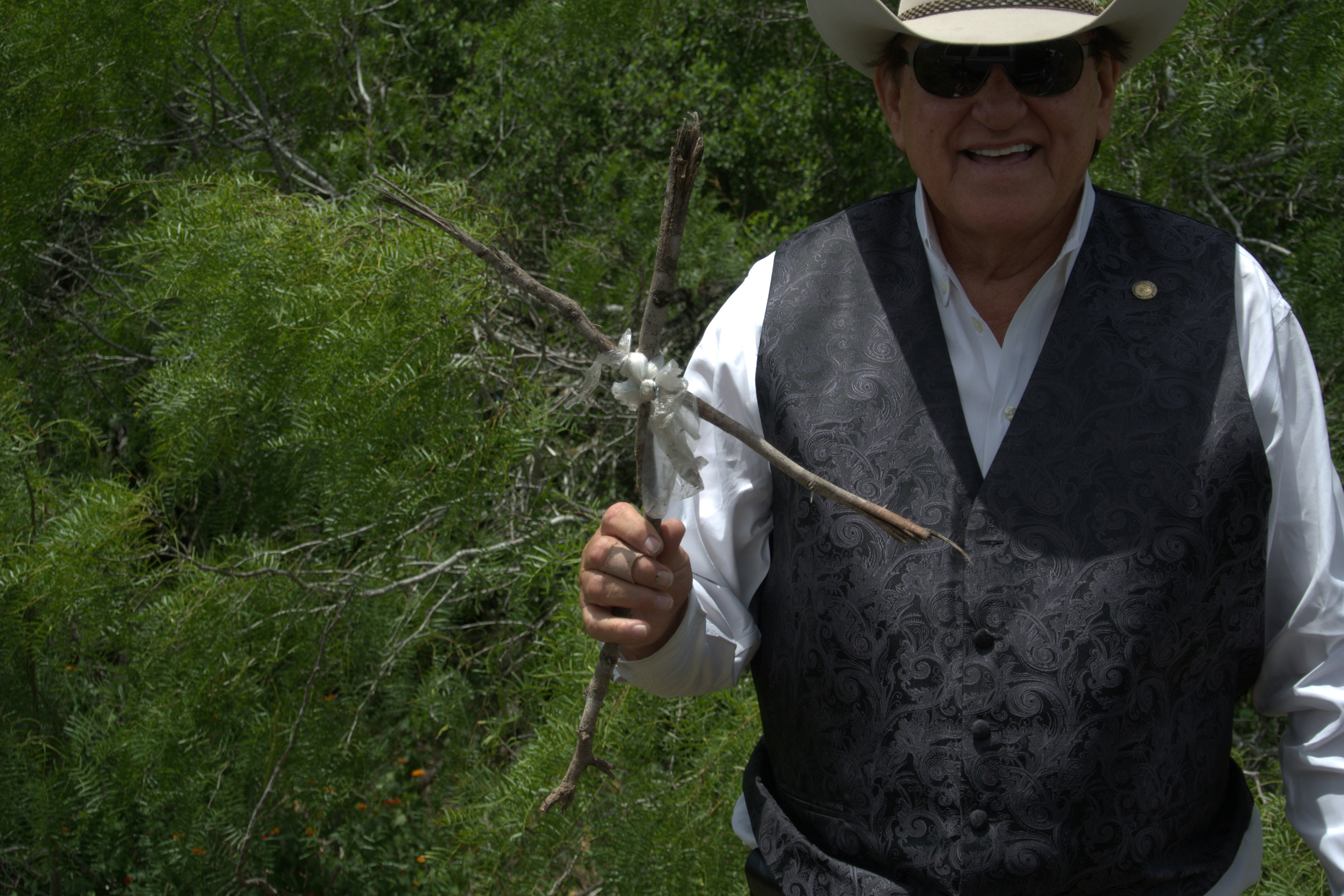
Lavoyger with a cross put together with sticksWe also stopped at a water station Lavoyger had set up that was very simple.  A waving flag jutted into the sky above the trees to mark its location.  The station consisted of a 55-gallon bright blue drum with a cap on it and labeled “agua” was filled with 5 gallon water jugs purchased from the local store.  He said a couple had been taken out, but he checks it regularly to make sure there is always water available.
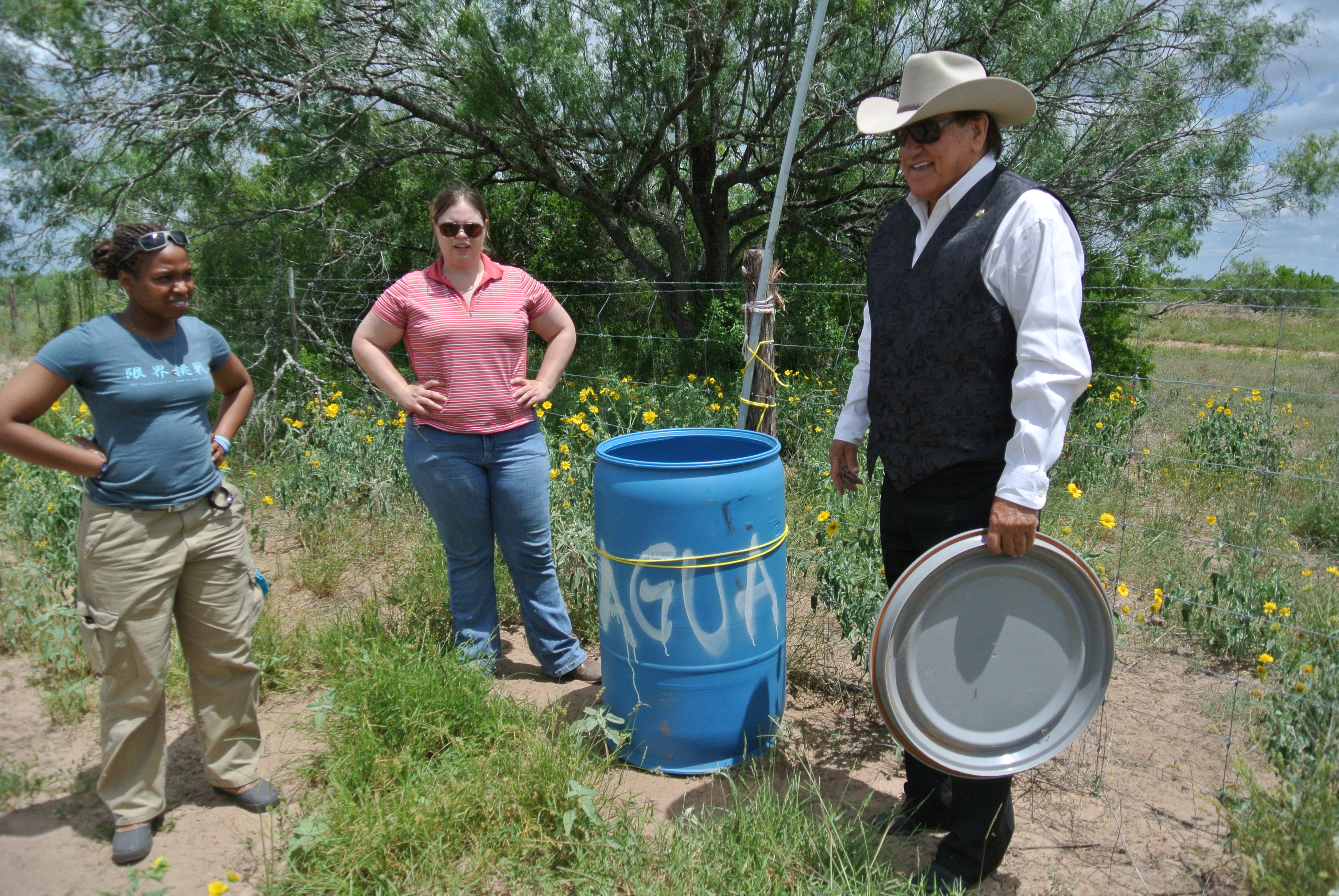
Lavoyger with two UIndy students at a water barrel We continued to drive around the ranch, and after a short time everything looked the same.  We knew where the highway was when we could see it, but after a few turns could not point it out.  The two-lane sand roads merged and crisscrossed so I couldn’t answer if asked if we traveled the same one twice.  Without a GPS, or a knowledgeable guide, it would be extremely difficult to not walk in circles.

Lavoyger also told us a few stories of people he had come across on El Tule. He told us of the individuals he has spoken to (he’s bilingual). He has been told that migrants traveling alone are rare and do so for two main reasons: people who get left behind intentionally because they are too slow, due to heat exhaustion, injuries, age, or any other factor, and the people who escape a Border Patrol raid and wind up lost and alone (whether the only one to escape or simply unable to find the group again).

Overall, the trip to the ranch was a mix of sobering realities. It was good to step out of the cemetery for an afternoon and see this crisis from yet another viewpoint.  We normally gather information from talking to various people involved in various aspects.  This trip allowed us to see it from yet another perspective, and being scratched by sharp thorns and pulling off countless grass spurs (while uncomfortable) is only a portion of what these migrants go through, all for a better life for themselves and their families left behind.
Jessica

Day 4

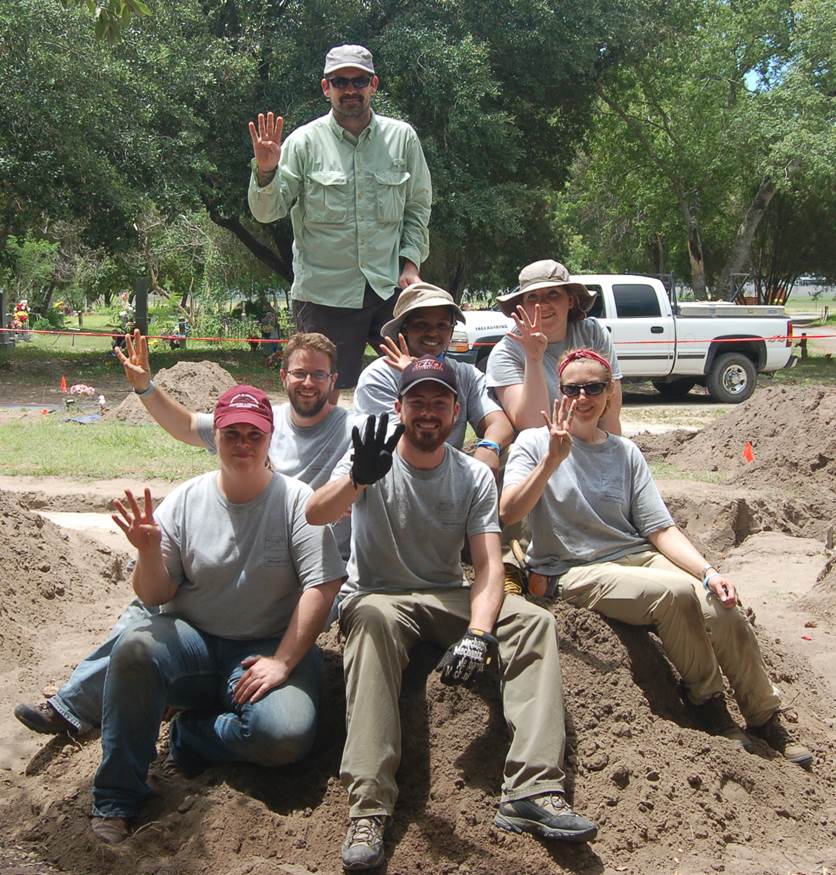
Day 4 group picture sitting on a pile of dirt with 4 fingers in the airDay 4 has been such a full day that I don’t know where to begin! The heat and humidity are taking their toll on everyone. The Baylor team decided to make today an optional day to allow students to rest, which resulted in a smaller than usual crew at the cemetery.  But instead of slowing down with less people to work, everyone went into high gear and made exceptional progress. The UIndy team did a lot of digging today. We also had a burial that tested our forensic archeological skills and was emotionally challenging. Not only was today a heavy work day, but it was filled with friends and adventures as well.

Our new friend Sarah Friedland, a documentary film maker, left today after being with us in the field from day one. Her co-director Esy Casey left yesterday.  Our work will be part of their new film called “Memorials” (https://www.facebook.com/memorialsfilm).  While the team and I have known them for just a few days we will forever be friends united by our experiences here in Falfurrias.  This human rights mission and the experience of Sacred Heart Cemetery have the ability to bring people together in a way that very few other experiences do. We wish them the best and look forward to keeping in touch with them.

For the past two days Guy Housewright of Guy Housewright photography (http://www.guyhousewrightphotography.com/) has been with us at the cemetery. Guy is an old friend and amazing photographer that my university hired to capture our work in Sacred Heart. He embedded himself with us, beginning with breakfast at 5:15am and ending with debriefing and late dinners.  He truly wanted to understand the issues and why we were doing the work here in Falfurrias. It was great to have him with us for two days and we hope he isn’t too exhausted after staying out in the hot sun with us.  We also asked Guy be a part of our Day 4 picture (shown above). We can’t wait to see the images he took of us working and hope he was able to capture the emotions we feel at Sacred Heart Cemetery each day we are there.

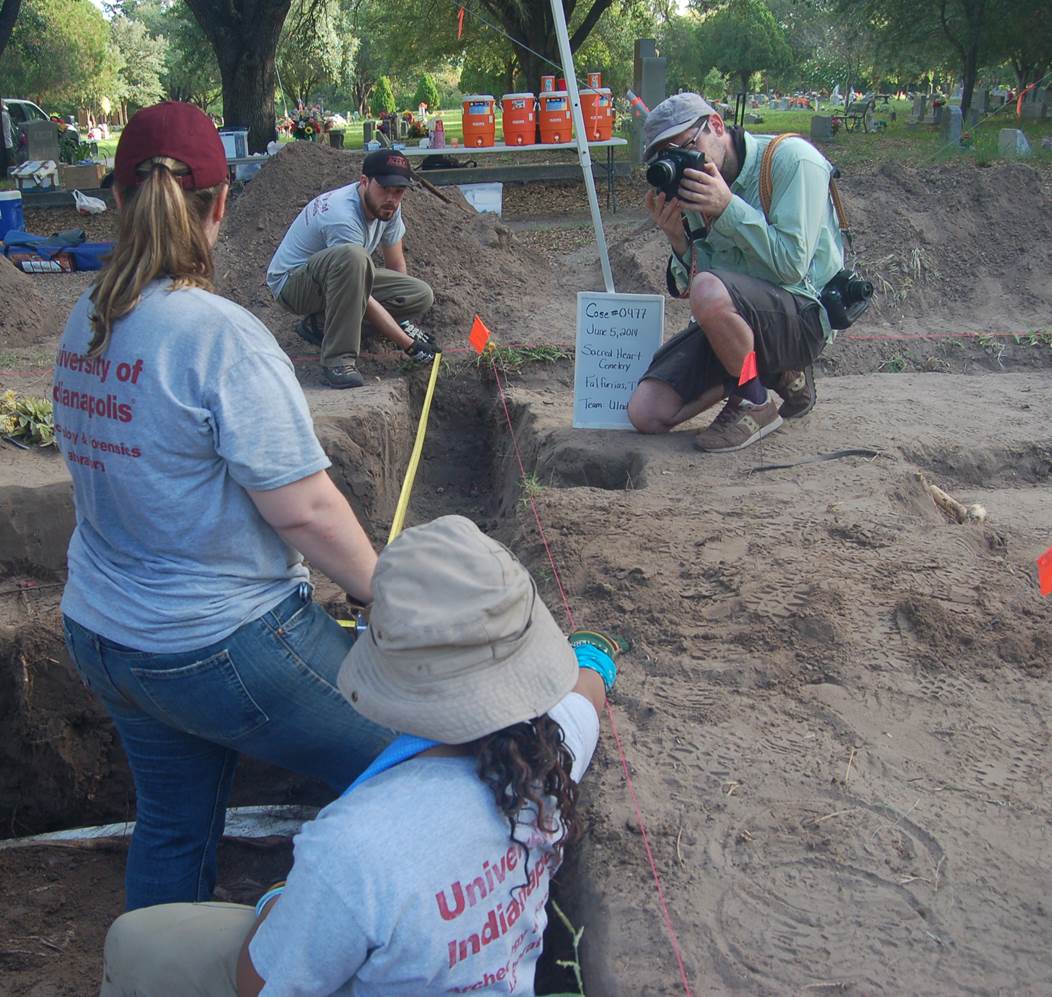
Pictures being taken of UIndy team members taking measurements of a burialRyan, Jessica and Cheneta had the opportunity to tour parts of El Tule Ranch today.  The security manager of the ranch, Lavoyger Durham offered to take them to the ranch to see the type of environment the migrants journey through. Also traveling to the the ranch with them was Ananda Rose, author of “Showdown in the Sonoran Desert”. We’re going to tell you more about our time with Ananda tomorrow. I know Ryan, Jessica and Cheneta are very excited to talk about their adventures at El Tule, so I’ll stop here.

Finally, the day ended with an amazing diner and relaxing evening at Arturo’s house. His family invited our whole team over for an evening of amazing food, dancing, singing and fun.

~KEL

Documentary Filmmakers Become Part of the Team

I’d like to introduce our readers to a phenomenal team of documentary filmmakers who have been following our work this week in Falfurrias, TX. Meet Sarah and Esy.

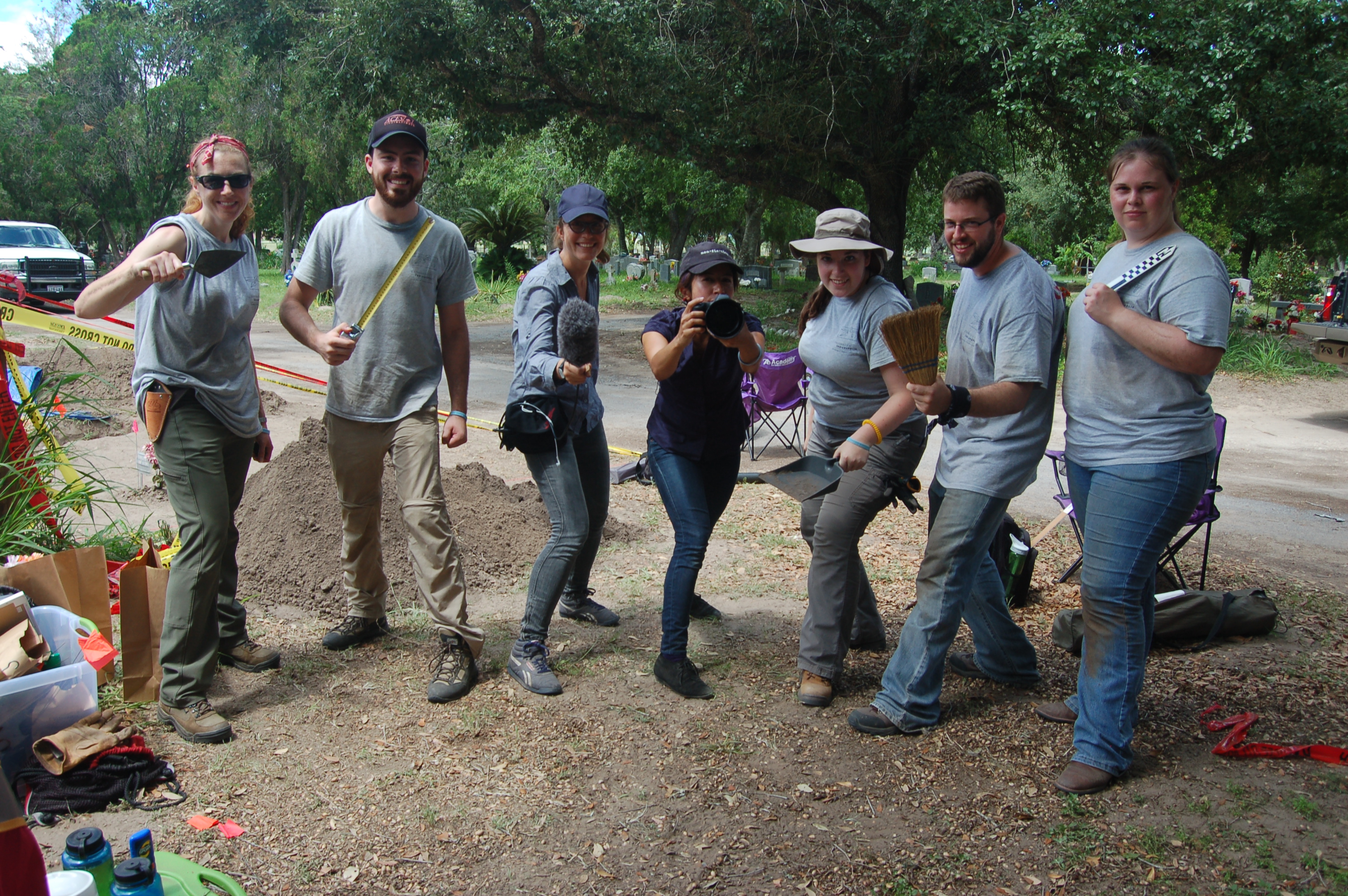
Team UIndy strikes a pose with Sarah and Esy, the documentary filmmakers.As graduate students working in a forensic anthropology lab, we learn very quickly how to interact with media. Sometimes news stations get the story right, and sometimes they don’t. Often times we are misquoted or taken out of context. And in order to get the story, cameras are often intrusive, getting in the way of forensic analysis and building an annoying stereotype for themselves. These young filmmakers couldn’t have been any farther from this description.

Sarah and Esy were at the scene before we arrived on Sunday, greeting us with smiles and handshakes. The filmmakers told us of their project to create a documentary about the various ways Americans memorialize the deceased, currently entitled MEMORIALS. Arriving at the cemetery before sunrise and leaving only after the last crew has packed up and taken off, Sarah and Esy have seen nearly everything we have at the site. They join us for debriefings and listen to us as we talk through our progress, hoping to capture much of the behind-the-scenes of our work.

But what really impresses me about this duo is their raw style and manner of filming. Neither of them has approached us asking for an interview. Instead, they rely on the sounds and vocals that they capture. They stand from afar and film unobtrusively. No cameras in faces, no mics right next to the grave as we dig. In fact, the filmmakers became a seamless part of the group, moving buckets and supplies for us and sharing lunch with us daily. Esy told me that she often makes sure while filming to dedicate an equal time with the camera off. They aren’t there to just film; they are there to experience, to learn, and to become immersed in our project, which is impossible to do with an eye through the viewfinder. She discussed her annoyance with watching people spending so much time using cell phones to capture awful video footage of an experience that can’t be recreated. The immersion into these rare experiences must be valued.

I talked to Esy during lunch about their film, and I asked her about the competition for topics among independent filmmakers: what if someone else beats them to it with their topic on memorials? Can’t they just change the vocal overdubs and commentary and keep their same footage, allowing them to adapt to the competition? Esy said absolutely not, because they don’t provide any commentary. They let the footage narrate itself, allowing the viewer to draw their own conclusions from the footage rather than using commentary to tell the viewer the facts straightforward.

The human rights crisis that the country is facing can’t be fully described  or narrated with facts and commentary because there are so many perspectives to take into account. Instead, each person has their own take on what is happening from their unique perspective. There is no wrong or right solution to the crisis. By presenting our work in such a raw style, Sarah and Esy have safely avoided forcing any bias or perspective on the viewer, which I deeply admire. It is up to each one of us to decide what we can do to help. At Sacred Heart, we are contributing our expertise towards only one angle of the issue, but we have been fortunate to see other angles that broaden our perspective and make us more aware of what can be done to help.

I highly encourage our readers to explore Sarah and Esy’s previous work. I’ve watched their trailers for many of their films and can’t wait to see the full features. Follow their vlog at www.perinspire.com for information on films such as Jeepney, The Rink, and Thing With No Name that deeply explore important social issues around the world.

Thanks Sarah and Esy for temporarily joining our team, and best of luck in the future with your films!

Ryan