Latest Posts

The Mountain, Desert & Coastal Forensic Anthropologists Meeting

Mountain Desert and Coastal Forensic Anthropologists logo, green with a puzzle of a skull missing its last piece
MD&C

Tomorrow we leave for the Mountain, Desert & Coastal (MD&C) Forensic Anthropologists meeting being held in Boulder City, NV on the shores of beautiful Lake Mead.  Jessica, Erica, Ryan, Justin and I will be traveling to present about our work on migrant death and interact with other forensic scientists involved in the same type of human rights work.  Cheneta is currently enrolled in a class for the first summer semester and unfortunately will not be able to join us.

 At this year’s MD&C meeting we will give a presentation on the skeletal analysis of the unidentified migrants we are currently analyzing in the University of Indianapolis Archeology & Forensics Laboratory.  This will allow us the opportunity to present the challenges associated with the identification of these individuals to the forensic science community.  In addition, we will get to interact with other forensic anthropologists working with issues of migrant death.  Dr. Lori Baker, who is directing the identification efforts in Brooks County, will be at the meeting.  Dr. Bruce Anderson of the Pima County Office of the Medical Examiner (PCOME) who works with unidentified migrants in AZ and Robin Reineke of The Colibrí Center for Human Rights will also be in attendance.  This will provide an invaluable opportunity to discuss the various approaches and challenges to migrant death issues with other individuals who work with these types of cases on a constant basis.

The University of Indianapolis will be well represented at the meeting this year. In addition to the presentation on human rights in South Texas, Jessica, Erica, Justin and Ryan each have a second presentation focusing on forensic casework or projects at UIndy, giving us a total of five presentations this year (An Interesting Case Study from Indiana by Jessica Campbell & Stephen Nawrocki, A Case of Dismemberment in Northern Indiana by Erica Christensen & Krista Latham, Over the River and Through the Woods by Justin Maiers & Krista Latham and No Bones About It: Projects at UIndy Outside of Forensic Anthropology by Ryan Strand) .  I will be moderating this year and organized the conference schedule. UIndy alum Meg Madonna will be handling fundraising.  The conference raises money for student travel and research grants.   Justin is coordinating the annual bone quiz, which tests the skeletal knowledge of its attendees.  Jessica is in charge of organizing the conference center and Ryan and Justin will be the grill masters at our annual Buffalo Chip dinner.
Many people on top of a rock hiking
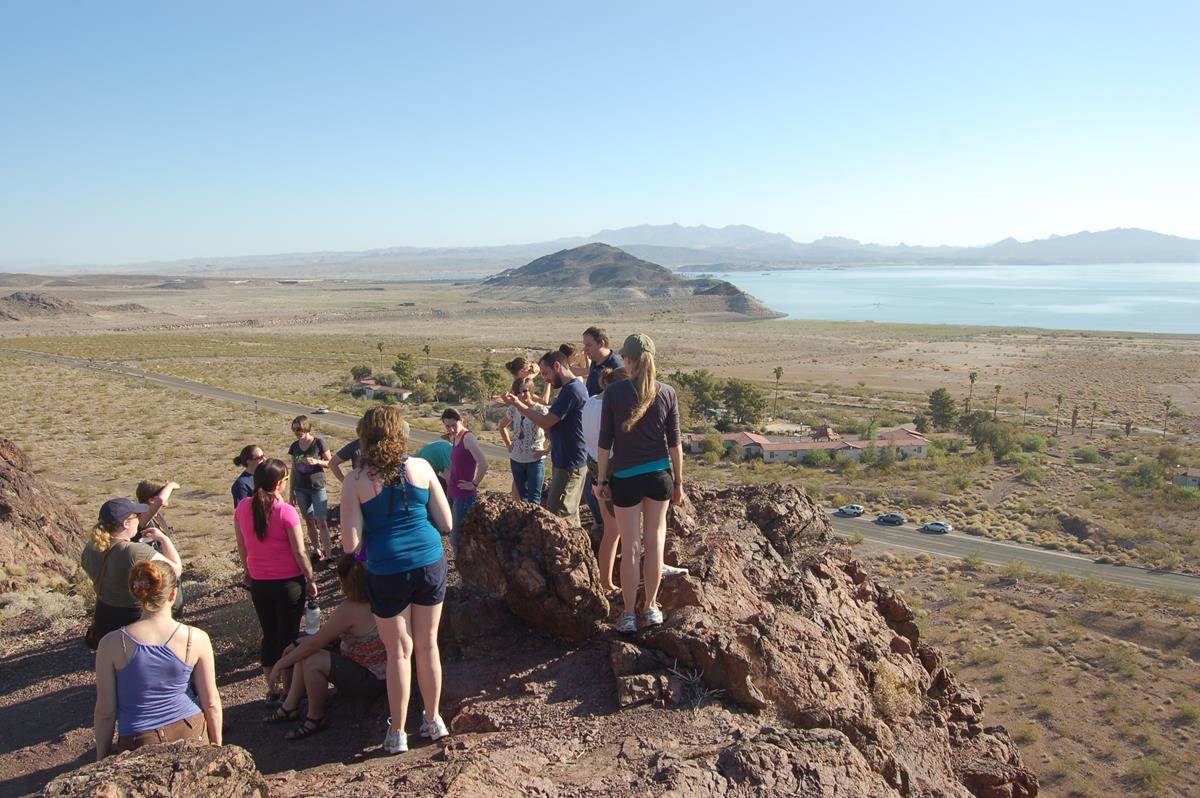
Hiking near Lake Mead. Photo from the 2013 MD&C meeting.

In addition, the students will get to interact with some of the founders of the field of forensic anthropology and meet award winning author Aaron Elkins.  We will have time for some fun while we are there as well. We will get to do some climbing, swimming and sightseeing.  It will be a nice mix of work and a little relaxation before we leave for two hard weeks of digging in the Texas sun.

 Dr. Krista Latham

Excitement and Opportunities

Everything is coming so quickly! The trip is just  a couple weeks away and I know it will come faster than I can imagine. I have been shopping for items to take with me – probably over shopping but better safe than sorry. I am so excited to be apart of this team and I am so grateful for the opportunity. I will probably say that countless times during this blog. This is allowing me to have the opportunity of a life time and I am blessed to be in this position. I am excited to get the know the team better. Everyone is so nice and I am sure with all the fun personalities it will be a trip to remember. I have a lot  to learn.

The most recent item that I have purchased are my gloves and hopefully I will purchase my cargo pants this weekend which should complete my list . The most important thing that I will be packing I think is my phone and iPad charger. Although I will probably not have much time for them I have to have them charged. I find myself thinking more about what I am going to pack my belonging in instead of what I am actually packing (suitcase or duffel bag).

Book cover of Holes by Louis Sachar
Holes

While I am in Texas I will be bird watching for a class that I am finishing  for my Human Biology degree.  I have become very interested in birds although a lot of them look the same it is very relaxing and I will post the new birds that I see while down there. I have a feeling that I will have a “holes” experience. When I read the book they discussed how much people  liked the idea of digging a hole until they actually did it. I am sure with being the rookie there will be tricks to that I will need to learn along the way.

As always I am excited to fly and I love traveling by planes. I have told my parents and friends about the trip since I was told that I would have the opportunity to go. I am excited that they will be able to follow along as I experience new things. Hopefully when we first arrive in Texas I will be able to have sushi. I think that is the one food that I want to try most while down south. As the team will soon learn about me I love food and there are not too many things that I will not try.

Cheneta Morrison

5 more minutes, Mom!

Our team has worked together previously on cases, on projects and on presentations. But never like in Falfurrias. We work with unidentified human remains, and we do it not because we like it (we do) but because there is nothing else we would ever want to do. And most of us would have a difficult time explaining why, exactly, this type of work means so much to us.

Still, with the experiences we’ve had, we were wholly unprepared for Texas last year.  The heat to start. It was over a 100° easily, every day. Then there was the sun that banished all the clouds that might have offered a respite. I don’t remember any clouds in Texas.  Definitely just sun. But it was the humidity that did us in. Isn’t Texas supposed to be dry?

Additionally, our team had not worked a case of this magnitude either. Indiana has primarily individual casework. Our human rights mission in Falfurrias was quite a bit larger. We were expecting it and we were prepared for it, along with the intensive work that comes with it.

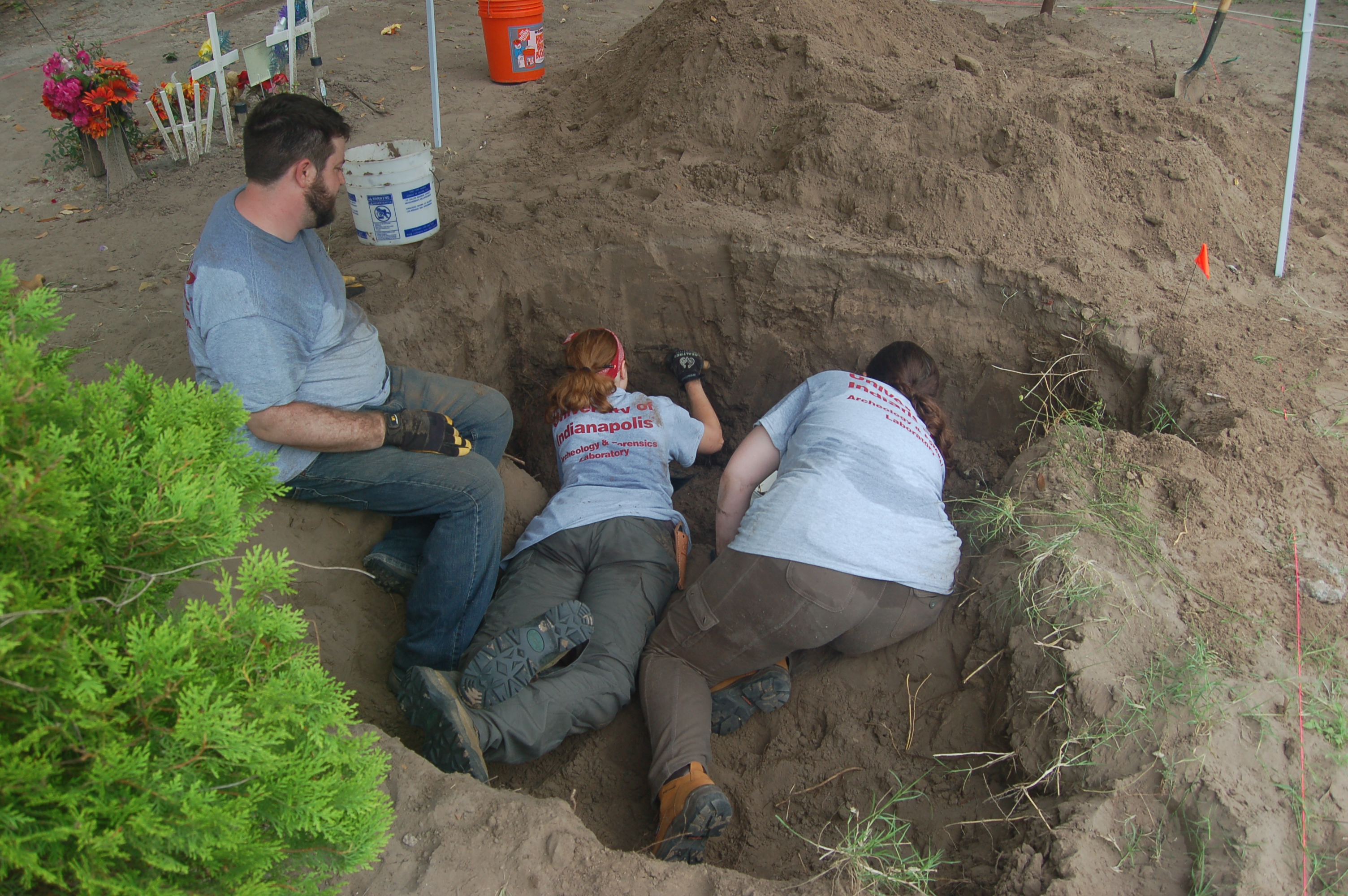
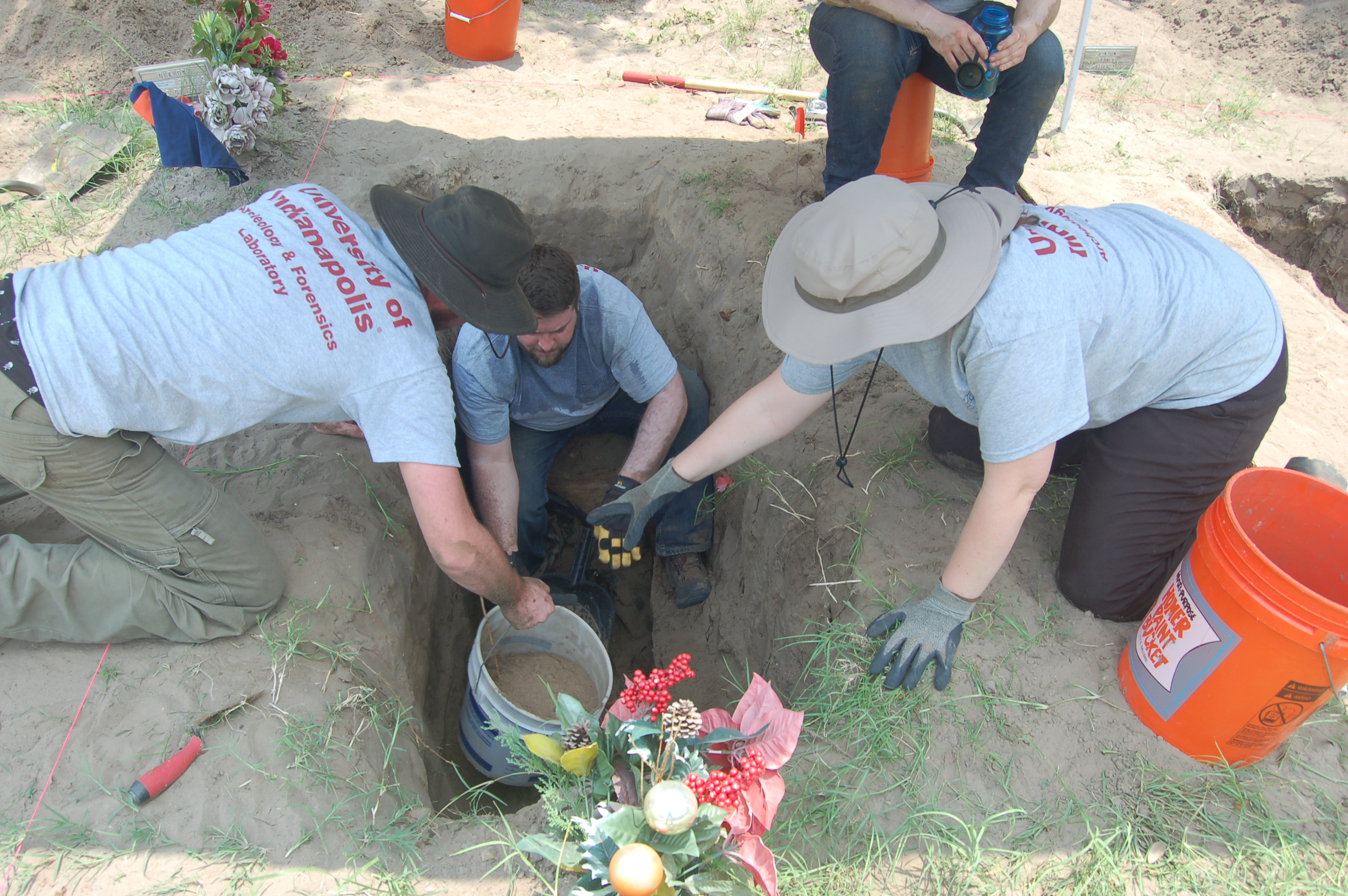
Beyond borders team members taking a bucket of dirt from a team member in a burialFrom this point, I can tell you about our strategy last year. Or perhaps measures we took to overcome the climate. I can tell you about some of the things that changed us in the short time we were there. I can tell you more about the climate, and perhaps something about what the migrants crossing the area on foot might have encountered. But I want to tell you about our team, because they amazed me.

They amazed me because of the commitment (though the word seems inadequate) and the energy that was given every day, to every burial we encountered. I know how much and what this work means to me, and now I have an inkling of how much it means to all of us.

Get out of the hole!

I’ve got to tell you, traveling and working with five type-A personalities is rarely a pleasure.   Everyone has an opinion, but I’m always right (just kidding—sometimes). If they’d just listen we could do this faster. That is typically what you encounter and observe, just a group butting heads. How in the world can they work together, let alone be efficient, speedy, and thorough?

That was one of my biggest concerns last year. Not only would we be working together in volatile conditions, but also living together, with no escape for ten days.  A case in Indiana would last a day, maybe two, but everyone could go home after or to class, or to work.  Not so in Texas.  I was sure this trip was going to be interesting, in more ways than one.

Seriously, get out. Get some water. Sit down. Get out!

The tone was set for us immediately the first day we arrived at the Cemetery. Justin was a great leader in this regard (he always is, but shhh! don’t tell him!). Remember the heat and humidity I mentioned? It started well before 6 a.m., and only increased throughout the day.  We were even told we couldn’t work past noon because the heat got so bad. We usually pushed that “suggestion” to around two without fail, everyday. How could you stop working when you can see the casket and know that if we can just get this last individual out for the day, that’s one more person that can start the identification process? Seriously.

beyond borders team members laying in a burial to properly excavateBack to the climate, Justin was our voice of reason, which may be the best way to put it. If we would have worked like we do in Indiana, we would have passed out from heat exhaustion or heat stroke. He was the first one to start yelling at us all to take breaks.

We realized very quickly that we needed a work rotation, in which everyone worked 10 to 15 minutes and switched out. That 10 to 15 minutes may seem so little, but in the humidity our energy and hydration levels plummeted. We drank Gatorade during these forced rest periods in order to replenish the mass quantities of fluids we didn’t realize were just floating off us, or running down our shirts.

By the end of the first day, we were all insistent about that imposed break for whoever was digging. Such a simple thing, but yet another factor that pushed us together so seamlessly. I wouldn’t trade this experience or the team for any other.

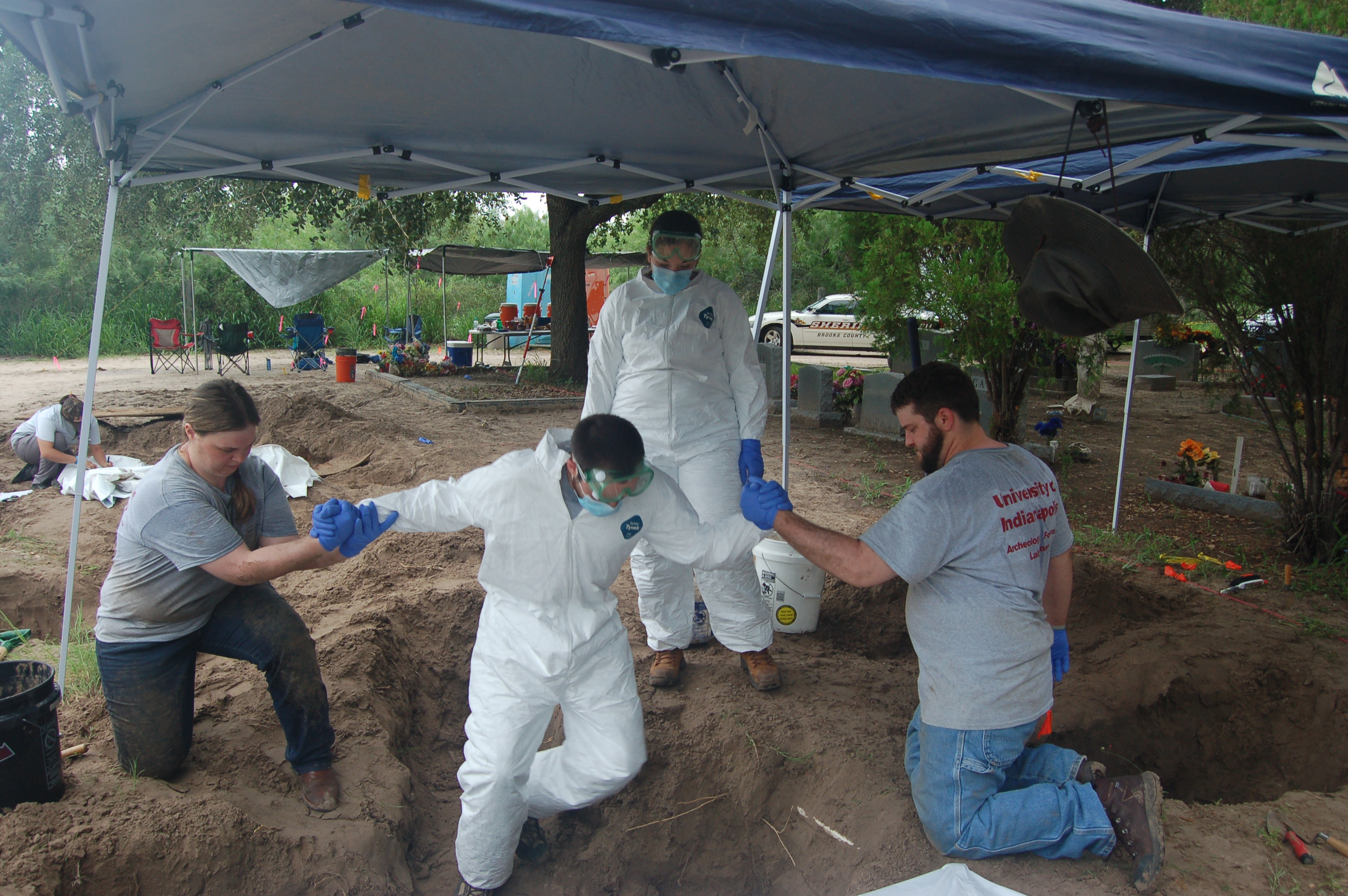
Beyond borders team members helping another member who is in full PPE head to toe into a burialBut five more minutes, that’s all, then I’ll switch out… I’m so close!

That never worked.

Jessica Campbell